
Celebrating the Art of Siamese Culinary Wisdom and Thai Cuisine
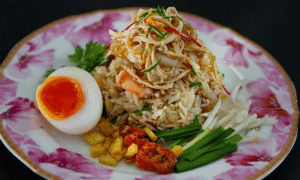
Khao Mee Seasoned Rice (ข้าวหมี่อย่างคลุก; khaao mee yaang khlook)
This article explores two methods of preparing Mee Fried Rice - the traditional Khao Mee Fried Rice and the lighter, seasoned rice alternative known as khaao mee yaang khlook. Discover the flavor chemistry at play and choose your preferred method for a delicious meal.
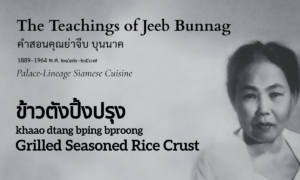
Grilled Seasoned Rice Crust (ข้าวตังปิ้งปรุง; khaao dtang bping bproong)
Khaao dtang bping bproong, rice crust grilled with garlic-lard and fish sauce, brushed on with a banana leaf. Jeeb Bunnag, 1933.
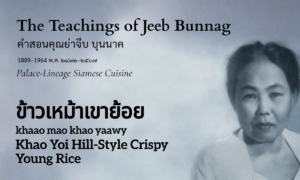
Khao Yoi Hill-Style Crispy Rice (ข้าวเหม้าเขาย้อย; khaao mao khao yaawy)
Khao Yoi Hill-Style Crispy Rice, a royal Thai snack mix combining puffed rice with crispy pork, aromatic herbs, and tofu. From Jeeb Bunnag's cookbook, 1945.
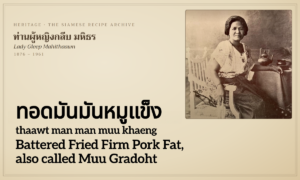
Battered Fried Firm Pork Fat, also called Muu Gradoht (ทอดมันมันหมูแข็ง; thaawt man man muu khaeng)
Muu gradoht — firm pork fat boiled, sliced, and fried in a rice-flour coconut batter tinted with red limestone solution. Lady Gleep Mahithaawn, 1949.
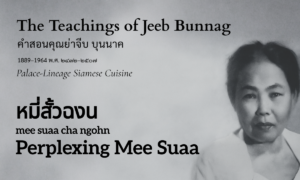
Perplexing Mee Suaa (หมี่สั้วฉงน; mee suaa cha ngohn)
Mee suaa cha ngohn: wheat noodle bundles bound with shrimp-corn paste, steamed, served in clear pork-crab broth. Jeeb Bunnag, 1933.
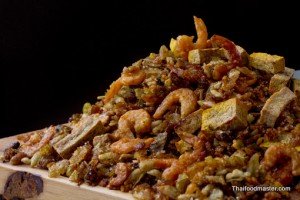
Old Fashioned Pounded Unripe Rice Snack (ข้าวเม่าหมี่ ; khaao mao mee)
Unripe rice snack - “Khao Mao Mee” (ข้าวเม่าหมี่ ) also known as “Khao Mao Song Kreuang” (ข้าวเม่าทรงเครื่อง) or by it's royal name “Khanom Khao Mao Rang” (ขนมข้าวเม่าราง) is a delicious snack. It makes an unusual use of the unripe rice grains, which are normally used for desserts making. The following recipe describes an ancient and hard to find version of it. These days, there is a tendency to add other ingredients like peanuts or to deep fry the unripe rice grains until fluffy and crispy.
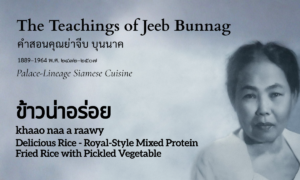
Delicious Rice (ข้าวน่าอร่อย; khaao naa a raawy)
Delicious Rice, a royal Thai fried rice combining shrimp, pork and chicken with elaborate garnishes including pickled vegetables and salted egg. From Jeeb Bunnak's 1945 cookbook.
New-Style Vietnamese Crispy Khanom Beuuang Crepes (ขนมเบื้องญวนใหม่; khanom beuuang yuan mai)
Khanom beuuang yuan mai: a rice-mung bean crepe kneaded with limewater for crispness, filled with shrimp tomalley and lotus seeds. Jeeb Bunnag, 1933.
Alternating Colored Conch Shells (สังข์สลับสี; sang sa lap see)
Alternating Colored Conch Shells, multicolored dumplings tinted with natural dyes and shaped like conch shells. From Jeeb Bunnag's 1945 dessert cookbook.
Roman Tube Noodles (Macaroni) (แป้งหลอดโรมัน; bpaaeng laawt ro:h man)
Roman Tube Noodles, a 1945 Thai-Western fusion dish with rich duck broth and macaroni. From Jeeb Bunnag's 'Cookbook of Desserts, Tea Accompaniments, and Snacks or Appetizers'.
Layered Savory Rice Cake (ข้าวแขกสลับสี; khaao khaaek sa lap see)
Layered Savory Rice Cake features steamed rice, seasoned prawn filling, and golden turmeric-coconut custard. From Mrs. Samakkhanatthon's 1945 Thai cookbook.

Savory Filled Cockle Shell Dumplings (คลางแคลงทรงเครื่อง; khlaang khlaaeng sohng khreuuang)
Savory Filled Cockle Shell Dumplings, translucent palace-style dumplings with seafood and pork filling. From Jeeb Bunnag's 1945 Thai cookbook of appetizers.
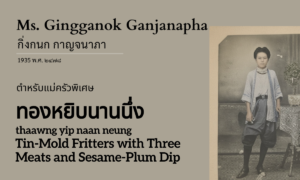
Thong Yip Naan Nueng (ทองหยิบนานนึ่ง; thaawng yip naan neung)
Thong Yip Naan Nueng, mold-fried wheat batter with crab, pork, and chicken, inverted mid-fry until golden. From Gingganok Gaanjanaaphaa, 1935.
Heavenly Beef (เนื้อทิพย์; neuua thip)
Neuua thip, beef rump stir-fried in thick coconut milk with Indian turmeric, served on cabbage with a chili dipping sauce. Jeeb Bunnag, 1933.
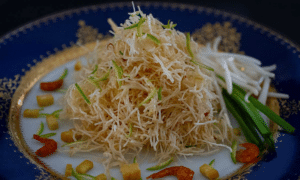
Sour-Sweet Savory Crispy Rice Vermicelli with Bitter Orange (Mee Krob) (หมี่กรอบส้มซ่าทรงเครื่อง ; Mee Graawp)
mee graawp sohng khreuuang (หมี่กรอบทรงเครื่อง), is an exquisitely regal dish of crispy rice vermicelli. The delicate noodles strands are washed and dried, then fried to a crisp light-golden hue. They retain their brittle crunch and airy texture even after being stir-fried with a clinging sticky sauce that encases the noodles in a thin layer of sheen. This sauce, mixed into the noodles together with other ingredients such as thin slices of pickled garlic and bitter orange peel, impart the dish with a light, fresh sweet and sour, and slightly salty and citrusy glaze.
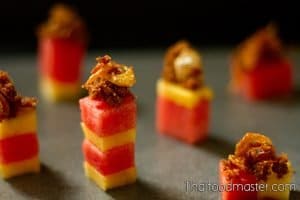
Fried Dried Fish with Watermelon (ผัดปลาแห้งแตงอุลิต ; phat bplaa haaeng dtaaeng oo lit)
Here is a summer dish that showcases the wisdom of creating complex flavors through simplicity. Using just lightly salted semi-dried snakehead fish, golden deep-fried shallots and a sweetening agent (either sugar or coconut), we create a condiment that partners perfectly with pieces of sweet juicy watermelon.
The Ambassador’s House Style Rice Vermicelli in Broth (หมี่น้ำบ้านราชทูต; mee naam baan raat thuut)
The Ambassador's House Style Rice Vermicelli features crispy rice noodles in a complex sweet-sour broth with multiple proteins. From Jeeb Bunnag, 1945.
Khanohm Jeen with Hindu Style Nam Ya Sauce (น้ำยาฮินดู; naam yaa hin duu)
Naam yaa hin duu, a coconut curry sauce with red and white beans, flavored with fermented soybean paste. From Jeeb Bunnag's 1945 cookbook.
Miang on Golden Trays (เมี่ยงถาดทอง; miang thaat thaawng) (กระทงทอง)
Miang thaat thaawng, palm-pressed fried pastry cups filled with crab, pork, pickled garlic, and bitter orange zest. Jeeb Bunnag, 1933.
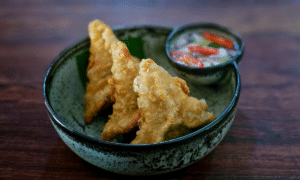
The Elegance of Khanohm Khaang Khaao (ขนมค้างคาว)
If palaces represent grandeur and wealth within a society, and poems often focus on emotional experience or the beauty of language, then the significance of a dumpling may be inferred by its structured elegance and minimalism – each fold and pleat a deliberate act, and each filling a curated experience constructing comfort in its most elemental form.
Khanom khaang khaao (ขนมค้างคาว) is a traditional Siamese fried, triangular-shaped dumpling with obvious Chinese origins. Its earliest recorded recipe can be traced back to Jao Khraawk Thaawng Yuu (เจ้าครอกทองอยู่), a distinguished aristocrat from the royal court of Ayutthaya. Historical records indicate that, from the early days of the Rattanakosin era, her recipe was a favored snack within the Siamese royal court.
These dumplings are shaped like triangles and, according to some, resemble bats: For this reason, they are called khanom khaang khaao (ขนมค้างคาว) – ‘the bat’s treat’. The dumpling’s dough is made from rice and mung bean flours; its filling is prepared by combining grated coconut and shrimp meat, which are cooked together into a dense, flavorful mixture that brings out the nutty-sweet taste of the grated coconut and the savory-sweet flavors of the shrimp. Kaffir lime leaves, sliced into hair-thin juliennes, add a hint of citrus.
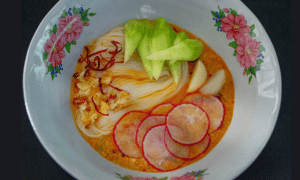
c1936 Arabian noodles – Princess Maao Thongthaem’s Siamese-Orientalist fermented rice noodles light meal (ขนมจีนอาหรับ อย่าง เม้า ทองแถม; khanohm jeen aarap)
1
2
3
4
5

Get Access – Join Thaifoodmaster Today
Practical and kitchen-tested recipes with a mix of theory, history, psychology, and Siamese culture tidbits.
-
Get access to everything right away. Unlock more than 50 Masterclasses, over 700 recipes and Articles
Access to Thaifoodmaster’s constantly growing library of prime professional classes, articles, recipes and videos on Siamese culinary topics, available nowhere else in English.
-
GET EXTRA - New Masterclasses and Daily Recipes
Gain access to NEW masterclasses as they become available. Access DAILY translations of heritage-recipes.
-
1-1 support from Hanuman
1-1 support from Hanuman to help you achieve your professional Thai culinary goals
-
Live Q&A Sessions
The opportunity to join a monthly live two-hour videoconference where I can answer your questions.
-
Great Value!
one year access for the price of 3 days in-person training.
You will get everything you need to:
-
To Get inspired
When you design or build a new menu for an event or restaurant or even prepare for dinner with friends.
-
To Satisfy your curiosity.
Finally !
-
To Master Your Craft
Master your Thai cooking skills and expand your repertoire.
It is truly brilliant with a revolutionary approach introducing aspects and concepts never broached by cookbooks.

Ian Westcott
Sourcing Wines for Discerning Private Clients
© 2008 – 2026 Thaifoodmaster


