
Celebrating the Art of Siamese Culinary Wisdom and Thai Cuisine
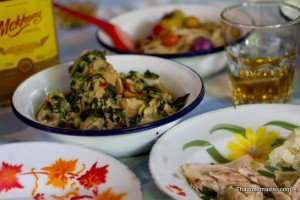
Braised Chicken in Thai Aromatic Paste (ไก่ใต้น้ำ ; gai dtai naam)
Gai dtai naam, which means “under water chicken” in Thai, consists of braised chicken in a coarse, aromatic paste made from lemongrass, galangal, garlic, chilies, kaffir lime leaves, holy basil, coriander and spring onions. In the home-cooked dish popular among the Thai working class, the entire chicken - including the bones - is chopped into bite-size pieces, and served with a bottle of rice wine accompanied by local country-style music (luktung) at high volume.
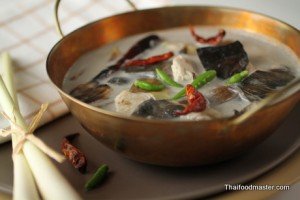
Fresh Coconut Milk Tom Yum Soup Recipe of Grilled Banana Blossom and Chicken
(dtohm yam gathi huaa bplee yang sai gai ;
ต้มยำกะทิหัวปลีย่างใส่ไก่) It will not be an overstatement to say that banana trees accompany Thai people from their birth to the afterlife. Starting with the decorative objects made out of banana leaves newborns receive to invite protective spirits, and continues their entire life with the endless uses for banana leaves, trunks and fruits; finally ending with the female spirit ghost, maae praai taanee (แม่พรายตานี), who resides in banana trees and Thai beliefs.
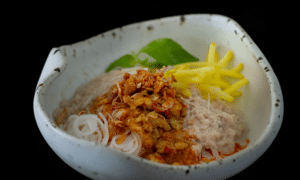
Naam Yaa Neuua – Northern Style Naam Ya according to Lady Plean Passakornrawong (น้ำยาเหนือ)
This fermented rice noodle dish is served with a slow-cooked, chili-less broth made from pounded fish meat and aromatics cooked in coconut cream. Creamy in color and velvety in texture, the broth is seasoned either with fish sauce, fermented fish or salted fish according to one’s preferences. The broth is allowed to slow-cook, achieving its full richness over a couple of hours. Once ready, the broth is poured over the noodles, which are then topped with a glossy-orangey layer of minced shrimp meat fried with their tomalley in pork lard. Complementing this richness are crunchy yellowish bean sprouts blanched in turmeric-tinted water, a sprinkle of sweet, golden crispy-fried shallots and, finally, green lemon basil leaves that endow the dish with a unique, rustic herbal persona.
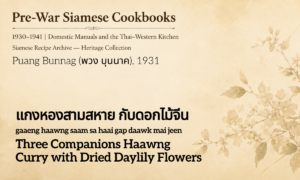
Three Companions Haawng Curry with Dried Daylily Flowers (แกงหองสามสหาย กับดอกไม้จีน; gaaeng haawng saam sa haai gap daawk mai jeen)
Haawng curry of pork belly, chicken and duck in a star anise and tao chiao paste, finished with daylily flowers, sweet before salty. From Puang Bunnag, 1931.
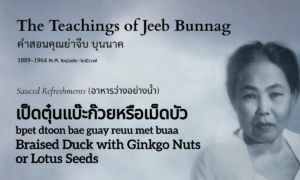
Braised Duck with Ginkgo Nuts or Lotus Seeds (เป็ดตุ๋นแบ๊ะก๊วยหรือเม็ดบัว; bpet dtoon bae guay reuu met buaa)
Braised Duck with Ginkgo Nuts, a Thai-Chinese dish where fried duck is slow-simmered with aromatic spices and ginkgo nuts. From Jeeb Bunnag's 1945 cookbook.
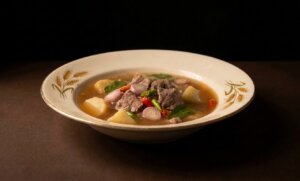
Dtohm Jiu Beef Soup (แกงต้มจิ๋ว; gaaeng dtohm jiu)
Dtohm Jiu Beef Soup: sirloin simmered soft with sweet potato, soured with tamarind, finished with bird's eye chili and lime. Tamrap Sai Yaowapa, 1935.
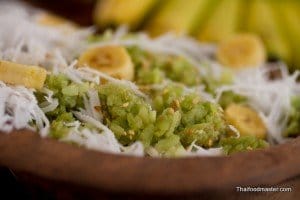
Sweet Pounded Unripe Rice Flakes Cereal with Coconut Flesh and Banana (ข้าวเม่าคลุก ; khaao mao khlook )
Sweet Pounded Unripe Rice Flakes Cereal - Rice harvesting takes place only once a year, and there are only two weeks where the ripening grains are suitable for producing Khao Mao.
Khao Mao doesn't age well, it gets dry and tough quickly. The-once-vivid beautiful green color that portrayed the essence of its immaturity and the beginning of the rice harvesting season, slowly fades away, along with its bread like scent.
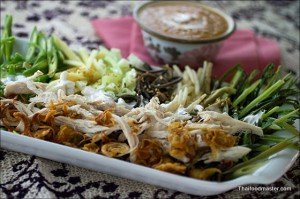
Thai Salad of Chicken and Seven Vegetables Blanched in Coconut Milk and Served With Sour-Salty and Sweet Coconut Curry Dressing, Crispy Fried Shallots and Roasted Sesame Seeds
(yam thawaai ; ยำทวาย) This recipe would probably change your perception about the term "salad", maybe because its dressing has a multi layered, curry-like personality, rather than the common sour vinaigrette-like dressing, or maybe because it takes some good few hours to prepare, somewhat longer than simply opening a bag of hydroponic greens. This salad is the fruit of the dedication of court ladies from aristocratic households, that for centuries perfected and elaborated on the art of cooking through detailed and calculated process, to create sophisticated dishes that are not only delicious but also very healthy and visually pleasing. These ladies made a very large commitment for small things, and they attended all their time and efforts to make minor things better and getting the small things just right.
(yam thawaai ; ยำทวาย) This recipe would probably change your perception about the term "salad", maybe because its dressing has a multi layered, curry-like personality, rather than the common sour vinaigrette-like dressing, or maybe because it takes some good few hours to prepare, somewhat longer than simply opening a bag of hydroponic greens. This salad is the fruit of the dedication of court ladies from aristocratic households, that for centuries perfected and elaborated on the art of cooking through detailed and calculated process, to create sophisticated dishes that are not only delicious but also very healthy and visually pleasing. These ladies made a very large commitment for small things, and they attended all their time and efforts to make minor things better and getting the small things just right.
Beef Teochew Meatball and Pumpkin Coconut Curry (แกงบะช่อเนื้อโคกะทิ; gaaeng ba chaaw neuua kho:h ga thi)
Gaeng ba chaaw, Teochew-style beef meatballs seasoned with coriander root paste, simmered in coconut milk with pumpkin. Jeeb Bunnag, 1933.
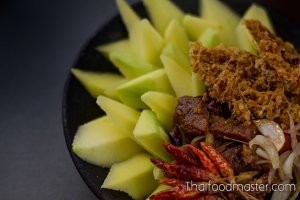
Yam Sohm Choon Mango Salad with Sweet Pork Condiment, Fermented Shrimp Paste, Shallots, and Crispy Deep-Fried Fluffy Fish (ยำส้มฉุน ; yam sohm choon)
Yam sohm choon is a sour green mango salad served with grilled fermented shrimp paste; roughly chopped shallots; sweet pork condiment, deep-fried fluffy grilled catfish and seasoned with fish sauce, palm sugar and lime juice and topped with deep-fried dry chilies cut into small pieces.
If you follow Thai movies and TV dramas, you probably remember Sohm Choon, the adorable boy ghost character from the period romance movie Reun Mayura (1997), which was a love story between a beautiful woman and a handsome man living in different periods of time.
Three-Style Pork (สุกรสามวรรณ; soo gaawn saam wan)
Soo gaawn saam wan: fatty pork reduced three ways—fish sauce with palm sugar, garcinia leaf juice, and fermented bean curd. Jeeb Bunnag, 1933.
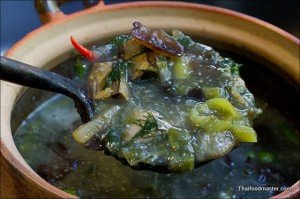
Or Lam Gai Recipe - Velvety Laotian Stew of Chicken, Eggplants and Wild Pepper Vine (aw laam gai sai sakan) สูตรทำเอาะหลามไก่ใส่สะค้าน
This Laotian dish is popular in the mountainous region of Luang Prabang, the magical city in the northern part of Central Laos.
It is a complex and mildly spicy stew, multi layered with flavors and textures, creating a unique, nutritious and delicious dish. It possesses a subtle harmony within a charismatic orchestra of flavors and textures; the taste of meat coupled with the sweetness of vegetables, opposing the bitterness of the greens and willingly surrendering to the aroma of fresh dill and fragrant lemon basil... but it's not all yet....
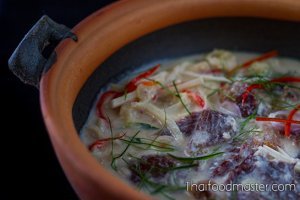
Coconut-Braised Sun-Dried Salted Beef with Bamboo Shoots (แกงต้มกะทิเนื้อโคเค็ม ; gaaeng dtohm gathi neuua khoh khem)
แกงต้มกะทิเนื้อโคเค็ม - In this dish, umami-charged, salted sun-dried beef is gently grilled over charcoal, adding smoke and caramelized elements that emerge in the core of the flavor profile, alongside the umami and the savor of fat. The meat is then cut into bite-size pieces, and slowly braised in thick coconut milk. The coconut fits perfectly onto the triangle of umami, fat and smoke. It brings its own umami and fatty shades, and introduces a rich sweetness that pairs seamlessly with the caramelized character of the grilled beef. The braising also rehydrates the beef and softens it. Bamboo shoots, shallots, galangal, lemongrass and kaffir lime leaves are added, perfecting the dish with a complementary sweetness, echoing the umami hues, and cutting citrusy notes while creating hidden astringent layers. The dish is finished with fresh chili peppers and hair-thin julienned kaffir lime for a fresh aroma and piquant bite.
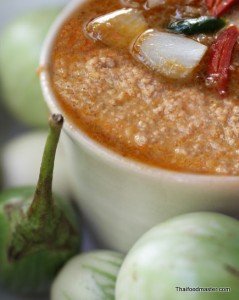
Gabpi Khuaa, An Ancient Dip from The Central Plains (Lohn Gabpi Khuaa; หลนกะปิคั่ว)
In the Thai language, lon (lohn; หลน) means to simmer. In this ancient style dip, minced pork and fermented shrimp paste, along with smoked-charred dry fish, chilies and other aromatics, are slowly simmered in rich coconut cream to create a deep, multi-layered - yet subtle and silky – dip; a dip which is then lightly seasoned with just palm sugar and fish sauce. The dip is served with an array of fresh and fried vegetables, tempura-like cakes, crispy small fishes or tiny transparent salt-water shrimp. For a dish with so many subtle flavors, there is surprisingly little fuss.
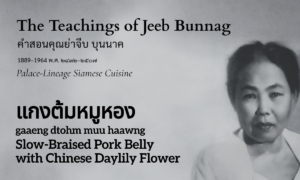
Slow-Braised Pork Belly with Chinese Daylily Flower (แกงต้มหมูหอง; gaaeng dtohm muu haawng)
Gaaeng dtohm muu haawng, pork belly slow-braised with Chinese daylily flower, star anise and tao chiao paste. From Jeeb Bunnag's 1933 Cookbook of Rice Companion Recipes.
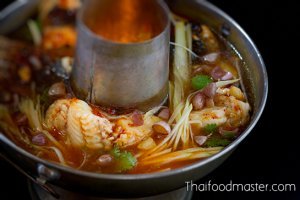
An Ancient Siamese Recipe for Tom Yum Soup (First Published in 1890). Sour Spicy Tom Yum Soup with Snakehead Fish, Roasted Chili Jam and Green Mango (Dtohm Yam Bplaa Chaawn, ต้มยำปลาช่อนแบบโบราณ อย่างหม่อมซ่มจีน ราชานุประพันธุ์ ร.ศ.๑๐๙)
Tom yum soup from the late 19th-century Siam to present days. Including a step-by-step recreation of tom yum soup with snakehead fish (dtohm yam bplaa chaawn, ตัมยำปลาช่อน) as recorded by Maawm Sohm Jeen (Raa Chaa Noopraphan) (หม่อมซ่มจีน, ราชานุประพันธุ์) in her book “Tam Raa Gap Khao” (ตำรากับเข้า), published in 1890 (2433 BE, 109RE).
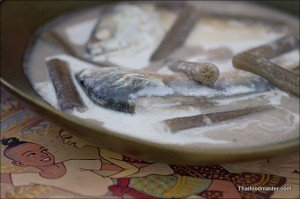
Thai Coconut Curry of Steamed Mackerels and Lotus Stems
(gaaeng gathi saai buaa bplaa thuu neung ;
แกงกะทิสายบัวปลาทูนึ่ง) This old-fashioned Thai coconut curry dish is a simple expression made with ingredients commonly available to Thais, it features steamed mackerels - the fish that Thai people probably love the best and the stems of the lotus flowers - one of Buddhism's most recognized motifs. The fish together with peeled lotus stems are boiled in coconut milk, to which a simple yet very aromatic curry paste, made only of white pepper corns, shallots and fermented shrimp paste is added.
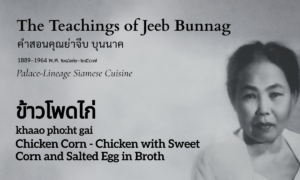
Chicken Corn (ข้าวโพดไก่; khaao pho:ht gai)
Chicken Corn, a delicate Thai snack where thinly sliced corn is simmered in chicken stock with shredded breast meat and salted egg yolk. From Jeeb Bunnag's 1933 cookbook.
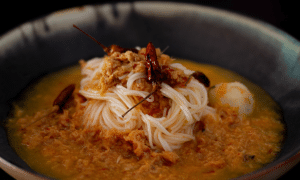
Khanohm Jeen Naam Yaa (ขนมจีนน้ำยา) - Fermented Rice Noodles with Minced Fish in Aromatic Coconut Curry
In the Central Plains of the Kingdom, fermented rice noodles are inextricably linked to a dish known as naam yaa. Composed of a dense, coconut-based minced fish curry, the dish is infused with layers of salted fish and possesses the distinctive, invigorating and purifying notes of fingerroot. Typically, naam yaa is served with fresh lemon basil as the herb of choice along with an array of side dishes collectively known as meuuat khanohm jeen (เหมือดขนมจีน). These include blanched bean sprouts seasoned with a touch of turmeric for color, fresh lemon basil leaves, thinly sliced three colored chilies, and ground chili for added heat. More elaborate versions will add blanched Chinese bitter gourd slices, batter-fried young morning glory shoots, and fresh shrimp minced and fried with its tomalley in pork lard, as well as crispy-fried shallots as the finishing touch.
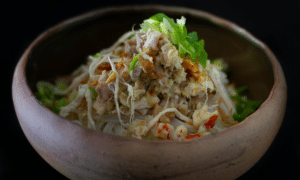
Naam Yaa Jeen - Fermented Rice Noodles with Chinese Sauce by HRH Prince Krom Luang Pitak Montri (น้ำยาจีน อย่างกรมหลวงพิทักษมนตรี)
Among the various curries that can be poured over khanom jeen fermented rice noodles, this broth, known as Chinese-style “naam yaa,” is unique in that it is a water-based curry that does not have chilies. As such, rather than the typical reddish-rust color of most coconut-based naam ya dishes from the Central Plains of the Kingdom, the sauce glows with a soft, light ivory hue, beautifully reflecting the dish’s natural sweet-savoriness, which is derived from slow-braising three proteins – chicken, pork and shrimp – along with a curry paste galvanized by smoke-dried fish and aromatic roots like galangal, fingerroot and sand ginger. The naam ya broth is served over a bed of fermented rice noodles and garnished with toppings such as delicate pulled chicken breast threads, golden-crispy fried shallots and garlic, and vivid green fresh coriander leaves and spring onion. All these elements add a visual grace and a hint of freshness to the robust broth – the signature dish of Prince Krom Luang Pitak Montri (กรมหลวงพิทักษ์มนตรี).
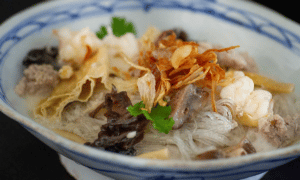
Gaaeng Raawn (แกงร้อน)
Gaaeng raawn (แกงร้อน) is a colloquial Thai term that refers to ‘hot curry’. Today, gaaeng raawn is used to denote soups or curries served with steamed rice. While the precise origin of the term is unclear, gaaeng raawn (แกงร้อน) was deployed in the 1800s for a specific dish – a Siamese soup featuring glass noodles, cooked as either a coconut or a water-based soup with an assortment of dry ingredients revered in Chinese cuisine. The soup’s potential health benefits, combined with its ease of preparation and subtle yet profound flavor, made it a popular choice for entertaining large groups of people, of all ages and backgrounds. The soup is often augmented with fresh proteins: in its more luxurious versions, multiple proteins may be added, including a combination of chicken, pork, shrimp, squid, and crab meat. Thus, over the years, gaaeng raawn (แกงร้อน) was established as a staple source of comfort and warmth for people of all walks of life in Siamese society.
1
2
3


Get Access – Join Thaifoodmaster Today
Practical and kitchen-tested recipes with a mix of theory, history, psychology, and Siamese culture tidbits.
-
Get access to everything right away. Unlock more than 50 Masterclasses, over 700 recipes and Articles
Access to Thaifoodmaster’s constantly growing library of prime professional classes, articles, recipes and videos on Siamese culinary topics, available nowhere else in English.
-
GET EXTRA - New Masterclasses and Daily Recipes
Gain access to NEW masterclasses as they become available. Access DAILY translations of heritage-recipes.
-
1-1 support from Hanuman
1-1 support from Hanuman to help you achieve your professional Thai culinary goals
-
Live Q&A Sessions
The opportunity to join a monthly live two-hour videoconference where I can answer your questions.
-
Great Value!
one year access for the price of 3 days in-person training.
You will get everything you need to:
-
To Get inspired
When you design or build a new menu for an event or restaurant or even prepare for dinner with friends.
-
To Satisfy your curiosity.
Finally !
-
To Master Your Craft
Master your Thai cooking skills and expand your repertoire.
It is truly brilliant with a revolutionary approach introducing aspects and concepts never broached by cookbooks.

Ian Westcott
Sourcing Wines for Discerning Private Clients
© 2008 – 2026 Thaifoodmaster


