
Celebrating the Art of Siamese Culinary Wisdom and Thai Cuisine
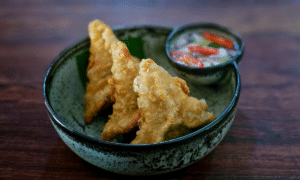
The Elegance of Khanohm Khaang Khaao (ขนมค้างคาว)
If palaces represent grandeur and wealth within a society, and poems often focus on emotional experience or the beauty of language, then the significance of a dumpling may be inferred by its structured elegance and minimalism – each fold and pleat a deliberate act, and each filling a curated experience constructing comfort in its most elemental form.
Khanom khaang khaao (ขนมค้างคาว) is a traditional Siamese fried, triangular-shaped dumpling with obvious Chinese origins. Its earliest recorded recipe can be traced back to Jao Khraawk Thaawng Yuu (เจ้าครอกทองอยู่), a distinguished aristocrat from the royal court of Ayutthaya. Historical records indicate that, from the early days of the Rattanakosin era, her recipe was a favored snack within the Siamese royal court.
These dumplings are shaped like triangles and, according to some, resemble bats: For this reason, they are called khanom khaang khaao (ขนมค้างคาว) – ‘the bat’s treat’. The dumpling’s dough is made from rice and mung bean flours; its filling is prepared by combining grated coconut and shrimp meat, which are cooked together into a dense, flavorful mixture that brings out the nutty-sweet taste of the grated coconut and the savory-sweet flavors of the shrimp. Kaffir lime leaves, sliced into hair-thin juliennes, add a hint of citrus.
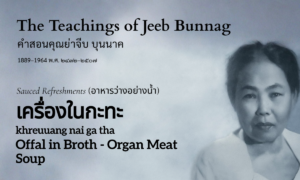
Offal in Broth (เครื่องในกะทะ; khreuuang nai ga tha)
Offal in Broth combines carefully cleaned organ meats in a seasoned pork bone broth. From Jeeb Bunnag's 1945 Thai culinary manuscript for appetizers and snacks.
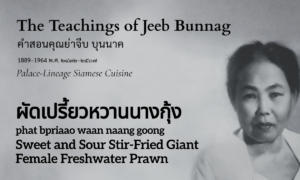
Sweet and Sour Stir-Fried Giant Female Freshwater Prawn (ผัดเปรี้ยวหวานนางกุ้ง; phat bpriaao waan naang goong)
Phat bpriaao waan naang goong, giant female freshwater prawns steamed then stir-fried with a cassava flour sweet-sour glaze. Jeeb Bunnag, 1933.
The Art of Siamese Duck Curries - Theory and Practice (แกงเป็ด - ศิลปะ ทฤษฎี และ การปฏิบัติ)
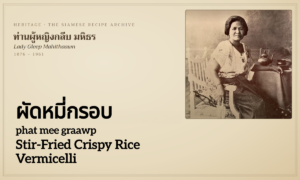
Stir-Fried Crispy Rice Vermicelli (ผัดหมี่กรอบ; phat mee graawp)
Phat mee graawp, rice vermicelli fried crisp in pork lard, seasoned salty–sweet–sour, finished with slivered bitter orange. Lady Gleep Mahithaawn, 1949.
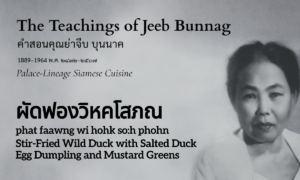
Stir-Fried Wild Duck with Salted Duck Egg Dumpling and Mustard Greens (ผัดฟองวิหคโสภณ; phat faawng wi hohk so:h phohn)
Phat faawng wi hohk so:h phohn: wild duck stir-fried with ornamental salted egg yolk dumplings in naam khlook khlik sauce. Jeeb Bunnag, 1933.
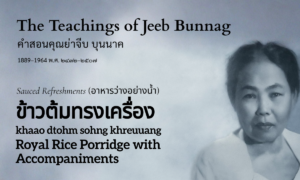
Royal Rice Porridge with Accompaniments (ข้าวต้มทรงเครื่อง; khaao dtohm sohng khreuuang)
Royal Rice Porridge with Accompaniments features crispy dried shrimp, tofu, peanuts, and potato chips atop soft rice porridge. From Jeeb Bunnag's 1945 cookbook.

c1949 Salad of grilled pork and coconut-cooked pumpkin by Maawm Ying Soophaa (ยำฟักทองกะทิ ตำราการปรุงอาหารยำ หม่อมหญิงสุภา พ.ศ. 2492; yam fak thaawng Gathi)
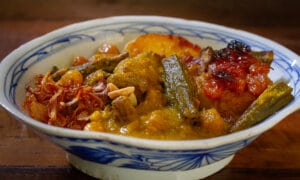
c1929 Green Curry of the Sultan (แกงเขียวหวานสุลต่าน อ่ยาง หะยี ฮิบรอเฮม และ จีบ บุนนาค พ.ศ. 2472 ; gaaeng khiaao waan soola dtaan)
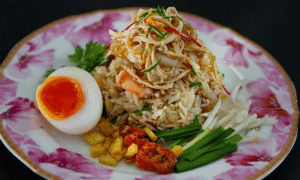
Khao Mee Seasoned Rice (ข้าวหมี่อย่างคลุก; khaao mee yaang khlook)
This article explores two methods of preparing Mee Fried Rice - the traditional Khao Mee Fried Rice and the lighter, seasoned rice alternative known as khaao mee yaang khlook. Discover the flavor chemistry at play and choose your preferred method for a delicious meal.
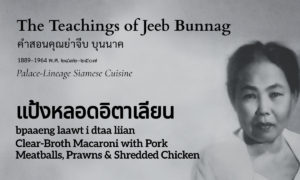
Italian Tube Pasta (แป้งหลอดอิตาเลียน; bpaaeng laawt i dtaa liian)
Bpaaeng laawt i dtaa liian, macaroni in clear bone broth with steamed pork meatballs, prawns, and shredded chicken. Jeeb Bunnag, 1933.
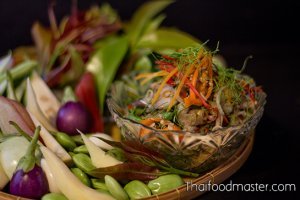
Spicy Salad of Grilled Tiger Prawns, Mackerel, Lemongrass and Aromatics with Infused Fermented Fish Innards Dressing (ไตปลาทรงเครื่อง ; dtai bpla sohng khreuuang)
If we could strip away the spices, the seasonings, the vegetables and the herbs from savory dishes we could uncover their naked flavor profile core. There, we would encounter a strong savory-umami, sometimes coupled with other basic elements of smoke and fat. This flavor core is, for us humans, the sought-after taste of protein; our first sip of mother’s milk, and the primal experience of burned game meat on the fire.
Today we would like to highlight a powerhouse for umami creation: the fermentation process. We will focus on fermented fish innards from southern Thailand (dtai bpla ไตปลา), one of about a dozen fermented products used in the country. We will show you how chefs for the capital’s elite, as early as or, before the reign of King Phra Phutthaloetla Naphalai (Rama II, 1767-1824), harnessed its wild nature and created a dish similar to what we present today - a salad with infused fermented fish innards dressing.
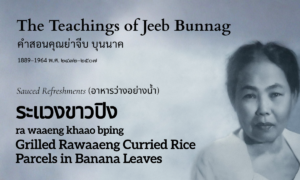
Grilled Rawaaeng Curried Rice Parcels in Banana Leaves (ระแวงขาวปิง; ra waaeng khaao bping)
Ra waaeng khaao bping, rice parcels with duck and coconut cream wrapped in banana leaves and grilled. From Jeeb Bunnag's 1945 Thai appetizer cookbook.
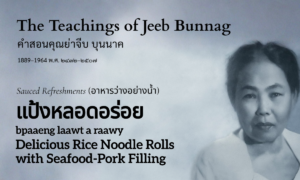
Delicious Rice Noodle Rolls (แป้งหลอดอร่อย; tham raae yam sa bpaaeng laawt a raawy)
Delicious Rice Noodle Rolls, a Thai appetizer of rice sheets wrapped around seafood-pork filling and tied with spring onion. From Jeeb Bunnag's 1945 cookbook.
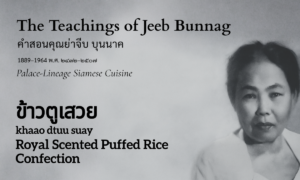
Royal Puffed Rice Confection (ข้าวตูเสวย; khaao dtuu suay)
Khaao dtuu suay: toasted sun-dried rice kneaded with coconut and palm sugar, then scented with jasmine and ylang-ylang. Jeeb Bunnag, 1933.
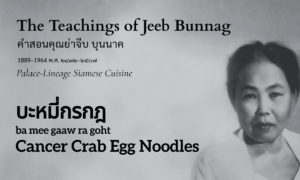
Cancer Crab Egg Noodles (บะหมี่กรกฎ; ba mee gaaw ra goht)
Ba mee gaaw ra goht, puffed deep-fried egg noodles topped with crab, shrimp, and salted duck egg yolk balls. Jeeb Bunnag, 1933.
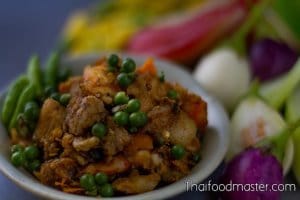
Thai Chili Relish with Pork, Shrimp and Fresh Peppercorns (น้ำพริก พริกไทยสด ; naam phrik phrik thai soht)
Studded with small green peppercorns that burst with a mild peppery pungency, this relish is not as spicy as one might expect from a Thai chili relish - nor does the sour taste serve as a noticeable flavor pillar. Instead, a warmer and softer peppery bite, coupled with the aroma of young pepper, delivers a complex kick. The peppercorns, together with the flavorful yellow chilies, wrap the pork’s natural umami and fatty characters and enhance its natural sweetness; this sweetness, despite being placed far in the back and only appearing at the end of each bite, is nicely layered by the use of shrimp meat and palm sugar.
Fermented Soybean Paste Dipping Relish (เต้าเจี้ยวพล่า; dtao jiaao phlaa)
Dtao jiaao phlaa, fermented soybean paste relish bruised with lemongrass, kaffir lime, and tamarind. From Jeeb Bunnag, 1933.
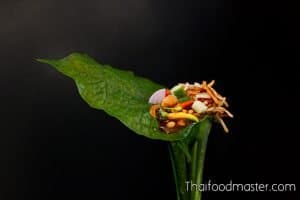
Miang kham - A royal leaf wrap appetizer เมี่ยงคำ
Each leaf-wrapped parcel is a kaleidoscope of flavors and richness, textures, aromas and sensations. Fresh green-earthy-chlorophyll-herby-tobacco-peppery wild betel leaves enfold bursts of flavor from nutty roasted peanuts and crispy roasted coconut matches, the umami of savory dry shrimp, pungent-sweet diced shallots, small ginger cubes with a warm bite, sour and bitter unpeeled lime cubes, citrusy perfumed diced bitter orange (som za), naughty whole fresh tiny bird’s eye chilies, and small slices of the sharp and sour dtaling bpling (Averrhoa bilimbi, a relative of the carambola/starfuit). All of which is blended with a thick paste of sweet-sour and salty palm sugar and tamarind sauce.
The miang kham takes every taste bud on a fascinating pleasure trip through sweetness, saltiness, sourness, bitterness, and umami, piquancy, sharpness and spiciness, with an array of textures that slowly subside as the journey ends, leading to a familiar post orgasmic expression, a smile and the desire for more.
Whole Roasted Duck (เป็ดอบทั้งตัว; bpet ohp thang dtuaa)
Bpet ohp thang dtuaa, whole duck brandy-rubbed and air-dried before roasting with a nutmeg butter paste. From Jeeb Bunnag, 1933.
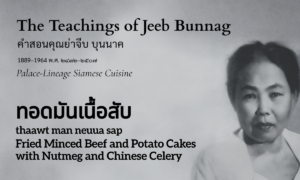
Fried Minced Beef and Potato Cakes with Nutmeg and Chinese Celery (ทอดมันเนื้อสับ; thaawt man neuua sap)
Thaawt man neuua sap, minced beef cakes with boiled potato, nutmeg and Chinese celery, fried in egg and flour. From Jeeb Bunnag, 1933.
1
2
3
4
5
6
7
8
9
10
11
12
13
14

Get Access – Join Thaifoodmaster Today
Practical and kitchen-tested recipes with a mix of theory, history, psychology, and Siamese culture tidbits.
-
Get access to everything right away. Unlock more than 50 Masterclasses, over 700 recipes and Articles
Access to Thaifoodmaster’s constantly growing library of prime professional classes, articles, recipes and videos on Siamese culinary topics, available nowhere else in English.
-
GET EXTRA - New Masterclasses and Daily Recipes
Gain access to NEW masterclasses as they become available. Access DAILY translations of heritage-recipes.
-
1-1 support from Hanuman
1-1 support from Hanuman to help you achieve your professional Thai culinary goals
-
Live Q&A Sessions
The opportunity to join a monthly live two-hour videoconference where I can answer your questions.
-
Great Value!
one year access for the price of 3 days in-person training.
You will get everything you need to:
-
To Get inspired
When you design or build a new menu for an event or restaurant or even prepare for dinner with friends.
-
To Satisfy your curiosity.
Finally !
-
To Master Your Craft
Master your Thai cooking skills and expand your repertoire.
It is truly brilliant with a revolutionary approach introducing aspects and concepts never broached by cookbooks.

Ian Westcott
Sourcing Wines for Discerning Private Clients
© 2008 – 2026 Thaifoodmaster


