
Celebrating the Art of Siamese Culinary Wisdom and Thai Cuisine
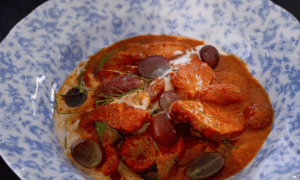
c1941 Roasted Duck Curry with Grapes (Gaaeng Ho) (แกงเป็ดเหาะใส่องุ่น อย่างคุณถนอม ปาลบุตร พ.ศ. 2484; gaaeng bpet haw sai angoon)
Grapes have long been associated with prosperity, fertility and abundance across various cultures and historical periods due to the fruit’s large clusters and bountiful growth. In ancient China, grapes were considered a symbol of wealth and nobility, and often deployed as a status symbol among the elite. In Greek mythology, Dionysus, the god of wine and fertility, was often depicted holding a bunch of grapes, further emphasizing the connection between grapes and abundance. This association is also likely rooted in the fact that grapes were a valuable crop in antiquity – used to produce wine and other fermented products, and an important source of food and nutrition. In Indian Ayurvedic texts, grapes are referred to as vineaksha and utilized in treating a variety of ailments, including fever and indigestion.
From the Siamese perspective, the incorporation of fruits in culinary preparations was viewed as a luxurious indulgence, as many fruits commonly available today were once difficult to obtain. Thus the pairing of an extravagant ingredient – such as fruit – with an equally opulent and exclusive delicacy like roasted duck resulted in a dish fit for royalty.
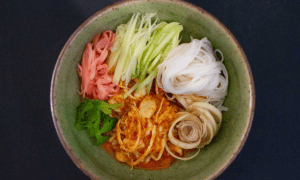
“Sang-de-Boeuf Porcelain” Fermented Rice Noodles by Princess Jongjittanom Dissakul (ขนมจีนครามแดง อย่าง หม่อมเจ้าหญิงจงจิตรถนอม ดิศกุล ; khanohm jeen khraam daaeng)
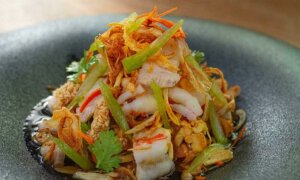
c1933 Sour bilimbi fruit and crispy candied peanut salad with pork, shrimp and pork fat (ยำตะลิงปลิง ; yam dtaling bpling)
A candied peanut bar might be considered an unlikely ingredient for an old-fashioned Siamese-style salad. Yet, peanut bars were familiar to the Siamese as early as the Ayutthaya period and were part of a broader set of Teochew Chinese sweets called, in Thai, “khanohm janap (ขนมจันอับ)”.
Shrimp Ball Soup (แกงลูกชิ้นกุ้ง; gaaeng luuk chin goong)
Gaaeng luuk chin goong, shrimp balls pounded and slapped for springy texture in clear broth with garland chrysanthemum. Jeeb Bunnag, 1933.
Side dish - Birds Resting in the Nest (นกนอนรัง; nohk naawn rang)
Birds Resting in the Nest, baya weavers stuffed with peppery pork and draped in fine duck egg threads. From Jeeb Bunnag, 1933.
Red Pickled Anchovies with Seasonings (ปลาแดงทรงเครื่อง; bplaa daaeng sohng khreuuang)
Fermented anchovy relish with dual citrus, grilled shrimp, and salt-worked ginger served with raw vegetables and fried catfish. Jeeb Bunnag, 1933.
Decorated Corn (ข้าวโพดประดับ; khaao pho:ht bpra dap)
Decorated Corn, a palace-style appetizer featuring spiced chicken molded around baby corn and adorned with kernels. From Jeeb Bunnak's 1945 Thai cookbook.
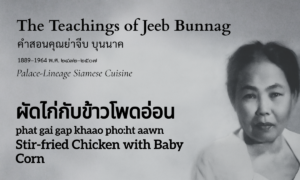
Stir-fried Chicken with Baby Corn (ผัดไก่กับข้าวโพดอ่อน; phat gai gap khaao pho:ht aawn)
Phat gai gap khaao phoht aawn, chicken and baby corn stir-fried with garlic, sauce thickened by pounded corn kernels. Jeeb Bunnag, 1933.
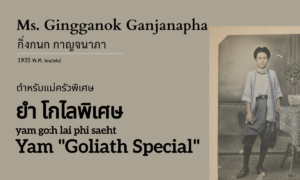
Yam "Goliath Special" (ยำ "โกไลพิเศษ"; yam go:h lai phi saeht)
Yam Goliath Special: eight boiled proteins — shrimp, pork, squid — dressed with pounded coriander root and garlic. Delicious Side Dishes, 1935.
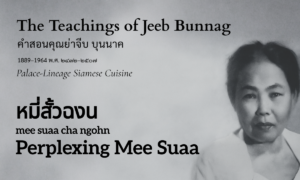
Perplexing Mee Suaa (หมี่สั้วฉงน; mee suaa cha ngohn)
Mee suaa cha ngohn: wheat noodle bundles bound with shrimp-corn paste, steamed, served in clear pork-crab broth. Jeeb Bunnag, 1933.
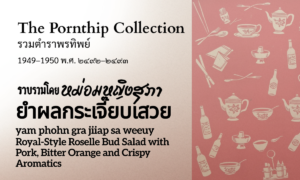
Royal-Style Roselle Bud Salad (ยำผลกระเจี๊ยบเสวย; yam phohn gra jiiap sa weeuy)
Royal-Style Roselle Bud Salad combines wine-ruby roselle buds with pork and crispy aromatics in a bitter orange dressing. Components remain separate until serving, per Maawm Ying Soophaa's 1949 manuscript.
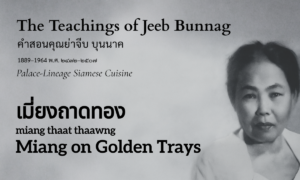
Miang on Golden Trays (เมี่ยงถาดทอง; miang thaat thaawng) (กระทงทอง)
Miang thaat thaawng, palm-pressed fried pastry cups filled with crab, pork, pickled garlic, and bitter orange zest. Jeeb Bunnag, 1933.
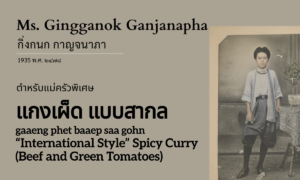
“International Style” Spicy Curry (แกงเผ็ด แบบสากล; gaaeng phet baaep saa gohn)
Gaeng phet baaep saa gohn — beef pre-seared with fish sauce, curry paste bloomed in cracked coconut cream. green tomatoes or hairy-fruited eggplant (maeuk) and dual basils - Gingganok Gaanjanaaphaa, 1935.
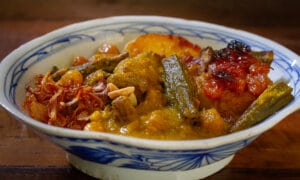
c1929 Green Curry of the Sultan (แกงเขียวหวานสุลต่าน อ่ยาง หะยี ฮิบรอเฮม และ จีบ บุนนาค พ.ศ. 2472 ; gaaeng khiaao waan soola dtaan)
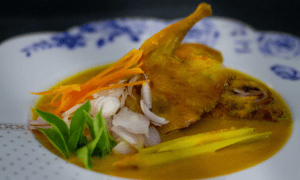
Curry of yellow chilies with whole quail, fresh turmeric and lemon basil (แกงเผ็ดนกกระทาพริกเหลืองสด; gaaeng phet nohk grathaa phrik leuuang soht)
Salty leading and sour-sweet to follow, this coconut-based gaaeng phet spicy curry might be made of chilies, but it is fruitier than it is spicy, and lighter than it is dense. Originally cooked with the meat of game birds, it retains a surprisingly light body that opens space for the birds to fly. The curry is tinted golden orange from a paste imbued with fresh yellow chilies and turmeric; it is perfumed with lemongrass and lemon basil leaves.
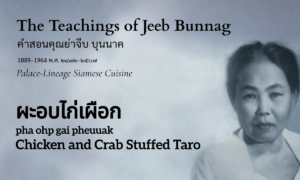
Chicken-Stuffed Taro (ผะอบไก่เผือก; pha ohp gai pheuuak)
Pha ohp gai pheuuak: taro carved into a lidded vessel, filled with phrik khing paste, chicken, and sea crab. Jeeb Bunnag, 1945.
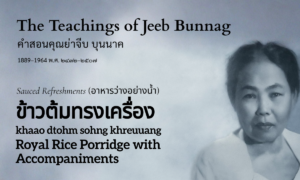
Royal Rice Porridge with Accompaniments (ข้าวต้มทรงเครื่อง; khaao dtohm sohng khreuuang)
Royal Rice Porridge with Accompaniments features crispy dried shrimp, tofu, peanuts, and potato chips atop soft rice porridge. From Jeeb Bunnag's 1945 cookbook.
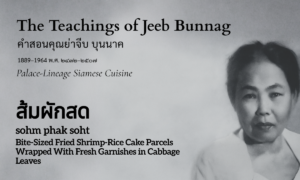
Bite-Sized Fried Shrimp-Rice Cake Parcels Wrapped With Fresh Garnishes in Cabbage Leaves (ส้มผักสด; sohm phak soht)
Sohm phak soht: coconut-battered fried shrimp-rice cakes wrapped in Chinese cabbage with pickled ginger, peanuts, shallots, lime and bitter orange. Jeeb Bunnag, 1945.
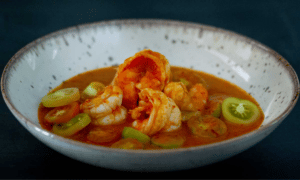
c1937 Shrimp and tomato curry (แกงกุ้งกับมะเขือเทศ คู่มือการครัว นางสาวฉลวย กันตวรรณี พ.ศ. 2480; gaaeng goong gap makheuua thaeht)
Stocked with a contemporary brew of umami-rich ingredients, this ancient, bright and slightly sour coconut-based shrimp and tomato curry demonstrates how simple – yet clever – flavor-layering techniques can spotlight the shrimp and the spectacular savory tomatoes over the curry background.
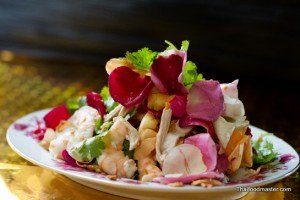
ยำกลีบกุพชกะ - ตำนาน "ดอกกุหลาบ" กับ เรื่องรัก 14 กุมภาพันธ์ แบบไทย ๆ
สูตรทำยำกลีบกุพชกะ อย่าง พระยานครราชเสนี - วันแห่งความรัก 14 กุมภาพันธ์นี้ ข้าพเจ้าเปลี่ยนความคิดใหม่แล้ว แทนที่จะพาครอบครัวไปฉลองข้างนอก เปลี่ยนมาฉลองที่บ้านดีกว่า จะลงปรุงอาหารคาวหวานจากดอกกุหลาบหลาย ๆ ตำรับให้เป็นธีม (theme) ดูท่าคงจะมีเรื่องเล่า จากดอกกุหลาบแดงช่อนั้นของแม่ลูกสาวข้าพเจ้าในโต๊ะอาหารเป็นแน่แท้... คิดแล้วก็ขับรถไป ฮัมเพลงไป เบา ๆ
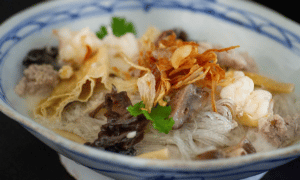
Gaaeng Raawn (แกงร้อน)
Gaaeng raawn (แกงร้อน) is a colloquial Thai term that refers to ‘hot curry’. Today, gaaeng raawn is used to denote soups or curries served with steamed rice. While the precise origin of the term is unclear, gaaeng raawn (แกงร้อน) was deployed in the 1800s for a specific dish – a Siamese soup featuring glass noodles, cooked as either a coconut or a water-based soup with an assortment of dry ingredients revered in Chinese cuisine. The soup’s potential health benefits, combined with its ease of preparation and subtle yet profound flavor, made it a popular choice for entertaining large groups of people, of all ages and backgrounds. The soup is often augmented with fresh proteins: in its more luxurious versions, multiple proteins may be added, including a combination of chicken, pork, shrimp, squid, and crab meat. Thus, over the years, gaaeng raawn (แกงร้อน) was established as a staple source of comfort and warmth for people of all walks of life in Siamese society.
1
2
3
4
5
6
7
8
9
10
11
12
13

Get Access – Join Thaifoodmaster Today
Practical and kitchen-tested recipes with a mix of theory, history, psychology, and Siamese culture tidbits.
-
Get access to everything right away. Unlock more than 50 Masterclasses, over 700 recipes and Articles
Access to Thaifoodmaster’s constantly growing library of prime professional classes, articles, recipes and videos on Siamese culinary topics, available nowhere else in English.
-
GET EXTRA - New Masterclasses and Daily Recipes
Gain access to NEW masterclasses as they become available. Access DAILY translations of heritage-recipes.
-
1-1 support from Hanuman
1-1 support from Hanuman to help you achieve your professional Thai culinary goals
-
Live Q&A Sessions
The opportunity to join a monthly live two-hour videoconference where I can answer your questions.
-
Great Value!
one year access for the price of 3 days in-person training.
You will get everything you need to:
-
To Get inspired
When you design or build a new menu for an event or restaurant or even prepare for dinner with friends.
-
To Satisfy your curiosity.
Finally !
-
To Master Your Craft
Master your Thai cooking skills and expand your repertoire.
It is truly brilliant with a revolutionary approach introducing aspects and concepts never broached by cookbooks.

Ian Westcott
Sourcing Wines for Discerning Private Clients
© 2008 – 2026 Thaifoodmaster


