
Celebrating the Art of Siamese Culinary Wisdom and Thai Cuisine

Wild Boar Curry with Salacca (แกงหมูบป่าระกำ; gaaeng muup bpaa ra gam)
Gaaeng muup bpaa ra gam, wild Boar curry with sourness from both tamarind and crushed salacca. From Maawm Ying Soophaa's Divine Dishes, 1949.
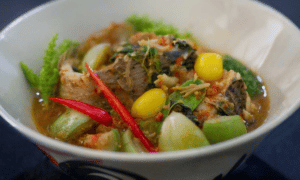
Kanchanaburi-Style Snakehead Fish Jungle Curry with Bitter Yellow Eggplants (แกงป่าปลา ; gaaeng bpaa bplaa)
This recipe is adapted from a recipe I obtained from a jungle food restaurant in Kanchanaburi province. The paste is a downgrade of a phrik khing paste – it omits the coriander roots and shallots. In addition, the recipe substitutes the fermented shrimp paste (kapi) with maawn fermented fish paste (กะปิมอญ; gabpi maawn), which is a popular ingredient among the Mon-Burmese population of the western province. The lack of shallots eliminates any sweetness that might impair the sharpness and heat of the dish. Furthermore, a double hit of citrus notes from holy basil are infused into the dish: from the holy basil flowers added to the paste and the holy basil leaves added to the curry.
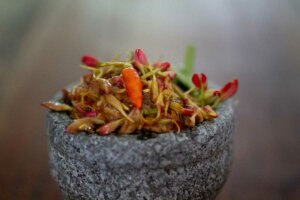
Tamarind flower chili relish inspired by Princess Jongjittanom Dissakul (น้ำพริกดอกมะขาม อย่าง หม่อมเจ้าหญิงจงจิตรถนอม ดิศกุล ; naam phrik daawk makhaam)
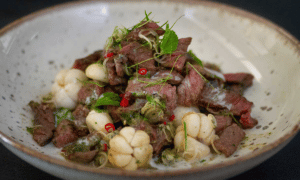
Grilled beef and mangosteen (or grape) salad with mint dressing, by Princess Jongjittanom Dissakul (ยำเนื้อย่างกับมังคุดหรือองุ่น; yam neuua yaang gap mangkhoot reuu angoon)
This grilled beef salad with luscious mangosteen (or grapes) is seasoned with a crisp, cooling dressing of fermented shrimp paste and mint. The mangosteen’s tropical character – a flavor redolent of many other fruits – dominates its fruity essence and is a perfect complement to both the grilled meat and the lingering, sour-salty-sweet, minty dressing. Furthermore, citrusy notes of thinly sliced lemongrass and kaffir lime leaves, coupled with richness of thickened coconut cream, unite the caramelized, meaty elements with the dish’s fruity spectrum.
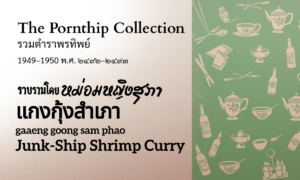
Junk-Ship Shrimp Curry (แกงกุ้งสำเภา; gaaeng goong sam phao)
Gaaeng goong sam phao, a palace phrik khing curry of whole shrimp soured with chebulic myrobalan. From Maawm Ying Soophaa's Divine Dishes, 1949.
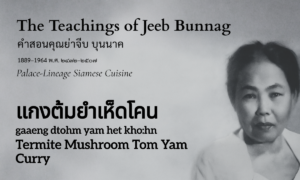
Termite Mushroom Tom Yam Curry (แกงต้มยำเห็ดโคน; gaaeng dtohm yam het kho:hn)
Gaaeng dtohm yam het khohn — termite mushrooms in reduced, strained stock with shredded chicken and crispy fried garlic. Jeeb Bunnag, 1933.

c1949 Salad of grilled pork and coconut-cooked pumpkin by Maawm Ying Soophaa (ยำฟักทองกะทิ ตำราการปรุงอาหารยำ หม่อมหญิงสุภา พ.ศ. 2492; yam fak thaawng Gathi)
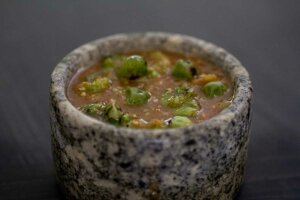
Fermented shrimp paste relish with grilled pea eggplants (น้ำพริกมะเขือพวง ; naam phrik ma kheuua phuaang)
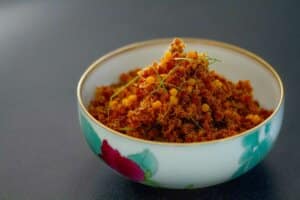
Old-Fashioned Phat Phrik Khing, Yesteryear's Travel Food (ผัดพริกขิง อาหารคนเดินทาง)
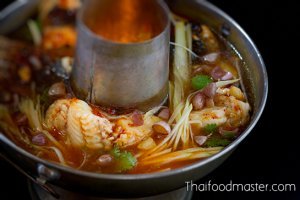
An Ancient Siamese Recipe for Tom Yum Soup (First Published in 1890). Sour Spicy Tom Yum Soup with Snakehead Fish, Roasted Chili Jam and Green Mango (Dtohm Yam Bplaa Chaawn, ต้มยำปลาช่อนแบบโบราณ อย่างหม่อมซ่มจีน ราชานุประพันธุ์ ร.ศ.๑๐๙)
Tom yum soup from the late 19th-century Siam to present days. Including a step-by-step recreation of tom yum soup with snakehead fish (dtohm yam bplaa chaawn, ตัมยำปลาช่อน) as recorded by Maawm Sohm Jeen (Raa Chaa Noopraphan) (หม่อมซ่มจีน, ราชานุประพันธุ์) in her book “Tam Raa Gap Khao” (ตำรากับเข้า), published in 1890 (2433 BE, 109RE).
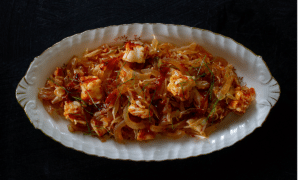
Angel Visiting the Chamber: A Salad of Pomelo, Pork Skin and Shrimp with Chili Jam Dressing, circa 1920s (ยำนางฟ้าเยี่ยมห้อง; yam naang faa yiiam haawng)
The name of this dish, yam naang faa yiiam haawng (ยำนางฟ้าเยี่ยมห้อง), translates to ‘Angel Visiting the Chamber Salad’ in English. This celestial salad, which originated in the 1920s, is a playful chili jam-based salad that combines the textural gradients of pomelo, with its citrusy bursts, chewy cooked pork skin, and the sweet and slightly resilient cooked shrimp meat. The pomelo’s citrusy notes are further amplified with thinly sliced lemongrass and kaffir lime leaves sliced into hair-thin juliennes. I like to adjust the sourness and sweetness of the chili jam-based dressing based on the acidity of the pomelo. As our aim is to achieve a final sour-salty and sweet flavor profile, a sour-salty dressing is suggested if the pomelo is sweet, while a salty-sweet dressing pairs better with a sour pomelo.
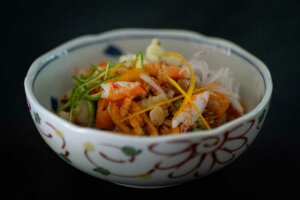
Jungle chili relish by Princess Jongjittanom Dissakul (น้ำพริกป่า อย่าง หม่อมเจ้าหญิงจงจิตรถนอม ดิศกุล ; naam phrik bpaa)
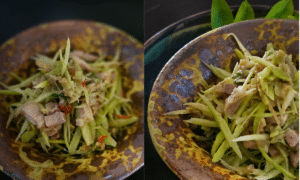
Pork Belly Coated with Salted-Fish and Green Mango Chili Relish (น้ำพริกมะม่วง หมูเคลือบเค็ม พ.ศ. 2476; naam phrik ma muaang mu khleuuap khem)
In this dish, slices of pork belly are coated with a sticky sauce; the sauce is reduced from braising a slice of grilled salted fish with coriander roots, garlic and white peppercorns (saam gluuhr). The dish is served with a sour-leading green mango chili relish that adds tartness with fiery accents to the saltiness of the pork. The salted fish gives the pork an initial fishy aroma that, although robust, gives way to a sense of home as it merges into the sourness and fruitiness of the mango chili relish. As an ingredient commonly used in the kitchens of rice-growing communities, salted fish signifies a comforting familiarity that conveys simplicity and warmth to the table. I like to pair the salted, fishy pork with seasoned rice dishes in which sour-leading relishes are mixed with rice along with other condiments.
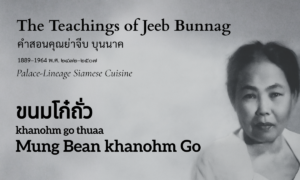
Mung Bean khanohm Go (ขนมโก๋ถั่ว; khanohm go thuaa)
Khanohm go thuaa, a molded palace confection of dry-roasted mung bean flour and coarse-grain sugar, scented with jasmine and ylang-ylang. Jeeb Bunnag, 1933.
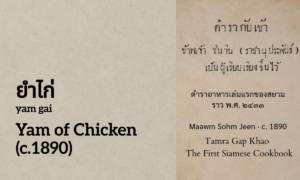
Yam of Chicken (ยำไก่; yam gai)
Yam gai: chicken simmered in coconut milk until dry, then dressed with mint, kaffir lime and green mango. Maawm Sohm Jeen, Tamra Gap Khao, 1890.
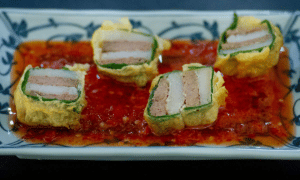
Pork liver and firm pork fat fried in batter (มันสลับตับสุกร; man salap dtap soogaawn)
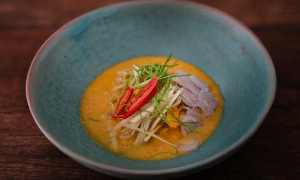
Citrus-Infused Crumbled Duck Egg Yolk Salad (ไขเค็มพล่า; Khai Khem Phlaa)
This vibrant salad combines the richness of crumbled duck egg yolks with the zesty notes of citrus and aromatic herbs.
Set against a backdrop of aromatics, the crumbled essence of cured duck egg yolks glow in a delicate orange-gold shade, evoking a shimmering sunlit dawn. The cured yolks bestow a rich, briny base that acquires even deeper undertones when seasoned with fish sauce and sugar. This base takes on a luxuriously silky texture, reminiscent of a finely whipped mousse, when mixed with juices of lime and kaffir lime, which also give the mix a crisp, clean citrusy finish.
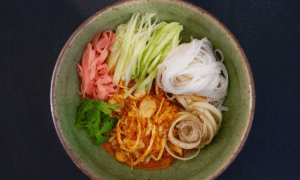
“Sang-de-Boeuf Porcelain” Fermented Rice Noodles by Princess Jongjittanom Dissakul (ขนมจีนครามแดง อย่าง หม่อมเจ้าหญิงจงจิตรถนอม ดิศกุล ; khanohm jeen khraam daaeng)
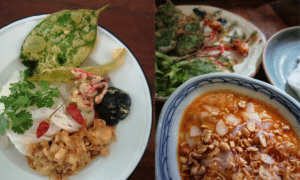
c1949 Fermented rice noodles with multi-sour aromatic chicken sauce by Lady Gleep Mahithaawn (ขนมจีนน้ำพริกไก่ อย่างท่านผู้หญิงกลีบ มหิธร พ.ศ. 2492; khanohm jeen naam phrik gai)
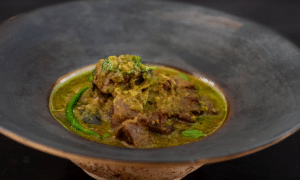
Perfumed Muslim-style Curry of Fresh Chilies with Beef (แกงเขียวหวานเนื้อทรงเครื่อง; Gaaeng Khiaao Waan Neuua Sohng Khreuuang)
The Indian and Muslim cuisines present distinct approaches to using dried spices in curries, both of which influence Siamese cuisine in different ways. Indian-inspired Siamese curries spotlight chilies for their vibrant color, fragrance, flavor and heat, while spices like cumin and coriander play a supporting role. The spices complement and temper the chilies’ intensity, creating a rounded, multi-layered flavor profile; nonetheless, the chilies remain the star ingredient, gently complemented by the spices.
Conversely, Muslim-influenced curries, such as massaman curry, prioritize spices over chilies. Spices like cardamom, nutmeg and mace take center stage, while the chilies provide subtle background heat rather than being the primary flavor. In these curries, the focus is on the rich, warm and complex aromas created by the blend of spices, which is a defining characteristic of many Muslim dishes.
Moreover, Siamese cuisine favors using rehydrated dried chilies in curries for their depth; this depth is highly appreciated, along with the complexity, and comparatively milder heat of the rehydrated dried chilies. As well, the harsh grassy notes of fresh chilies are not favored; they’re referred to in Thai as “green rank” or “men khiaao (เหม็นเขียว)”. Muslim curries often use fresh green chilies, tempering their vibrant, grassy taste with dry spices and thus shifting the flavor from bright and fresh to more subdued and earthy tones, resulting in a dish that is perceived to be layered, despite the burst of fresh chilies.
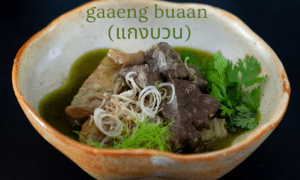
The Story of Gaaeng Buaan (แกงบวน) – The Oldest Siamese Dish?
1
2
3
4
5
6
7
8
9
10



Get Access – Join Thaifoodmaster Today
Practical and kitchen-tested recipes with a mix of theory, history, psychology, and Siamese culture tidbits.
-
Get access to everything right away. Unlock more than 50 Masterclasses, over 700 recipes and Articles
Access to Thaifoodmaster’s constantly growing library of prime professional classes, articles, recipes and videos on Siamese culinary topics, available nowhere else in English.
-
GET EXTRA - New Masterclasses and Daily Recipes
Gain access to NEW masterclasses as they become available. Access DAILY translations of heritage-recipes.
-
1-1 support from Hanuman
1-1 support from Hanuman to help you achieve your professional Thai culinary goals
-
Live Q&A Sessions
The opportunity to join a monthly live two-hour videoconference where I can answer your questions.
-
Great Value!
one year access for the price of 3 days in-person training.
You will get everything you need to:
-
To Get inspired
When you design or build a new menu for an event or restaurant or even prepare for dinner with friends.
-
To Satisfy your curiosity.
Finally !
-
To Master Your Craft
Master your Thai cooking skills and expand your repertoire.
It is truly brilliant with a revolutionary approach introducing aspects and concepts never broached by cookbooks.

Ian Westcott
Sourcing Wines for Discerning Private Clients
© 2008 – 2026 Thaifoodmaster


