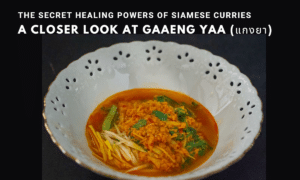
แกงไส้กรอกหมูแห้ง
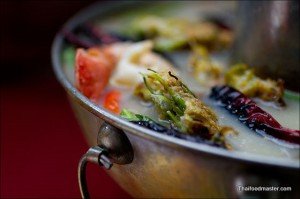
c1935 Princess Yaovabha's Sweet Chinese Sausage in Coconut Cream Soup (แกงไส้กรอกหมูแห้ง; gaaeng sai graawk muu haaeng)
A 1935 Thai palace recipe preserving Princess Yaovabha's Chinese sausage coconut curry. This ivory-colored soup features sweet goon chiang sausage in creamy coconut with lemongrass, kaffir lime, and tamarind. The dish represents a historic culinary shift when Chinese ingredients entered royal Thai kitchens, transforming from street food to palace cuisine.
phat-phrik-khing
Old-Fashioned Phat Phrik Khing, Yesteryear's Travel Food (ผัดพริกขิง อาหารคนเดินทาง)
sarama-shrimp-curry
c1920 Sarama Shrimp Curry with White Eggplants and Lotus Stems (แกงสะระหม่ากุ้งกับมะเขือขาว และ สายบัว พ.ศ. 2463; gaaeng saramaa goong gap makheuua khaao reuu saai buaa)
A dish of complex flavors and an aromatic brightness, this Sarama curry features shrimp and the smaller Thai white eggplant, or crunchy lotus stems, in a golden, salty leading broth with clear tangy-sweet notes. The broth is silky and combines the nutty richness of coconut cream with the subtle sweetness of butter, cooked with a blend of dry spices that include coriander, cumin and turmeric. This spice blend evokes the penetrating aroma of curry powder, reflecting Muslim culinary influences. Unlike spicy gaaeng phet (แกงเผ็ด) curries, which typically deploy dried chilies in the paste, Sarama curry contains fresh chilies. A mix of both red and yellow chili varieties are utilized, fusing the vibrant, fruity piquancy of the fresh chilies with the warm, earthy aromas of the spices. The red chilies contribute a ripe tropical fruitiness while the yellow offer citrusy and floral notes, creating a light yet layered curry with nuanced heat and depth of flavor.
Sour Curry with Prawns and Pickled Vegetables (แกงส้มกุ้งกับผักดอง; gaaeng sohm goong gap phak daawng)
Gaaeng sohm goong, a tamarind-soured prawn curry with pickled vegetables, paste dissolved into boiling water. Jeeb Bunnag, 1933.
Tom Yum Goong Soup Recipe of Prawns and SaNoh Flowers Fried Cakes (ต้มยำกุ้งทอดมันดอกโสน ; tom yum goong thaawt man daawk sanoh)
Today’s tom yum goong soup recipe is a refreshing addition to the tom yum soup repertoire. The fried SaNoh Flower Cakes sensationally enhance the shrimp’s natural sweetness, while the flower’s bittersweet aftertaste is a superb tropical match to the citrusy and aromatic hot and sour tom yum goong soup.
Turtle Curry
The complete story of turtle curries in Siamese cuisine (เจาะลึกประวัติศาสตร์เรื่องแกงตะพาบน้ำ)
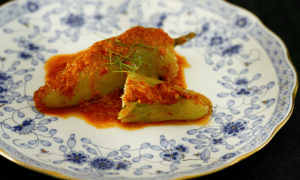
c1935 Stuffed Potatoes with Bitter Orange Fragrant Beef Gaaeng Garee (แกงกะหรี่บรรจุมัน ม.ล. เติบ กำภู ; gaaeng garee ban joo man)
In Anglo-Indian cuisine, potatoes were used liberally in the curries; alongside the favorite sour chutneys, curries were also accompanied by fried, baked, boiled or mashed potatoes. Although the potato gradually found its way into many iconic Indian dishes, and even into Siamese cuisine, the tuber never replaced the rice of South Asia, despite the intentions of both the British and East Indian company officials. In the 1935 book Sai Yaowapa (ตำรับสายเยาวภา), Princess Yaovabha Bongsanid (พระเจ้าบรมวงศ์เธอ พระองค์เจ้าเยาวภาพงศ์สนิท) reflects the Anglo-Indian style gaaeng garee in her composition of bitter orange-fragrant beef gaaeng garee, which she serves in individual bowls made of fried potatoes, per a recipe recorded by M.L. Terb Gamphu (ม.ล. เติบ กำภู) and M.R. Tuang Sanitwong (ม.ร.ว.เตื้อง สนิทวงศ์).
Chicken Massaman Curry Recipe
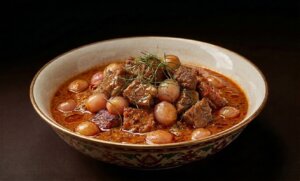
Massaman Curry - The Untold Story (แกงมัสมั่น – แกงมาชะแมน – แกงหมัดสมั่น)
Considered by some to be the most famous, and the most delicious, dish in Thai cooking, the story of Massaman curry is interwoven with trade, politics and religion in 17th-century Siam. The story is filled with mighty kings, legendary explorers and unsolved mysteries, adding an air of magic and power to this already-heavenly perfumed dish, and thickening the plot of this full bodied, coconut-based curry’s birth.
Fish Miang Naem (เมี่ยงแนมปลา; miiang naaem bplaa)
Miiang naaem bplaa, grilled snakehead fish with fire-roasted galangal juice and bitter orange, served in lettuce cups. Jeeb Bunnag, 1933.
gaaeng_sohm_raang_roong
(c1932) Sour water-based curry of pork, salted fish and vegetables blanched in pork lard (gaaeng sohm raang roong ; แกงส้มร่างรุ้ง แกงส้มหมูกับปลาเค็มใส่ผักตี่น้ำมัน )
IMG_0010
Rice Seasoned with Shrimp Paste
(khaao khlook gabpi ; ข้าวคลุกกะปิ)
สูตรทำข้าวคลุกกะปิของ หม่อมเจ้าจงจิตรถนอม ดิศกุล - Rice Seasoned with Shrimp Paste Recipe - Each of the dish’s components is separately prepared and set aside, and mixed individually for each serving. A pleasant harmony of several flavors is created – complex and profound in taste, the dish is a stunning display of confidence. There are many variations of this dish: I have chosen to publish the version described by Prince Johngjit thanaawm Disagoon. This is the very same version prepared for King Chulalongkorn the Great during his unforgettable trip to Italy.
grilled beef mangosteen salad
Grilled beef and mangosteen (or grape) salad with mint dressing, by Princess Jongjittanom Dissakul (ยำเนื้อย่างกับมังคุดหรือองุ่น; yam neuua yaang gap mangkhoot reuu angoon)
This grilled beef salad with luscious mangosteen (or grapes) is seasoned with a crisp, cooling dressing of fermented shrimp paste and mint. The mangosteen’s tropical character – a flavor redolent of many other fruits – dominates its fruity essence and is a perfect complement to both the grilled meat and the lingering, sour-salty-sweet, minty dressing. Furthermore, citrusy notes of thinly sliced lemongrass and kaffir lime leaves, coupled with richness of thickened coconut cream, unite the caramelized, meaty elements with the dish’s fruity spectrum.
Coconut-Braised Spiced Beef (เนื้อสัมฤทธิ์; neuua samrit)
Neuua samrit — beef tenderloin dry-braised in coconut milk with roasted coriander and cumin, glazed dry. Lady Gleep Mahithaawn, 1949.
phrik Khing Phukam (พริกขิงภุกาม; phrik khing phoo gaam)
Phrik khing phukam, a crispy phrik khing (พริกขิง) of deep-fried smoke-dried fish and shrimp with lemongrass, bound in a fish sauce glaze. Jeeb Bunnag, 1933.
naam-yaa
Khanohm Jeen Naam Yaa (ขนมจีนน้ำยา) - Fermented Rice Noodles with Minced Fish in Aromatic Coconut Curry
In the Central Plains of the Kingdom, fermented rice noodles are inextricably linked to a dish known as naam yaa. Composed of a dense, coconut-based minced fish curry, the dish is infused with layers of salted fish and possesses the distinctive, invigorating and purifying notes of fingerroot. Typically, naam yaa is served with fresh lemon basil as the herb of choice along with an array of side dishes collectively known as meuuat khanohm jeen (เหมือดขนมจีน). These include blanched bean sprouts seasoned with a touch of turmeric for color, fresh lemon basil leaves, thinly sliced three colored chilies, and ground chili for added heat. More elaborate versions will add blanched Chinese bitter gourd slices, batter-fried young morning glory shoots, and fresh shrimp minced and fried with its tomalley in pork lard, as well as crispy-fried shallots as the finishing touch.
Old Fashioned Pounded Unripe Rice Snack (ข้าวเม่าหมี่ ; khaao mao mee)
Unripe rice snack - “Khao Mao Mee” (ข้าวเม่าหมี่ ) also known as “Khao Mao Song Kreuang” (ข้าวเม่าทรงเครื่อง) or by it's royal name “Khanom Khao Mao Rang” (ขนมข้าวเม่าราง) is a delicious snack. It makes an unusual use of the unripe rice grains, which are normally used for desserts making. The following recipe describes an ancient and hard to find version of it. These days, there is a tendency to add other ingredients like peanuts or to deep fry the unripe rice grains until fluffy and crispy.
chuu chee pork shrimp tomalley
Coconut Cream-Based Chuu Chee of Pork and Shrimp Glazed with Shrimp Tomalley (แกงฉู่ฉี่หมูกับมันกุ้ง;  gaaeng chuu chee muu gap man goong)
In the context of Siamese samrub meal planning, this thick chuu chee of pork and shrimp with a reddish coconut-based, curry-like sauce is considered a side dish (ของจาน; khaawng jaan). It consists of small, equal-sized slices of pork meat and shrimp fried in coconut cream together with a phrik khing curry paste. With no other vegetables or herbs, the dish is seasoned using fish sauce and palm sugar to a salty and only slightly sweet profile. Finally, it is glazed with shrimp tomalley poured on top and left unstirred, then cooked covered with the lid on, until the tomalley is baked-cooked. When serving, garnish with hair-thin juliennes of kaffir lime leaves and hand-picked coriander leaves.
The Elegance of Khanohm Khaang Khaao (ขนมค้างคาว)
If palaces represent grandeur and wealth within a society, and poems often focus on emotional experience or the beauty of language, then the significance of a dumpling may be inferred by its structured elegance and minimalism – each fold and pleat a deliberate act, and each filling a curated experience constructing comfort in its most elemental form. Khanom khaang khaao (ขนมค้างคาว) is a traditional Siamese fried, triangular-shaped dumpling with obvious Chinese origins. Its earliest recorded recipe can be traced back to Jao Khraawk Thaawng Yuu (เจ้าครอกทองอยู่), a distinguished aristocrat from the royal court of Ayutthaya. Historical records indicate that, from the early days of the Rattanakosin era, her recipe was a favored snack within the Siamese royal court. These dumplings are shaped like triangles and, according to some, resemble bats: For this reason, they are called khanom khaang khaao (ขนมค้างคาว) – ‘the bat’s treat’. The dumpling’s dough is made from rice and mung bean flours; its filling is prepared by combining grated coconut and shrimp meat, which are cooked together into a dense, flavorful mixture that brings out the nutty-sweet taste of the grated coconut and the savory-sweet flavors of the shrimp. Kaffir lime leaves, sliced into hair-thin juliennes, add a hint of citrus.
The Three Kings Curry
The Three Kings Curry (แกงเผ็ดสามกษัตริย์ ; gaaeng phet saam gasat)
แกงเขียวหวานเป็ดย่าง - Thai Green Curry with Roasted Duck and Young Chilies
Thai Green Curry with Roasted Duck and Young Chilies (แกงเขียวหวานเป็ดย่าง ; gaaeng khiaao waan bpet yang)
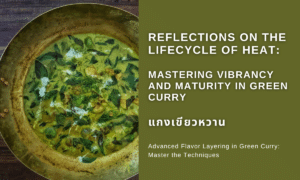
Green curry, with its mellow, creamy green color and rich coconut base, has both fresh and mature flavors. Like new growth on plants, it brings brightness, youthfulness, spring and rebirth to the meltdown of flavors created in the curry paste. The green curry paste uses mainly the same standard ingredients as Thai spicy-red curry paste: lemongrass, coriander roots, kaffir lime zest, galangal, garlic, shallots, white peppercorns, coriander seeds, cumin seeds, salt and kapi.
แกงพะแนงน้ำเป็ดย่างกับหอมเล็ก - gaaeng pha naaeng naam bpet yaang gap haawm lek
Phanaeng Curry of Grilled Duck Stock with Shallots (แกงพะแนงน้ำเป็ดย่างกับหอมเล็ก; gaaeng pha naaeng naam bpet yaang gap haawm lek)
Phanaeng curry from Mrs Puang Bunnag's 1931 manuscript, built on grilled duck stock and a paste of roasted coriander, cumin, and cinnamon.
1
2
3
4
5
6
7
8
9
10
11
12
13
14

Have a look at some of our favorite courses.

Aromatic Primer for Thai Cuisine - Part 1
Patterns – Decoding the Complexity of Siamese Curry Paste: A Multidimensional Exploration

Get Access – Join Thaifoodmaster Today

Practical and kitchen-tested recipes with a mix of theory, history, psychology, and Siamese culture tidbits.

  • Get access to everything right away. Unlock more than 50 Masterclasses, over 700 recipes and Articles

    Access to Thaifoodmaster’s constantly growing library of prime professional classes, articles, recipes and videos on Siamese culinary topics, available nowhere else in English.
  • GET EXTRA - New Masterclasses and Daily Recipes

    Gain access to NEW masterclasses as they become available. Access DAILY translations of heritage-recipes.

  • 1-1 support from Hanuman

    1-1 support from Hanuman to help you achieve your professional Thai culinary goals

  • Live Q&A Sessions

    The opportunity to join a monthly live two-hour videoconference where I can answer your questions.

  • Great Value!

    one year access for the price of 3 days in-person training.

You will get everything you need to:

  • To Get inspired

    When you design or build a new menu for an event or restaurant or even prepare for dinner with friends.

  • To Satisfy your curiosity.

    Finally !

  • To Master Your Craft

    Master your Thai cooking skills and expand your repertoire.

It is truly brilliant with a revolutionary approach introducing aspects and concepts never broached by cookbooks.
Ian Westcott
Ian Westcott
Sourcing Wines for Discerning Private Clients