
Celebrating the Art of Siamese Culinary Wisdom and Thai Cuisine
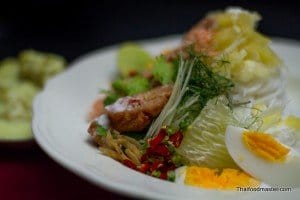
Fermented Rice Noodles Served with Pineapple, Fish Balls in Coconut Milk, Grilled Curried Fish Cakes, Young Ginger and Dry Shrimp Powder
(ขนมจีนซาวน้ำ ; khanohm jeen saao naam ) For the khanohm jeen saao naam version that we present today, we turn again to the writing of Thanpuying (Lady) Gleep Mahithaawn for her unique take on the dish. Her version is quite similar to the common recipe encountered nowadays, but Lady Gleep enhances it with more ingredients, elevating the dish yet another notch to the level of a majestic masterpiece.
(ขนมจีนซาวน้ำ ; khanohm jeen saao naam ) For the khanohm jeen saao naam version that we present today, we turn again to the writing of Thanpuying (Lady) Gleep Mahithaawn for her unique take on the dish. Her version is quite similar to the common recipe encountered nowadays, but Lady Gleep enhances it with more ingredients, elevating the dish yet another notch to the level of a majestic masterpiece.
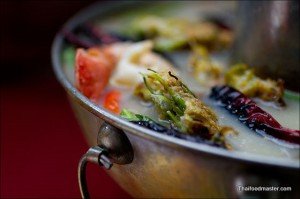
Tom Yum Goong Soup Recipe of Prawns and SaNoh Flowers Fried Cakes (ต้มยำกุ้งทอดมันดอกโสน ; tom yum goong thaawt man daawk sanoh)
Today’s tom yum goong soup recipe is a refreshing addition to the tom yum soup repertoire. The fried SaNoh Flower Cakes sensationally enhance the shrimp’s natural sweetness, while the flower’s bittersweet aftertaste is a superb tropical match to the citrusy and aromatic hot and sour tom yum goong soup.
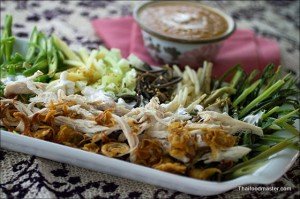
Thai Salad of Chicken and Seven Vegetables Blanched in Coconut Milk and Served With Sour-Salty and Sweet Coconut Curry Dressing, Crispy Fried Shallots and Roasted Sesame Seeds
(yam thawaai ; ยำทวาย) This recipe would probably change your perception about the term "salad", maybe because its dressing has a multi layered, curry-like personality, rather than the common sour vinaigrette-like dressing, or maybe because it takes some good few hours to prepare, somewhat longer than simply opening a bag of hydroponic greens. This salad is the fruit of the dedication of court ladies from aristocratic households, that for centuries perfected and elaborated on the art of cooking through detailed and calculated process, to create sophisticated dishes that are not only delicious but also very healthy and visually pleasing. These ladies made a very large commitment for small things, and they attended all their time and efforts to make minor things better and getting the small things just right.
(yam thawaai ; ยำทวาย) This recipe would probably change your perception about the term "salad", maybe because its dressing has a multi layered, curry-like personality, rather than the common sour vinaigrette-like dressing, or maybe because it takes some good few hours to prepare, somewhat longer than simply opening a bag of hydroponic greens. This salad is the fruit of the dedication of court ladies from aristocratic households, that for centuries perfected and elaborated on the art of cooking through detailed and calculated process, to create sophisticated dishes that are not only delicious but also very healthy and visually pleasing. These ladies made a very large commitment for small things, and they attended all their time and efforts to make minor things better and getting the small things just right.
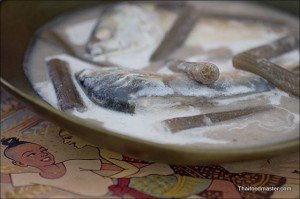
Thai Coconut Curry of Steamed Mackerels and Lotus Stems
(gaaeng gathi saai buaa bplaa thuu neung ;
แกงกะทิสายบัวปลาทูนึ่ง) This old-fashioned Thai coconut curry dish is a simple expression made with ingredients commonly available to Thais, it features steamed mackerels - the fish that Thai people probably love the best and the stems of the lotus flowers - one of Buddhism's most recognized motifs. The fish together with peeled lotus stems are boiled in coconut milk, to which a simple yet very aromatic curry paste, made only of white pepper corns, shallots and fermented shrimp paste is added.
(gaaeng gathi saai buaa bplaa thuu neung ;
แกงกะทิสายบัวปลาทูนึ่ง) This old-fashioned Thai coconut curry dish is a simple expression made with ingredients commonly available to Thais, it features steamed mackerels - the fish that Thai people probably love the best and the stems of the lotus flowers - one of Buddhism's most recognized motifs. The fish together with peeled lotus stems are boiled in coconut milk, to which a simple yet very aromatic curry paste, made only of white pepper corns, shallots and fermented shrimp paste is added.
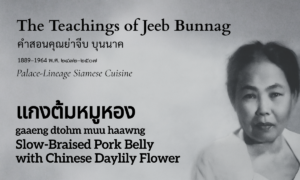
Slow-Braised Pork Belly with Chinese Daylily Flower (แกงต้มหมูหอง; gaaeng dtohm muu haawng)
Gaaeng dtohm muu haawng, pork belly slow-braised with Chinese daylily flower, star anise and tao chiao paste. From Jeeb Bunnag's 1933 Cookbook of Rice Companion Recipes.
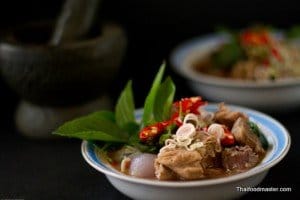
Beef Curry Seasoned with Fermented Shrimp Paste Chili Relish (แกงรัญจวน ; gaaeng ranjuaan)
Gaaeng Ranjuaan is spicy, sour, sweet and salty beef curry seasoned with no more than fermented shrimp paste chili sauce. It should be served steaming hot, and must possess three distinct flavors, similar to fish Tom Yam soup. These modest ingredients and an intensely-flavored curry emerge from a story about love, things lost in translation and…leftovers.
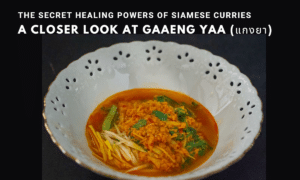
The Secret Healing Powers of Siamese Curries – A Closer Look at Gaaeng Yaa (แกงยา)
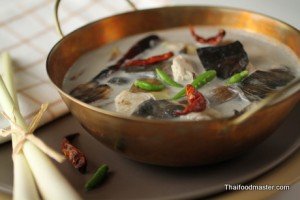
Fresh Coconut Milk Tom Yum Soup Recipe of Grilled Banana Blossom and Chicken
(dtohm yam gathi huaa bplee yang sai gai ;
ต้มยำกะทิหัวปลีย่างใส่ไก่) It will not be an overstatement to say that banana trees accompany Thai people from their birth to the afterlife. Starting with the decorative objects made out of banana leaves newborns receive to invite protective spirits, and continues their entire life with the endless uses for banana leaves, trunks and fruits; finally ending with the female spirit ghost, maae praai taanee (แม่พรายตานี), who resides in banana trees and Thai beliefs.
(dtohm yam gathi huaa bplee yang sai gai ;
ต้มยำกะทิหัวปลีย่างใส่ไก่) It will not be an overstatement to say that banana trees accompany Thai people from their birth to the afterlife. Starting with the decorative objects made out of banana leaves newborns receive to invite protective spirits, and continues their entire life with the endless uses for banana leaves, trunks and fruits; finally ending with the female spirit ghost, maae praai taanee (แม่พรายตานี), who resides in banana trees and Thai beliefs.
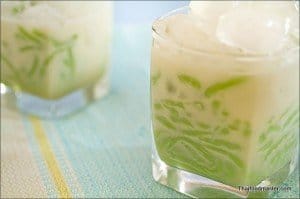
Lod Chong Recipe
Pandan Flavored Rice Flour Droplets in Sweetened Coconut Cream Syrup
(khanohm laawt chaawng naam gathi)
สูตรทำขนมลอดช่องน้ำกะทิ หรือ นกปล่อย Thai desserts are usually made from common ingredients and therefore very popular. However, it was only during the 17th century that desserts and sweets actually became part of everyday meals. In the old days, they were served only at auspicious occasions and ceremonies. During wedding ceremonies, for example, four kinds of sweets are usually served, collectively known as "the four plates dessert" (ขนมสี่ถ้วย ; khanohm see thuay). The ancient Thai expression "To eat four cups of dessert" (กินสี่ถ้วย ; gin see thuay ) used in the central region of the kingdom as an idiom referring to a wedding banquet.
Pandan Flavored Rice Flour Droplets in Sweetened Coconut Cream Syrup
(khanohm laawt chaawng naam gathi)
สูตรทำขนมลอดช่องน้ำกะทิ หรือ นกปล่อย Thai desserts are usually made from common ingredients and therefore very popular. However, it was only during the 17th century that desserts and sweets actually became part of everyday meals. In the old days, they were served only at auspicious occasions and ceremonies. During wedding ceremonies, for example, four kinds of sweets are usually served, collectively known as "the four plates dessert" (ขนมสี่ถ้วย ; khanohm see thuay). The ancient Thai expression "To eat four cups of dessert" (กินสี่ถ้วย ; gin see thuay ) used in the central region of the kingdom as an idiom referring to a wedding banquet.
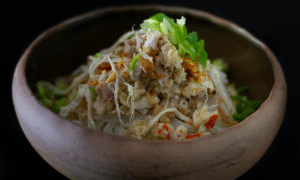
Naam Yaa Jeen - Fermented Rice Noodles with Chinese Sauce by HRH Prince Krom Luang Pitak Montri (น้ำยาจีน อย่างกรมหลวงพิทักษมนตรี)
Among the various curries that can be poured over khanom jeen fermented rice noodles, this broth, known as Chinese-style “naam yaa,” is unique in that it is a water-based curry that does not have chilies. As such, rather than the typical reddish-rust color of most coconut-based naam ya dishes from the Central Plains of the Kingdom, the sauce glows with a soft, light ivory hue, beautifully reflecting the dish’s natural sweet-savoriness, which is derived from slow-braising three proteins – chicken, pork and shrimp – along with a curry paste galvanized by smoke-dried fish and aromatic roots like galangal, fingerroot and sand ginger. The naam ya broth is served over a bed of fermented rice noodles and garnished with toppings such as delicate pulled chicken breast threads, golden-crispy fried shallots and garlic, and vivid green fresh coriander leaves and spring onion. All these elements add a visual grace and a hint of freshness to the robust broth – the signature dish of Prince Krom Luang Pitak Montri (กรมหลวงพิทักษ์มนตรี).
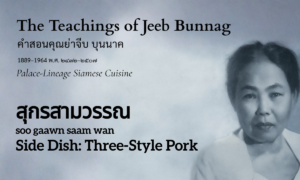
Three-Style Pork (สุกรสามวรรณ; soo gaawn saam wan)
Soo gaawn saam wan: fatty pork reduced three ways—fish sauce with palm sugar, garcinia leaf juice, and fermented bean curd. Jeeb Bunnag, 1933.
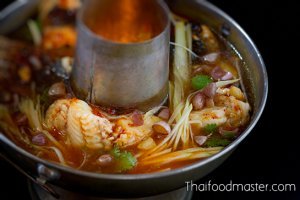
An Ancient Siamese Recipe for Tom Yum Soup (First Published in 1890). Sour Spicy Tom Yum Soup with Snakehead Fish, Roasted Chili Jam and Green Mango (Dtohm Yam Bplaa Chaawn, ต้มยำปลาช่อนแบบโบราณ อย่างหม่อมซ่มจีน ราชานุประพันธุ์ ร.ศ.๑๐๙)
Tom yum soup from the late 19th-century Siam to present days. Including a step-by-step recreation of tom yum soup with snakehead fish (dtohm yam bplaa chaawn, ตัมยำปลาช่อน) as recorded by Maawm Sohm Jeen (Raa Chaa Noopraphan) (หม่อมซ่มจีน, ราชานุประพันธุ์) in her book “Tam Raa Gap Khao” (ตำรากับเข้า), published in 1890 (2433 BE, 109RE).
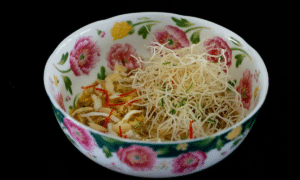
The Ambassador’s House Style Noodle Soup (หมี่น้ำบ้านราชทูต; Mee Naam Baan Raat Thuut)
This soup dish features crispy rice vermicelli noodles, a chicken broth that has a three-flavor profile infused with the aroma of bitter orange, and a plethora of other ingredients such as crispy fried tofu, chicken, pork, crab and pickled garlic.
In Thai, the phrase mee naam baan raat thuut refers to a rice vermicelli noodle soup in the style of the Ambassador’s house. The dish was not new when it appeared in the 1956 book Snacks, Tea Nibbles, Hors D’oeuvres and Drinking Food (ตำราอาหารว่าง - เครื่องน้ำชา และ เครื่องเคี้ยว หรือ กับแกล้ม) by Jeeb Bunnag (จีบ บุนนาค), as noodle dishes were often the preferred ingredient for light meals or snacks. In Grandparents Recipes: 100 Years Old Recipes (จานอร่อยจากปู่ย่า สูตรโบราณ 100 ปี), a volume printed in 2014 that highlights recipes from the kitchens of fifteen prominent families, a similar version of the dish is referred to as mee naam baan bpaak naai leert (หมี่น้ำบ้านปาร์คนายเลิศ) and is associated with Nai Lert.
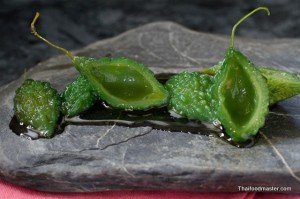
Jasmine Scented Candied Wild Bitter Gourd
(mara khee nohk cheuuam ; มะระขี้นกเชื่อม) Our ancestors, the early humans, had to base their food selection only on their senses. Sweet was energy, umami indicated the presence of proteins and saltiness was the sign for the much needed minerals. Generally, they avoided sour taste because it represented rotten or spoiled food, and bitter was the taste tonics and remedies were made of, and yes, it is now confirmed that bitter gourds are good for you.
(mara khee nohk cheuuam ; มะระขี้นกเชื่อม) Our ancestors, the early humans, had to base their food selection only on their senses. Sweet was energy, umami indicated the presence of proteins and saltiness was the sign for the much needed minerals. Generally, they avoided sour taste because it represented rotten or spoiled food, and bitter was the taste tonics and remedies were made of, and yes, it is now confirmed that bitter gourds are good for you.
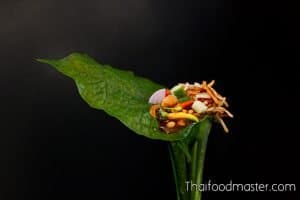
Miang kham - A royal leaf wrap appetizer เมี่ยงคำ
Each leaf-wrapped parcel is a kaleidoscope of flavors and richness, textures, aromas and sensations. Fresh green-earthy-chlorophyll-herby-tobacco-peppery wild betel leaves enfold bursts of flavor from nutty roasted peanuts and crispy roasted coconut matches, the umami of savory dry shrimp, pungent-sweet diced shallots, small ginger cubes with a warm bite, sour and bitter unpeeled lime cubes, citrusy perfumed diced bitter orange (som za), naughty whole fresh tiny bird’s eye chilies, and small slices of the sharp and sour dtaling bpling (Averrhoa bilimbi, a relative of the carambola/starfuit). All of which is blended with a thick paste of sweet-sour and salty palm sugar and tamarind sauce.
The miang kham takes every taste bud on a fascinating pleasure trip through sweetness, saltiness, sourness, bitterness, and umami, piquancy, sharpness and spiciness, with an array of textures that slowly subside as the journey ends, leading to a familiar post orgasmic expression, a smile and the desire for more.
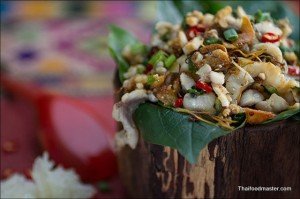
Luang Prabang Style Koi Fish Salad Recipe (Koi Pla)
(gaawy bplaa nin luang prabang ; สูตรทำก้อยปลานิลหลวงพระบาง) A marvelous Luang Prabang style fish salad recipe (Koi Pla), which is very easy to prepare and even though it looks simple, its flavors are complex and clever. Fresh fish fillet is sliced into thin strips which are quick blanched in lemongrass infused boiling water - a cooking method that presenting it’s natural flavors with an uplifting citrusy notes. The white fish slices are then mixed with, deep golden brown caramelized mix of fried garlic, shallots and lemongrass, which are not just visually pleasing but also add a unique sweetness and richness to the dish.
(gaawy bplaa nin luang prabang ; สูตรทำก้อยปลานิลหลวงพระบาง) A marvelous Luang Prabang style fish salad recipe (Koi Pla), which is very easy to prepare and even though it looks simple, its flavors are complex and clever. Fresh fish fillet is sliced into thin strips which are quick blanched in lemongrass infused boiling water - a cooking method that presenting it’s natural flavors with an uplifting citrusy notes. The white fish slices are then mixed with, deep golden brown caramelized mix of fried garlic, shallots and lemongrass, which are not just visually pleasing but also add a unique sweetness and richness to the dish.
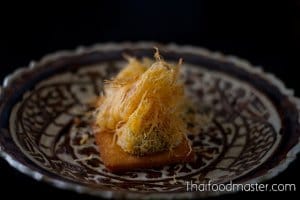
Khanohm faawy or Khanohm handtraa A Forgotten Thai Dessert and Snack ขนมฝอย หรือ ขนมหันตรา
Known as Khanohm faawy (ขนมฝอย) or Khanohm handtraa, this sweet or savory packet can be a dessert or a snack. The dessert has a sweet filling of silky mung beans and a coconut marzipan-like paste, while the snack’s savory filling consists of shrimp and pork minced and seasoned with garlic, coriander root and white peppercorns. Each is theatrically wrapped in a striking nest of skillfully crafted duck’s egg thread.
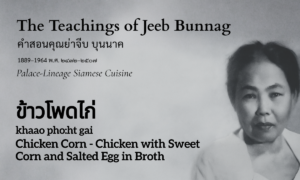
Chicken Corn (ข้าวโพดไก่; khaao pho:ht gai)
Chicken Corn, a delicate Thai snack where thinly sliced corn is simmered in chicken stock with shredded breast meat and salted egg yolk. From Jeeb Bunnag's 1933 cookbook.
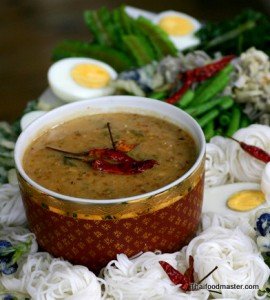
Rice Noodles with Shrimp and Aromatic Coconut Sauce
(khanohm jeen naam phrik goong; ขนมจีนน้ำพริกกุ้งสูตรมหาเด็ด) The sweet leading sour coconut cream based sauce, enriched and thickened with fragrant freshly roasted peanuts and golden beans are a wonderful coat to dress the sweet shrimp meat. The aromatics are being extracted in every possible way, by roasting, and frying, boiling and reducing, pounding and grounding. All the culinary methods are being fully employed to guarantee an absolute real first class dish. If you want to start some real Thai cooking going at your home, have the time and access to all the ingredients, than I really want you to try this dish. The building blocks of flavors work so well here and it will open you a great window to see the beginning of what is possible in Thai cuisine.
(khanohm jeen naam phrik goong; ขนมจีนน้ำพริกกุ้งสูตรมหาเด็ด) The sweet leading sour coconut cream based sauce, enriched and thickened with fragrant freshly roasted peanuts and golden beans are a wonderful coat to dress the sweet shrimp meat. The aromatics are being extracted in every possible way, by roasting, and frying, boiling and reducing, pounding and grounding. All the culinary methods are being fully employed to guarantee an absolute real first class dish. If you want to start some real Thai cooking going at your home, have the time and access to all the ingredients, than I really want you to try this dish. The building blocks of flavors work so well here and it will open you a great window to see the beginning of what is possible in Thai cuisine.
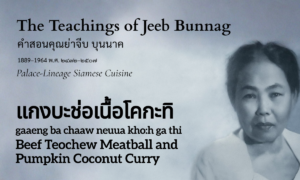
Beef Teochew Meatball and Pumpkin Coconut Curry (แกงบะช่อเนื้อโคกะทิ; gaaeng ba chaaw neuua kho:h ga thi)
Gaeng ba chaaw, Teochew-style beef meatballs seasoned with coriander root paste, simmered in coconut milk with pumpkin. Jeeb Bunnag, 1933.
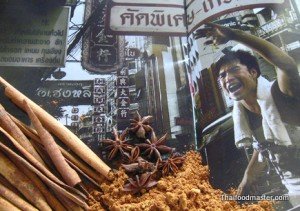
Moo Palo Recipe - Thai Eggs and Pork Chinese Five-Spice Fragrant Stew (สูตรทำไข่พะโล้หมูสามชั้นเห็ดหอม ; khai phalo muu saam chan het haawm)
This is an aromatic stew that leans into the sweet spectrum of the palate. An all-time Thai favorite, moo palo was introduced locally by the Chinese-Cantonese and Tae Chiew immigrants who flocked to the Kingdom in the early nineteenth century.
The name of this dish originates from two Chinese words: pah ziah and lou.
1
2
3

Get Access – Join Thaifoodmaster Today
Practical and kitchen-tested recipes with a mix of theory, history, psychology, and Siamese culture tidbits.
-
Get access to everything right away. Unlock more than 50 Masterclasses, over 700 recipes and Articles
Access to Thaifoodmaster’s constantly growing library of prime professional classes, articles, recipes and videos on Siamese culinary topics, available nowhere else in English.
-
GET EXTRA - New Masterclasses and Daily Recipes
Gain access to NEW masterclasses as they become available. Access DAILY translations of heritage-recipes.
-
1-1 support from Hanuman
1-1 support from Hanuman to help you achieve your professional Thai culinary goals
-
Live Q&A Sessions
The opportunity to join a monthly live two-hour videoconference where I can answer your questions.
-
Great Value!
one year access for the price of 3 days in-person training.
You will get everything you need to:
-
To Get inspired
When you design or build a new menu for an event or restaurant or even prepare for dinner with friends.
-
To Satisfy your curiosity.
Finally !
-
To Master Your Craft
Master your Thai cooking skills and expand your repertoire.
It is truly brilliant with a revolutionary approach introducing aspects and concepts never broached by cookbooks.

Ian Westcott
Sourcing Wines for Discerning Private Clients
© 2008 – 2026 Thaifoodmaster


