
Celebrating the Art of Siamese Culinary Wisdom and Thai Cuisine
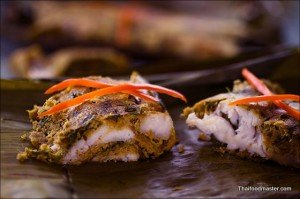
Rustic Grilled Thai Fish Curry in Banana Leaves (Snakehead Fish)
(ngohp bplaa chaawn ; งบปลาช่อน) I love this straightforward grilled Thai fish curry in banana leaves because it packs a punch with its aromatic curry mixture that embrace the white and tender fish meat with great flavors. It is a great addition for any Thai meal and very easy to prepare. Snakehead fish, traditionally caught from irrigation ditches or flooded rice fields, benefits from the aromatic curry paste because it helps to eliminate unpleasant odors which wild caught fishes might acquire from their muddy habitat. Nowadays though, it is commercially farmed and one can safely cook it in various ways with no risk of those undesirable odors.
(ngohp bplaa chaawn ; งบปลาช่อน) I love this straightforward grilled Thai fish curry in banana leaves because it packs a punch with its aromatic curry mixture that embrace the white and tender fish meat with great flavors. It is a great addition for any Thai meal and very easy to prepare. Snakehead fish, traditionally caught from irrigation ditches or flooded rice fields, benefits from the aromatic curry paste because it helps to eliminate unpleasant odors which wild caught fishes might acquire from their muddy habitat. Nowadays though, it is commercially farmed and one can safely cook it in various ways with no risk of those undesirable odors.
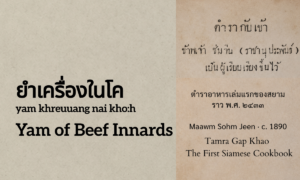
Yam of Beef Innards (ยำเครื่องในโค; yam khreuuang nai kho:h)
Yam khreuuang nai kho:h, beef innards cleaned with slaked lime and dressed without coconut. From Maawm Sohm Jeen's Tamra Gap Khao, c. 1890.
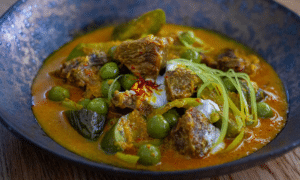
c1941 Magical beef curry (แกงเนื้อวิเศษ พ.ศ. 2484 ; gaaeng neuua wisaeht)
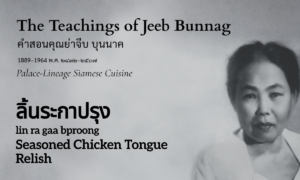
Seasoned Chicken Tongue Relish (ลิ้นระกาปรุง; lin ra gaa bproong)
Lin ra gaa bproong, pounded chicken tongue relish with ruaan shrimp and ginger, from Jeeb Bunnag's 1933 Cookbook of Rice Companion Recipes.
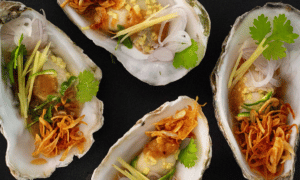
c1949 Quick-cured oysters with ginger and kaffir lime zest by Maawm Ying Soophaa (หอยนางรมดอง โดย หม่อมหญิงสุภา พ.ศ. 2492; haawy naang rohm daawng)
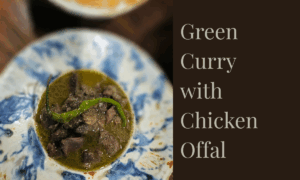
Yogurt-Based Ancient Green Curry with Chicken Offal (แกงเขียว; gaaeng khiaao)
Mrs. Yim Pichaiyat Bunnag (คุณยิ้ม พิชัยญาติ บุนนาค)'s 1920s aristocratic green curry reveals a forgotten chapter in Thai culinary history. This Muslim-style recipe uses ghee and yogurt instead of coconut milk, featuring chicken offal—liver, gizzard, and heart—each contributing distinct textures and concentrated flavors. Roasted spices like cinnamon, clove, and cardamom create warming aromatics, while fresh chilies provide signature heat. The dish documents how Bangkok's noble kitchens adapted Islamic cooking techniques before democratization, preserving methods that would shape modern Thai cuisine.
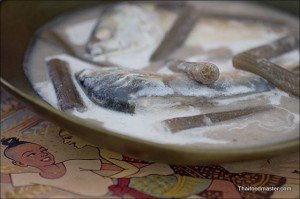
Thai Coconut Curry of Steamed Mackerels and Lotus Stems
(gaaeng gathi saai buaa bplaa thuu neung ;
แกงกะทิสายบัวปลาทูนึ่ง) This old-fashioned Thai coconut curry dish is a simple expression made with ingredients commonly available to Thais, it features steamed mackerels - the fish that Thai people probably love the best and the stems of the lotus flowers - one of Buddhism's most recognized motifs. The fish together with peeled lotus stems are boiled in coconut milk, to which a simple yet very aromatic curry paste, made only of white pepper corns, shallots and fermented shrimp paste is added.
(gaaeng gathi saai buaa bplaa thuu neung ;
แกงกะทิสายบัวปลาทูนึ่ง) This old-fashioned Thai coconut curry dish is a simple expression made with ingredients commonly available to Thais, it features steamed mackerels - the fish that Thai people probably love the best and the stems of the lotus flowers - one of Buddhism's most recognized motifs. The fish together with peeled lotus stems are boiled in coconut milk, to which a simple yet very aromatic curry paste, made only of white pepper corns, shallots and fermented shrimp paste is added.
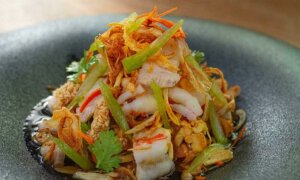
c1933 Sour bilimbi fruit and crispy candied peanut salad with pork, shrimp and pork fat (ยำตะลิงปลิง ; yam dtaling bpling)
A candied peanut bar might be considered an unlikely ingredient for an old-fashioned Siamese-style salad. Yet, peanut bars were familiar to the Siamese as early as the Ayutthaya period and were part of a broader set of Teochew Chinese sweets called, in Thai, “khanohm janap (ขนมจันอับ)”.
Gaaeng Khuaa Chicken with Shatavari (แกงคั่วไก่สามสิบ; gaaeng khuaa gai saam sip)
Gaaeng khuaa gai saam sip, chicken curry with young shatavari fruit; paste fried in rendered coconut oil. Jeeb Bunnag, 1933.
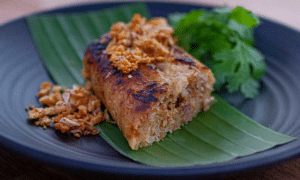
Khaao bping - grilled banana leaf parcels filled with fermented shrimp paste relish seasoned rice, sweet pork, and crispy garlic (ข้าวปิ้ง อย่างพระวิมาดาเธอ หม่อมเจ้าสาย ลดาวัลย์)
Khaao bping (ข้าวปิ้ง) is a dish of seasoned rice mixed with sweet pork and crispy fried garlic, then wrapped in banana leaves and grilled. Unwrapping the parcel reveals a slightly charred rice cake that melts into a pleasantly chewy, smoky, and deliciously savory treat. Created by using basic ingredients of Siamese cuisine, the dish can be served on a bed of banana leaves or on fine porcelain plates, thus touching the hearts of diners from all walks of life.
Yam of Chicken (ยำไก่; yam gai)
Yam gai: chicken simmered in coconut milk until dry, then dressed with mint, kaffir lime and green mango. Maawm Sohm Jeen, Tamra Gap Khao, 1890.
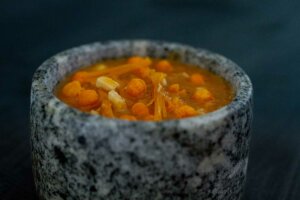
Chili relish of salted duck egg yolks (น้ำพริกไข่เค็ม ; naam phrik khai khem)
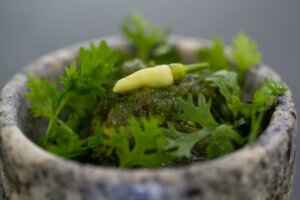
Chili relish of coriander leaves (น้ำพริกผักชี ; naam phrik phak chee)
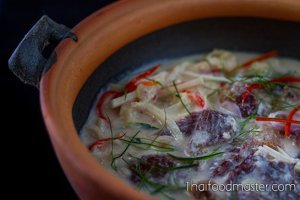
Coconut-Braised Sun-Dried Salted Beef with Bamboo Shoots (แกงต้มกะทิเนื้อโคเค็ม ; gaaeng dtohm gathi neuua khoh khem)
แกงต้มกะทิเนื้อโคเค็ม - In this dish, umami-charged, salted sun-dried beef is gently grilled over charcoal, adding smoke and caramelized elements that emerge in the core of the flavor profile, alongside the umami and the savor of fat. The meat is then cut into bite-size pieces, and slowly braised in thick coconut milk. The coconut fits perfectly onto the triangle of umami, fat and smoke. It brings its own umami and fatty shades, and introduces a rich sweetness that pairs seamlessly with the caramelized character of the grilled beef. The braising also rehydrates the beef and softens it. Bamboo shoots, shallots, galangal, lemongrass and kaffir lime leaves are added, perfecting the dish with a complementary sweetness, echoing the umami hues, and cutting citrusy notes while creating hidden astringent layers. The dish is finished with fresh chili peppers and hair-thin julienned kaffir lime for a fresh aroma and piquant bite.
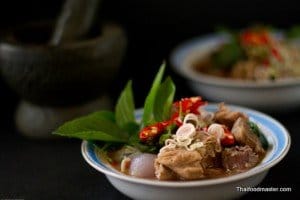
Beef Curry Seasoned with Fermented Shrimp Paste Chili Relish (แกงรัญจวน ; gaaeng ranjuaan)
Gaaeng Ranjuaan is spicy, sour, sweet and salty beef curry seasoned with no more than fermented shrimp paste chili sauce. It should be served steaming hot, and must possess three distinct flavors, similar to fish Tom Yam soup. These modest ingredients and an intensely-flavored curry emerge from a story about love, things lost in translation and…leftovers.
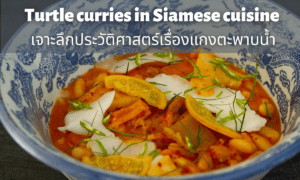
The complete story of turtle curries in Siamese cuisine (เจาะลึกประวัติศาสตร์เรื่องแกงตะพาบน้ำ)
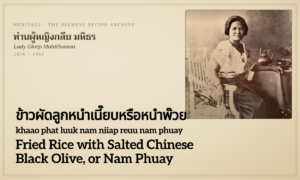
Fried Rice with Salted Chinese Black Olive, or Nam Phuay (ข้าวผัดลูกหนำเนี๊ยบหรือหนำพ๊วย; khaao phat luuk nam niiap reuu nam phuay)
Khao phat luk nam nieb: salted Chinese black olive, shelled and mashed fine, tossed through rice. Lady Gleep Mahithaawn, 1949.
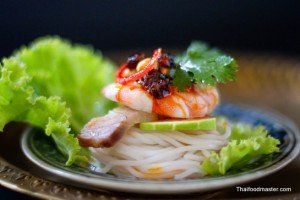
Fermented Rice Noodles, Shrimp and Pork Appetizer Dressed with Fried Chili Jam and Peanuts
(ขนมจีนญี่ปุ่น; Khanohm jeen Yee Poon) Khanohm jeen yee poon is an appetizer consisting of a small roll of fermented rice noodles laid on a green lettuce leaf and topped with a slice of cucumber and cooked shrimp and pork belly, dressed with sour-sweet and salty fried chili jam, sprinkled with roasted peanuts and decorated with coriander leaf and a thin julienne of fresh red chili pepper. A squeeze of fresh lime juice is applied just before eating the dish.
(ขนมจีนญี่ปุ่น; Khanohm jeen Yee Poon) Khanohm jeen yee poon is an appetizer consisting of a small roll of fermented rice noodles laid on a green lettuce leaf and topped with a slice of cucumber and cooked shrimp and pork belly, dressed with sour-sweet and salty fried chili jam, sprinkled with roasted peanuts and decorated with coriander leaf and a thin julienne of fresh red chili pepper. A squeeze of fresh lime juice is applied just before eating the dish.
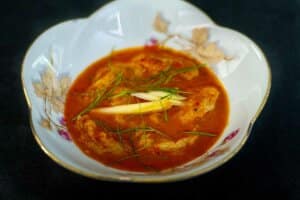
c1933 An Auspicious fish ball curry with two basils (แกงเผ็ดปลาเล็กปลาน้อย; gaaeng phet bplaa lek bplaa naawy)
Typically, in Central-style curries, different types of basil are not used together. In higher cuisine, it is an unstated – but understood – practice to avoid blending the definitive scents of various basils. A curry’s final herbal identity is intended to remain definitively with its basil: the citrus notes of holy basil; the spicy-woody and pungent flavor of tree basil; the tart fragrance of lemon basil; or the cooling anise sensation of Thai basil.

Swamp Eel Triple-Layered Red Curry with Fingerroot, Bitter Ginger, Sand Ginger and Thai Basil Flowers (แกงเผ็ดปลาไหลทรงเครื่อง ; Gaaeng Phet Bplaa Lai Sohng Khreuuang)
This eel curry includes a greater-than-usual quantity of aromatics used over three stages. First, the eel is cleaned and sliced into segments; then it is fried with a generous amount of lemongrass, galangal, kaffir lime leaves and shallots. These help to counter its muddy and somewhat iron-like odor, which disappears along with the liquids and the aromatics.
This eel curry recipe is adapted from the vintage book: “Gap Khaao O:H Chaa Roht” by Ging Ga Nohk) (กับข้าวโอชารส โดย กิ่งกนก – กาญจนาภา พ.ศ. 2485). This rare book was written in 1942 during WWII, a period of global turmoil in which Thailand was invaded by the Japanese. That same year marked a decade from the ending of absolute monarchy rule in 1932, and one generation away from the peak of the Siamese culinary renaissance that flourished in the court of King Rama V (1868-1910): a nostalgic era for its children who are still with us to remember and reflect on those times.
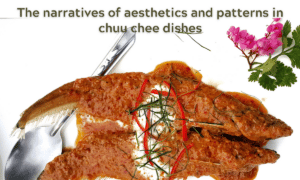
The Narratives of Aesthetics and Patterns in Chuu Chee Dishes (เรื่องฉู่ฉี่)
1
2
3
4
5
6
7
8
9
10

Get Access – Join Thaifoodmaster Today
Practical and kitchen-tested recipes with a mix of theory, history, psychology, and Siamese culture tidbits.
-
Get access to everything right away. Unlock more than 50 Masterclasses, over 700 recipes and Articles
Access to Thaifoodmaster’s constantly growing library of prime professional classes, articles, recipes and videos on Siamese culinary topics, available nowhere else in English.
-
GET EXTRA - New Masterclasses and Daily Recipes
Gain access to NEW masterclasses as they become available. Access DAILY translations of heritage-recipes.
-
1-1 support from Hanuman
1-1 support from Hanuman to help you achieve your professional Thai culinary goals
-
Live Q&A Sessions
The opportunity to join a monthly live two-hour videoconference where I can answer your questions.
-
Great Value!
one year access for the price of 3 days in-person training.
You will get everything you need to:
-
To Get inspired
When you design or build a new menu for an event or restaurant or even prepare for dinner with friends.
-
To Satisfy your curiosity.
Finally !
-
To Master Your Craft
Master your Thai cooking skills and expand your repertoire.
It is truly brilliant with a revolutionary approach introducing aspects and concepts never broached by cookbooks.

Ian Westcott
Sourcing Wines for Discerning Private Clients
© 2008 – 2026 Thaifoodmaster


