
Celebrating the Art of Siamese Culinary Wisdom and Thai Cuisine
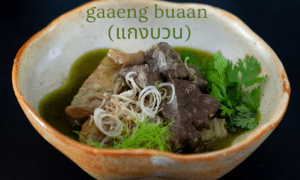
The Story of Gaaeng Buaan (แกงบวน) – The Oldest Siamese Dish?
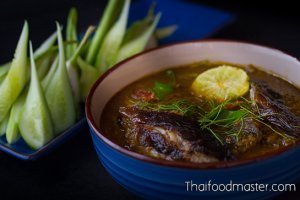
Southern Thai Ancient Fermented Fish Innards Curry with Grilled Catfish (แกงไตปลาปลาดุกย่างโบราณ ; gaaeng dtai bplaa bplaa dook yaang)
แกงไตปลาปลาดุกย่างโบราณ - Fermented fish innards curry is a dense curry made of fermented fish innards is dark coffee-brown in color – a salty, fiery hot dish, it grips the palate in an intense umami embrace. As the flagship dish in the repertoire of spicy southern Thai cuisine, it comes in different versions: some are water based; some have a base of coconut cream. But whatever the style, it is a fiercely hot dish that features both dried and fresh chilies.
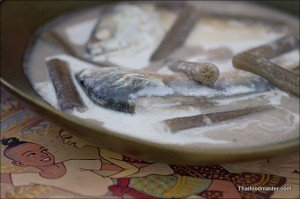
Thai Coconut Curry of Steamed Mackerels and Lotus Stems
(gaaeng gathi saai buaa bplaa thuu neung ;
แกงกะทิสายบัวปลาทูนึ่ง) This old-fashioned Thai coconut curry dish is a simple expression made with ingredients commonly available to Thais, it features steamed mackerels - the fish that Thai people probably love the best and the stems of the lotus flowers - one of Buddhism's most recognized motifs. The fish together with peeled lotus stems are boiled in coconut milk, to which a simple yet very aromatic curry paste, made only of white pepper corns, shallots and fermented shrimp paste is added.
Chili Choices in Curry - Crafting Flavor, Heat, and Aroma
The type of chilies – fresh, dried or rehydrated – and how they are processed into the curry paste have a significant influence on the dish’s flavor, color, aroma and heat profile. Fresh chilies inject an immediate, sharp spike of heat that rushes in with a piercing, punctuating intensity, a grassy aroma and fruity liveliness. Dried chilies, on the other hand, impart a subtle warmth alongside rich, earthy notes that gradually build up into a steady, lingering burn. The choice of the chili variety will also shape the curry’s flavor. Through an informed selection and processing of chilies, cooks can navigate between mild and spicy, fruity and earthy, and bright and mellow flavors, creating a complex and nuanced heart for their curries.

Into The Woods – The Story of Jungle Curry (แกงป่า; gaaeng bpaa)
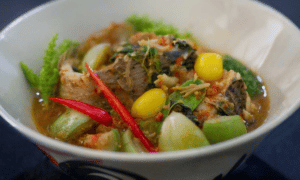
Kanchanaburi-Style Snakehead Fish Jungle Curry with Bitter Yellow Eggplants (แกงป่าปลา ; gaaeng bpaa bplaa)
This recipe is adapted from a recipe I obtained from a jungle food restaurant in Kanchanaburi province. The paste is a downgrade of a phrik khing paste – it omits the coriander roots and shallots. In addition, the recipe substitutes the fermented shrimp paste (kapi) with maawn fermented fish paste (กะปิมอญ; gabpi maawn), which is a popular ingredient among the Mon-Burmese population of the western province. The lack of shallots eliminates any sweetness that might impair the sharpness and heat of the dish. Furthermore, a double hit of citrus notes from holy basil are infused into the dish: from the holy basil flowers added to the paste and the holy basil leaves added to the curry.
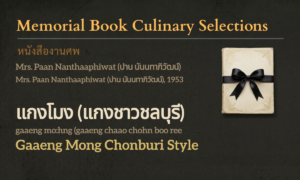
Gaaeng Mong (Chonburi-Style Curry) (แกงโมง (แกงชาวชลบุรี); gaaeng mo:hng (gaaeng chaao chohn boo ree))
Gaaeng Mong, a Chonburi regional curry with fermented shrimp paste, grilled catfish, and young watermelon. From Mrs. Paan Nanthaaphiwat, 1953.
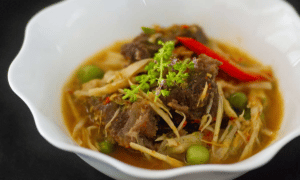
Saen Tung-Style Jungle Curry with Beef and Bamboo Shoots (แกงป่าเนื้อใส่หน่อไม้ แบบแสนตุ้ง; gaaeng bpaa neuua sai naaw mai baaep saaen dtoong)
This is my take on the famous jungle curry from the Saen Tung district in Trat province. In Trat it is usually cooked with game meat and thinly sliced pineapple shoots (แขนงสับปะรด).
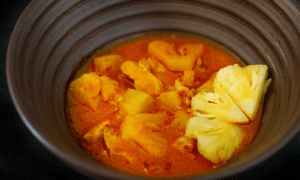
c1933 Manifold flavors curry – a chicken and pineapple spicy curry (แกงเผ็ดหลากหลายรส; gaaeng phet laak laai roht)
At first glance, this chicken and pineapple curry might seem ordinary or plain. After all, even though spicy curries with sour notes have been relished for ages, they feature repetitive patterns that could be viewed as common and perhaps uninteresting. However, with a calculated yet simple approach, this curry turns corners – quite literally – into a dish with a new flavor melody. It is thus referred to by its author, Mrs. Samaknantapol (Jeep Bunnag) (นางสมรรคนันทพล, จีบ บุนนาค), as laak laai roht, a “curry with manifold flavors (หลากหลายรส)”.
The Art of Siamese Duck Curries - Theory and Practice (แกงเป็ด - ศิลปะ ทฤษฎี และ การปฏิบัติ)
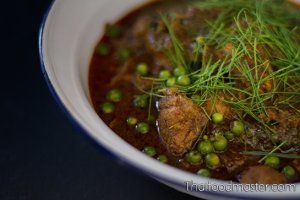
Roasted Southern Thai Curry of Pork, Three Peppers and Young Galangal (แกงเผ็ดลูกทุ่งภาคใต้ ; gaaeng phet luuk thoong phaak dtai)
This profoundly spicy, chestnut-colored pork curry radiates a pungent slow-burning heat from generous amounts of roasted black pepper, along with long peppers and naughty charred dry chili peppers. The curry’s aroma is concentrated even further by roasting the ingredients prior to pounding them - a process that shaves the high notes of the curry and provides a low-pitched intensity that lasts far beyond each bite.
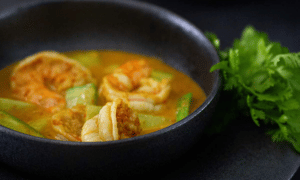
c1889 Garee Curry with Shrimp and Cucumber (แกงกะหรี่กุ้งกับแตงกวา; gaaeng garee goong gap dtaaeng gwaa)
In this old-fashioned coconut-based curry, orangey shrimp and bright green cucumber shine in a golden haze of curry powder, caressed by the light breeze of Indian flare. Cucumbers are used in traditional Ayurvedic medicine as a coolant, to offset internal heat and to resolve fevers. Thus, like a refreshing oasis in the middle of a shimmering desert, the cucumber counterbalances the chili’s internal heat energy and mellows the fragrant, earthy undertones of the spice blend in the dish.

Minced-Bird Style Curries - A Peek Into Traditional Ingredients and Cooking Methods (แกงสับนก; Gaaeng Sap Nohk)
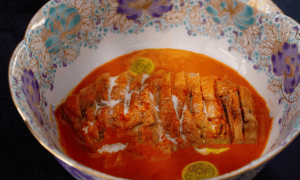
Pan Roasted Duck Breast and Hairy-Fruited Eggplant Curry (แกงเป็ดคั่วมะอึก; gaaeng bpet khuaa maeuk)
The hairy-fruited eggplant, known as ‘maeuk’ in Thai, is similar to the tomato in its unique confluence of sweetness, fruitiness, and savoriness. This ingredient is used in a wide range of Siamese dishes, including curries, salads, relishes, and seasoned rice dishes. This recipe, from the central region of Thailand, is a traditional duck khuaa sohm curry (แกงคั่วส้มเป็ด) that commonly uses garden ingredients to achieve sourness, including the madan (garcinia schomburgkiana) (มะดัน), the sour bilimbi fruit (averrhoa bilimbi) (ตะลิงปลิง), and the hairy-fruited eggplant.
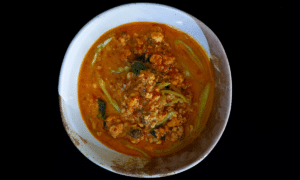
Minced-Bird Curry with Fish (ปลาช่อนแกงนก; Bplaa Chaawn Gaaeng Nohk)
Lady Plean Passakornrawong’s historic, first-ever recipe for minced-bird curry with snakehead fish revives the old minced-bird curry syle. The fish is minced and cooked with the curry paste, producing a hearty and comforting thick-textured curry.
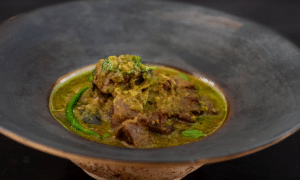
Perfumed Muslim-style Curry of Fresh Chilies with Beef (แกงเขียวหวานเนื้อทรงเครื่อง; Gaaeng Khiaao Waan Neuua Sohng Khreuuang)
The Indian and Muslim cuisines present distinct approaches to using dried spices in curries, both of which influence Siamese cuisine in different ways. Indian-inspired Siamese curries spotlight chilies for their vibrant color, fragrance, flavor and heat, while spices like cumin and coriander play a supporting role. The spices complement and temper the chilies’ intensity, creating a rounded, multi-layered flavor profile; nonetheless, the chilies remain the star ingredient, gently complemented by the spices.
Conversely, Muslim-influenced curries, such as massaman curry, prioritize spices over chilies. Spices like cardamom, nutmeg and mace take center stage, while the chilies provide subtle background heat rather than being the primary flavor. In these curries, the focus is on the rich, warm and complex aromas created by the blend of spices, which is a defining characteristic of many Muslim dishes.
Moreover, Siamese cuisine favors using rehydrated dried chilies in curries for their depth; this depth is highly appreciated, along with the complexity, and comparatively milder heat of the rehydrated dried chilies. As well, the harsh grassy notes of fresh chilies are not favored; they’re referred to in Thai as “green rank” or “men khiaao (เหม็นเขียว)”. Muslim curries often use fresh green chilies, tempering their vibrant, grassy taste with dry spices and thus shifting the flavor from bright and fresh to more subdued and earthy tones, resulting in a dish that is perceived to be layered, despite the burst of fresh chilies.
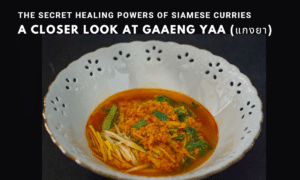
The Secret Healing Powers of Siamese Curries – A Closer Look at Gaaeng Yaa (แกงยา)
Patterns – Decoding the Complexity of Siamese Curry Paste: A Multidimensional Exploration
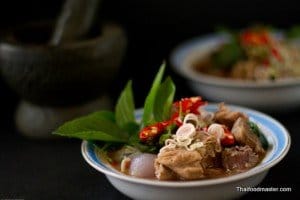
Beef Curry Seasoned with Fermented Shrimp Paste Chili Relish (แกงรัญจวน ; gaaeng ranjuaan)
Gaaeng Ranjuaan is spicy, sour, sweet and salty beef curry seasoned with no more than fermented shrimp paste chili sauce. It should be served steaming hot, and must possess three distinct flavors, similar to fish Tom Yam soup. These modest ingredients and an intensely-flavored curry emerge from a story about love, things lost in translation and…leftovers.
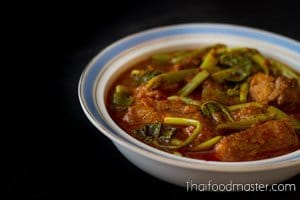
Thae Phoh Curry with Pork Neck and Water Spinach (แกงหมูเทโพใส่ผักบุ้ง ; Gaaeng Muu Thaeh Phoh Sai Phak Boong)
แกงหมูเทโพใส่ผักบุ้ง - Thae phoh curry is a spicy and salty Thai red curry with sour-sweet flavor shades. Thae phoh falls into the category of the gaaeng khuaa (แกงคั่ว) style of Thai red curries, as it contains no dry spices except white peppercorns. Instead, smoked dried fish meat is added to the red curry paste to accentuate and widen its umami-smoky savory flavor base.
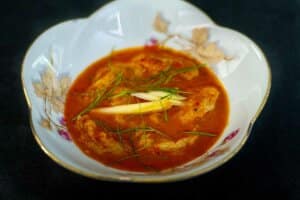
c1933 An Auspicious fish ball curry with two basils (แกงเผ็ดปลาเล็กปลาน้อย; gaaeng phet bplaa lek bplaa naawy)
Typically, in Central-style curries, different types of basil are not used together. In higher cuisine, it is an unstated – but understood – practice to avoid blending the definitive scents of various basils. A curry’s final herbal identity is intended to remain definitively with its basil: the citrus notes of holy basil; the spicy-woody and pungent flavor of tree basil; the tart fragrance of lemon basil; or the cooling anise sensation of Thai basil.
1
2
3
Get Access – Join Thaifoodmaster Today
Practical and kitchen-tested recipes with a mix of theory, history, psychology, and Siamese culture tidbits.
-
Get access to everything right away. Unlock more than 50 Masterclasses, over 700 recipes and Articles
Access to Thaifoodmaster’s constantly growing library of prime professional classes, articles, recipes and videos on Siamese culinary topics, available nowhere else in English.
-
GET EXTRA - New Masterclasses and Daily Recipes
Gain access to NEW masterclasses as they become available. Access DAILY translations of heritage-recipes.
-
1-1 support from Hanuman
1-1 support from Hanuman to help you achieve your professional Thai culinary goals
-
Live Q&A Sessions
The opportunity to join a monthly live two-hour videoconference where I can answer your questions.
-
Great Value!
one year access for the price of 3 days in-person training.
You will get everything you need to:
-
To Get inspired
When you design or build a new menu for an event or restaurant or even prepare for dinner with friends.
-
To Satisfy your curiosity.
Finally !
-
To Master Your Craft
Master your Thai cooking skills and expand your repertoire.
It is truly brilliant with a revolutionary approach introducing aspects and concepts never broached by cookbooks.

Ian Westcott
Sourcing Wines for Discerning Private Clients
© 2008 – 2026 Thaifoodmaster


