
Celebrating the Art of Siamese Culinary Wisdom and Thai Cuisine
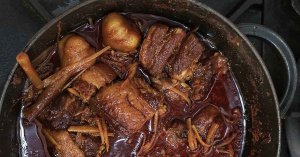
Northern Style Hang Lay Curry (gaaeng hang laeh muu ; แกงฮังเลหมู)
This recipe comes all the way from India through the northern Burmese border. The masala spice mix is still sold in small packages with retro looking prints that seem to forever exist.
There is no way in a recipe to communicate what's going on in here; a thick red chili paste marinate, that bursts in orange turmeric color, provides the perfect seen to the tender, almost falling apart, pork meat.
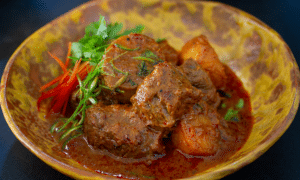
Perfumed Braised Beef and Potato Curry with Three Gingers, Thai Basil and Bitter Orange (แกงเนื้อใส่เปราะหอมสดและส้มซ่า; Gaaeng Neuua Sai Bpraw Haawm Soht Lae Sohm Saa)
Discovered in a memorial book for the funeral of SubLt. Soophoht Jeungpraphaa (ร.ต. สุพจน์ จึงประภา) (1925-1966), this beef and potato curry dish unites two distinct curry styles: Massaman curry, known for its sweet and warming complexity of dry spices, punctuated by the vibrancy of bitter orange juice; and gaaeng phet (แกงเผ็ด) spicy curry, dominated by a basil herbal identity. The recipe maintains a sense of traditional elegance despite the startlingly unusual culinary fusion; as these two cooking styles are woven together, their spiced comfort, earthy warmth, citrusy freshness, and cool herbaceous notes meld in a gentle refinement. Drawing upon familiar and novel elements, this curry is both comforting and stimulating.
Massaman curry typically presents as a deep, rich dish. Its unique flavor profile is derived predominantly from a range of dry spices that point to its Persian-inspired roots in Siamese cuisine, along with a curry paste that exudes a sense of freshness. The dried chilis are roasted to deepen their color; the rest of the ingredients, such as the shallots, garlic and dry spices, are roasted too, individually, before being pounded into the paste. Conversely, the gaaeng phet (แกงเผ็ด) curry integrates dry spices more sparingly and is known for flavor qualities that are based on a phrik khing (พริกขิง) paste made of fresh aromatics and a basil herbal identity.

Swamp Eel Triple-Layered Red Curry with Fingerroot, Bitter Ginger, Sand Ginger and Thai Basil Flowers (แกงเผ็ดปลาไหลทรงเครื่อง ; Gaaeng Phet Bplaa Lai Sohng Khreuuang)
This eel curry includes a greater-than-usual quantity of aromatics used over three stages. First, the eel is cleaned and sliced into segments; then it is fried with a generous amount of lemongrass, galangal, kaffir lime leaves and shallots. These help to counter its muddy and somewhat iron-like odor, which disappears along with the liquids and the aromatics.
This eel curry recipe is adapted from the vintage book: “Gap Khaao O:H Chaa Roht” by Ging Ga Nohk) (กับข้าวโอชารส โดย กิ่งกนก – กาญจนาภา พ.ศ. 2485). This rare book was written in 1942 during WWII, a period of global turmoil in which Thailand was invaded by the Japanese. That same year marked a decade from the ending of absolute monarchy rule in 1932, and one generation away from the peak of the Siamese culinary renaissance that flourished in the court of King Rama V (1868-1910): a nostalgic era for its children who are still with us to remember and reflect on those times.
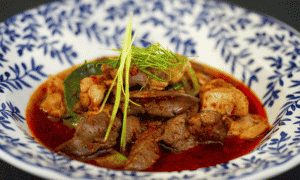
c1933 Water-based spicy curry of fatty chicken and seven spices (แกงเผ็ดไก่น้ำมัน พ.ศ. 2476; gaaeng phet gai naam man)
This water-based, spicy chicken curry is made with corn-yellow rendered chicken fat instead of coconut cream. Dark reddish-brown in color, this full-bodied and fatty beak-to-tail curry presents the chicken identity and personality in both a corporeal and tasty manner. Spices such as cardamom, nutmeg, mace and clove are added into the curry paste to temper the gamey-irony flavor of the offal and deodorize the meat, resulting in a luscious dish that is beautifully layered with textures and flavors.
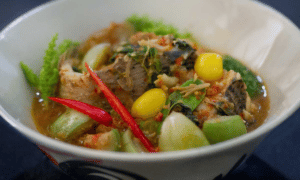
Kanchanaburi-Style Snakehead Fish Jungle Curry with Bitter Yellow Eggplants (แกงป่าปลา ; gaaeng bpaa bplaa)
This recipe is adapted from a recipe I obtained from a jungle food restaurant in Kanchanaburi province. The paste is a downgrade of a phrik khing paste – it omits the coriander roots and shallots. In addition, the recipe substitutes the fermented shrimp paste (kapi) with maawn fermented fish paste (กะปิมอญ; gabpi maawn), which is a popular ingredient among the Mon-Burmese population of the western province. The lack of shallots eliminates any sweetness that might impair the sharpness and heat of the dish. Furthermore, a double hit of citrus notes from holy basil are infused into the dish: from the holy basil flowers added to the paste and the holy basil leaves added to the curry.
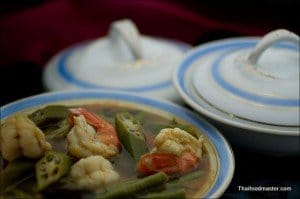
Gaeng Som Recipe, Thai Sour Curry Recipe of Shrimp, Okra and Roselle Leaves
(gaeng som maawn gra jiiap goong)
สูตรทำแกงส้มมอญกระเจี๊ยบกุ้ง Gaeng som recipe: Sour curries are without doubt one of Thai cuisine all-time favorites, free from foreign influence and with many regional variations they present a complex balance of four flavors while using only few ingredients, all find a pleasing harmony in one dish. There are the sourness of the tamarind paste, the saltiness of the fermented shrimp paste and fish sauce, the natural sweetness of the prawns and the vegetables and of course the peppery heat from the chilies. This easy curry paste is as rich as it is simple; the flavor offers a world of depth in a truly innovative combination of flavors.
(gaeng som maawn gra jiiap goong)
สูตรทำแกงส้มมอญกระเจี๊ยบกุ้ง Gaeng som recipe: Sour curries are without doubt one of Thai cuisine all-time favorites, free from foreign influence and with many regional variations they present a complex balance of four flavors while using only few ingredients, all find a pleasing harmony in one dish. There are the sourness of the tamarind paste, the saltiness of the fermented shrimp paste and fish sauce, the natural sweetness of the prawns and the vegetables and of course the peppery heat from the chilies. This easy curry paste is as rich as it is simple; the flavor offers a world of depth in a truly innovative combination of flavors.
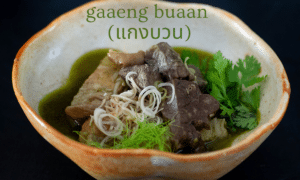
The Story of Gaaeng Buaan (แกงบวน) – The Oldest Siamese Dish?
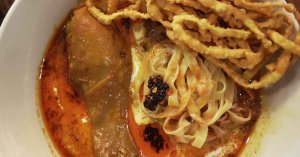
Khao Soi Recipe, Northern Style Curried Noodle Soup with Chicken
(khaao saawy gai ; สูตรทำข้าวซอยไก่) This dish (Khao Soi Recipe) takes us back in time to the mid-19th century. The trade caravans were trailing the jungles of northern Thailand along the ancient routes between India and China. Those long caravans were carrying wealth of exotic goods, leaving rich aroma of spices and the sweet scent of opium as they passed. The men on this long line of between fifty and one hundred mules would be Yunnanese Muslim Chinese, who dominated the trade routes and began to settle in Chiang Mai and the main towns of north Thailand at that time.
(khaao saawy gai ; สูตรทำข้าวซอยไก่) This dish (Khao Soi Recipe) takes us back in time to the mid-19th century. The trade caravans were trailing the jungles of northern Thailand along the ancient routes between India and China. Those long caravans were carrying wealth of exotic goods, leaving rich aroma of spices and the sweet scent of opium as they passed. The men on this long line of between fifty and one hundred mules would be Yunnanese Muslim Chinese, who dominated the trade routes and began to settle in Chiang Mai and the main towns of north Thailand at that time.
Curry Paste Permeability
Thai Curries: The Professional Chef's Guide - แกงไทย
Aromatic Alchemy - The Art and Science of Pounded Curry Pastes
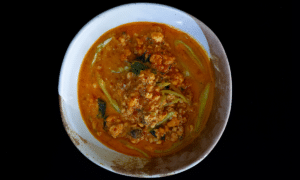
Minced-Bird Curry with Fish (ปลาช่อนแกงนก; Bplaa Chaawn Gaaeng Nohk)
Lady Plean Passakornrawong’s historic, first-ever recipe for minced-bird curry with snakehead fish revives the old minced-bird curry syle. The fish is minced and cooked with the curry paste, producing a hearty and comforting thick-textured curry.
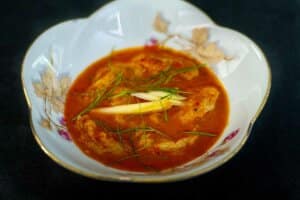
c1933 An Auspicious fish ball curry with two basils (แกงเผ็ดปลาเล็กปลาน้อย; gaaeng phet bplaa lek bplaa naawy)
Typically, in Central-style curries, different types of basil are not used together. In higher cuisine, it is an unstated – but understood – practice to avoid blending the definitive scents of various basils. A curry’s final herbal identity is intended to remain definitively with its basil: the citrus notes of holy basil; the spicy-woody and pungent flavor of tree basil; the tart fragrance of lemon basil; or the cooling anise sensation of Thai basil.
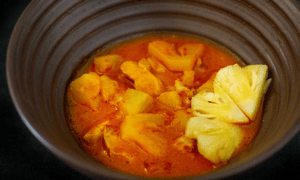
c1933 Manifold flavors curry – a chicken and pineapple spicy curry (แกงเผ็ดหลากหลายรส; gaaeng phet laak laai roht)
At first glance, this chicken and pineapple curry might seem ordinary or plain. After all, even though spicy curries with sour notes have been relished for ages, they feature repetitive patterns that could be viewed as common and perhaps uninteresting. However, with a calculated yet simple approach, this curry turns corners – quite literally – into a dish with a new flavor melody. It is thus referred to by its author, Mrs. Samaknantapol (Jeep Bunnag) (นางสมรรคนันทพล, จีบ บุนนาค), as laak laai roht, a “curry with manifold flavors (หลากหลายรส)”.
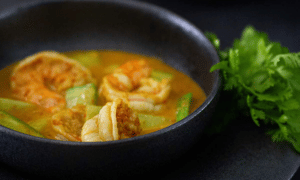
c1889 Garee Curry with Shrimp and Cucumber (แกงกะหรี่กุ้งกับแตงกวา; gaaeng garee goong gap dtaaeng gwaa)
In this old-fashioned coconut-based curry, orangey shrimp and bright green cucumber shine in a golden haze of curry powder, caressed by the light breeze of Indian flare. Cucumbers are used in traditional Ayurvedic medicine as a coolant, to offset internal heat and to resolve fevers. Thus, like a refreshing oasis in the middle of a shimmering desert, the cucumber counterbalances the chili’s internal heat energy and mellows the fragrant, earthy undertones of the spice blend in the dish.
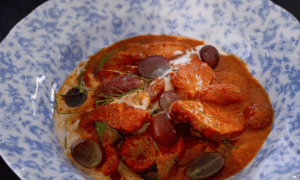
c1941 Roasted Duck Curry with Grapes (Gaaeng Ho) (แกงเป็ดเหาะใส่องุ่น อย่างคุณถนอม ปาลบุตร พ.ศ. 2484; gaaeng bpet haw sai angoon)
Grapes have long been associated with prosperity, fertility and abundance across various cultures and historical periods due to the fruit’s large clusters and bountiful growth. In ancient China, grapes were considered a symbol of wealth and nobility, and often deployed as a status symbol among the elite. In Greek mythology, Dionysus, the god of wine and fertility, was often depicted holding a bunch of grapes, further emphasizing the connection between grapes and abundance. This association is also likely rooted in the fact that grapes were a valuable crop in antiquity – used to produce wine and other fermented products, and an important source of food and nutrition. In Indian Ayurvedic texts, grapes are referred to as vineaksha and utilized in treating a variety of ailments, including fever and indigestion.
From the Siamese perspective, the incorporation of fruits in culinary preparations was viewed as a luxurious indulgence, as many fruits commonly available today were once difficult to obtain. Thus the pairing of an extravagant ingredient – such as fruit – with an equally opulent and exclusive delicacy like roasted duck resulted in a dish fit for royalty.
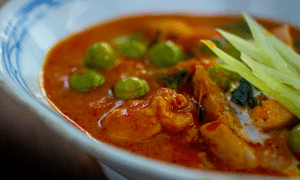
c1941 Old-Fashioned spicy curry of chicken with young chilies (แกงเผ็ดแบบโบราณอย่างคุณถนอม ปาลบุตร พ.ศ. 2484 ; gaaeng phet baaep bo:h raan)
This is a classical Siamese spicy curry that displays a spicy, salty and sweet flavor profile, and uses common curry ingredients such as pea eggplants and young green chilies with an interesting dry spice profile.
Patterns – Decoding the Complexity of Siamese Curry Paste: A Multidimensional Exploration
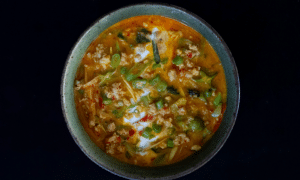
Pork and Three Beans Minced-Bird Style Curry with Fingerroot and Holy Basil (แกงคั่วหมูสับถั่วพู; Gaaeng Muu Sap Thuaa Phuu)
This contemporary minced-bird style curry uses pork rather than bird. However, since thicker, meatier curries have become associated in modern Thai cuisine with the bold presence of fingerroot – for example, in dishes such as fermented rice noodles in naam yaa thick fish curry (khanohm jeen naam yaa (ขนมจีนน้ำยา)) – this dish adopts the penetrating aromatic character of fingerroot along with the clove-like warmth of holy basil.
Like crisp footsteps in a forest, this satisfyingly meaty curry features vibrant fresh red chilies and thinly sliced yardlong beans and winged beans. It is suitable to serve with rice or with fermented rice noodles (khanom jeen paeng mak), conveying an aromatic upcountry flair.
Chili Choices in Curry - Crafting Flavor, Heat, and Aroma
The type of chilies – fresh, dried or rehydrated – and how they are processed into the curry paste have a significant influence on the dish’s flavor, color, aroma and heat profile. Fresh chilies inject an immediate, sharp spike of heat that rushes in with a piercing, punctuating intensity, a grassy aroma and fruity liveliness. Dried chilies, on the other hand, impart a subtle warmth alongside rich, earthy notes that gradually build up into a steady, lingering burn. The choice of the chili variety will also shape the curry’s flavor. Through an informed selection and processing of chilies, cooks can navigate between mild and spicy, fruity and earthy, and bright and mellow flavors, creating a complex and nuanced heart for their curries.
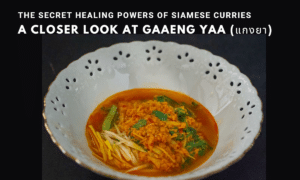
The Secret Healing Powers of Siamese Curries – A Closer Look at Gaaeng Yaa (แกงยา)
1
2
3

Get Access – Join Thaifoodmaster Today
Practical and kitchen-tested recipes with a mix of theory, history, psychology, and Siamese culture tidbits.
-
Get access to everything right away. Unlock more than 50 Masterclasses, over 700 recipes and Articles
Access to Thaifoodmaster’s constantly growing library of prime professional classes, articles, recipes and videos on Siamese culinary topics, available nowhere else in English.
-
GET EXTRA - New Masterclasses and Daily Recipes
Gain access to NEW masterclasses as they become available. Access DAILY translations of heritage-recipes.
-
1-1 support from Hanuman
1-1 support from Hanuman to help you achieve your professional Thai culinary goals
-
Live Q&A Sessions
The opportunity to join a monthly live two-hour videoconference where I can answer your questions.
-
Great Value!
one year access for the price of 3 days in-person training.
You will get everything you need to:
-
To Get inspired
When you design or build a new menu for an event or restaurant or even prepare for dinner with friends.
-
To Satisfy your curiosity.
Finally !
-
To Master Your Craft
Master your Thai cooking skills and expand your repertoire.
It is truly brilliant with a revolutionary approach introducing aspects and concepts never broached by cookbooks.

Ian Westcott
Sourcing Wines for Discerning Private Clients
© 2008 – 2026 Thaifoodmaster


