
Celebrating the Art of Siamese Culinary Wisdom and Thai Cuisine
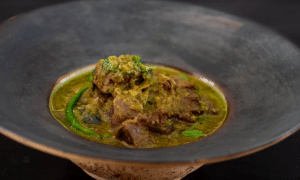
Perfumed Muslim-style Curry of Fresh Chilies with Beef (แกงเขียวหวานเนื้อทรงเครื่อง; Gaaeng Khiaao Waan Neuua Sohng Khreuuang)
The Indian and Muslim cuisines present distinct approaches to using dried spices in curries, both of which influence Siamese cuisine in different ways. Indian-inspired Siamese curries spotlight chilies for their vibrant color, fragrance, flavor and heat, while spices like cumin and coriander play a supporting role. The spices complement and temper the chilies’ intensity, creating a rounded, multi-layered flavor profile; nonetheless, the chilies remain the star ingredient, gently complemented by the spices.
Conversely, Muslim-influenced curries, such as massaman curry, prioritize spices over chilies. Spices like cardamom, nutmeg and mace take center stage, while the chilies provide subtle background heat rather than being the primary flavor. In these curries, the focus is on the rich, warm and complex aromas created by the blend of spices, which is a defining characteristic of many Muslim dishes.
Moreover, Siamese cuisine favors using rehydrated dried chilies in curries for their depth; this depth is highly appreciated, along with the complexity, and comparatively milder heat of the rehydrated dried chilies. As well, the harsh grassy notes of fresh chilies are not favored; they’re referred to in Thai as “green rank” or “men khiaao (เหม็นเขียว)”. Muslim curries often use fresh green chilies, tempering their vibrant, grassy taste with dry spices and thus shifting the flavor from bright and fresh to more subdued and earthy tones, resulting in a dish that is perceived to be layered, despite the burst of fresh chilies.
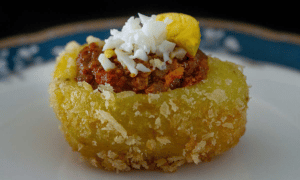
c1935 Stuffed Potatoes with Bitter Orange Fragrant Beef Gaaeng Garee (แกงกะหรี่บรรจุมัน ม.ล. เติบ กำภู ; gaaeng garee ban joo man)
In Anglo-Indian cuisine, potatoes were used liberally in the curries; alongside the favorite sour chutneys, curries were also accompanied by fried, baked, boiled or mashed potatoes. Although the potato gradually found its way into many iconic Indian dishes, and even into Siamese cuisine, the tuber never replaced the rice of South Asia, despite the intentions of both the British and East Indian company officials.
In the 1935 book Sai Yaowapa (ตำรับสายเยาวภา), Princess Yaovabha Bongsanid (พระเจ้าบรมวงศ์เธอ พระองค์เจ้าเยาวภาพงศ์สนิท) reflects the Anglo-Indian style gaaeng garee in her composition of bitter orange-fragrant beef gaaeng garee, which she serves in individual bowls made of fried potatoes, per a recipe recorded by M.L. Terb Gamphu (ม.ล. เติบ กำภู) and M.R. Tuang Sanitwong (ม.ร.ว.เตื้อง สนิทวงศ์).
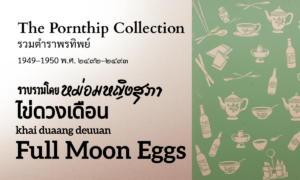
Full Moon Eggs (ไข่ดวงเดือน; khai duaang deuuan)
Full Moon Eggs, hard-boiled egg halves stuffed with ham, pork fat, and chicken, wrapped in caul fat and fried in lard. Maawm Ying Soophaa, 1949.
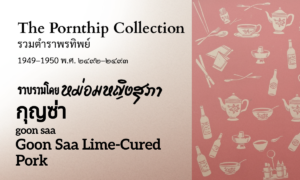
Goon Saa Lime-Cured Pork (กุญซ่า; goon saa)
Goon saa: lean pork cured by lime juice and salt without fire, shredded and tossed with its own reduced pressing liquid. From Maawm Ying Soophaa, 1949.
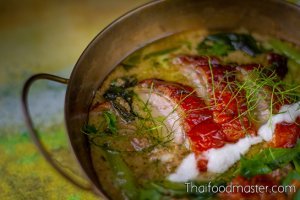
Thai Green Curry with Roasted Duck and Young Chilies (แกงเขียวหวานเป็ดย่าง ; gaaeng khiaao waan bpet yang)
Green curry, with its mellow, creamy green color and rich coconut base, has both fresh and mature flavors. Like new growth on plants, it brings brightness, youthfulness, spring and rebirth to the meltdown of flavors created in the curry paste.
The green curry paste uses mainly the same standard ingredients as Thai spicy-red curry paste: lemongrass, coriander roots, kaffir lime zest, galangal, garlic, shallots, white peppercorns, coriander seeds, cumin seeds, salt and kapi.
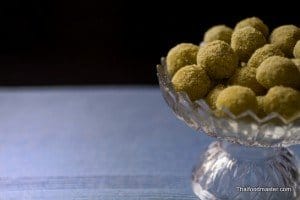
Coconut Balls Rolled in Ground Roasted Unripe Rice (ข้าวเม่าบด ; khaao mao boht)
This ball-shaped dessert has a sweet coconut filling (gracheek), surrounded by a thin crust of pounded unripe rice crumbs, along with a tempting fragrance enriched with a Thai dessert candle or fresh flowers.
Demonstrating brilliant creativity and attention to detail, this classical Thai dessert uses only three basic ingredients. In this article, we have elected to follow the traditional recipe published in 1908 by Thanpuying Plean Passakornrawong.
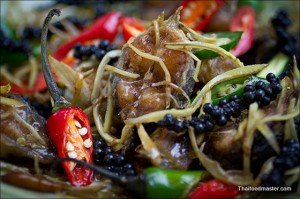
Thai Spicy Catfish Recipe
Crispy Catfish Stir-Fried with Wild Ginger and Fresh Peppercorn
(bplaa dook thaawt graawp phat grachaai phrik thai aawn)
สูตรทำปลาดุกทอดกรอบผัดกระชายพริกไทยอ่อน This Thai spicy catfish recipe gives catfish a new and fabulous spin. You can either use farmed or game fish with the same phenomenal results. The intensity of the wild ginger combined with aromatic fresh peppercorn will turn even muddy flavor fish into a delicacy. Slice the fish are first, then role it in flour and deep-fry it to a crispy crunch. Quickly stir-fry the crispy fish with wild ginger and the peppercorns releasing their aromatic oils, creating wonderful flavors. While seasoning with light soy sauce and oyster sauce, our fish is now regaining heavenly moisture without losing its tempting crispiness.
Crispy Catfish Stir-Fried with Wild Ginger and Fresh Peppercorn
(bplaa dook thaawt graawp phat grachaai phrik thai aawn)
สูตรทำปลาดุกทอดกรอบผัดกระชายพริกไทยอ่อน This Thai spicy catfish recipe gives catfish a new and fabulous spin. You can either use farmed or game fish with the same phenomenal results. The intensity of the wild ginger combined with aromatic fresh peppercorn will turn even muddy flavor fish into a delicacy. Slice the fish are first, then role it in flour and deep-fry it to a crispy crunch. Quickly stir-fry the crispy fish with wild ginger and the peppercorns releasing their aromatic oils, creating wonderful flavors. While seasoning with light soy sauce and oyster sauce, our fish is now regaining heavenly moisture without losing its tempting crispiness.
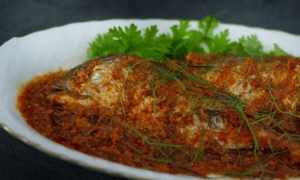
c1908 Chuu Chee with Mackerel (ฉู่ฉี่ปลาทู ; chuu chee bplaa thuu)
A salty-sweet, water-based chuu chee dish that features a thick, almost dry sauce. The deep burnt-red and shiny chuu chee sauce clings to the skin of the crispy mackerel, gold-colored from frying the fish in pork lard. The aromatic profile of the chuu chee complements the mackerel's rich, full-bodied flavor. Although chuu chee is usually made using freshwater fish, saltwater fish, especially mackerel, is featured in chuu chee dishes prepared along the coasts of the Central Plains. This is especially common during the rainy season, when the mackerel is plentiful and of excellent quality.
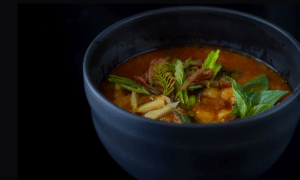
Gaaeng Jao Dtao – An Aristocratic Sour Curry of Catfish with Young Tamarind Leaves, Fingerroot and Lemon Basil, with a Rustic Flare (แกงเจ้าเต่า)
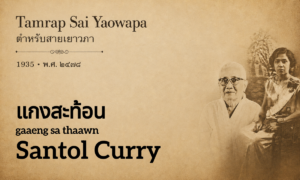
Santol Curry (แกงสะท้อน; gaaeng sa thaawn)
Gaeng sa thaawn, a santol-soured curry of chicken and pork belly in bone stock, finished with prawns. From Tamrap Sai Yaowapa, 1935.
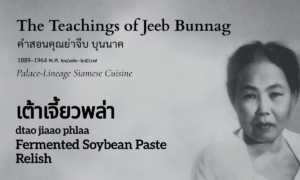
Fermented Soybean Paste Dipping Relish (เต้าเจี้ยวพล่า; dtao jiaao phlaa)
Dtao jiaao phlaa, fermented soybean paste relish bruised with lemongrass, kaffir lime, and tamarind. From Jeeb Bunnag, 1933.
Siamese Chili Relishes - The Professional Chef's Guide - น้ำพริก และ เครื่องจิ้ม
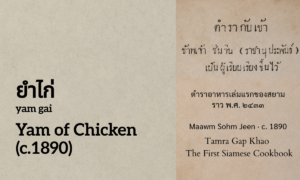
Yam of Chicken (ยำไก่; yam gai)
Yam gai: chicken simmered in coconut milk until dry, then dressed with mint, kaffir lime and green mango. Maawm Sohm Jeen, Tamra Gap Khao, 1890.
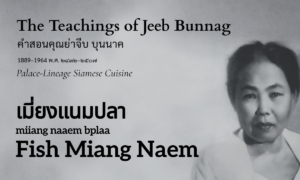
Fish Miang Naem (เมี่ยงแนมปลา; miiang naaem bplaa)
Miiang naaem bplaa, grilled snakehead fish with fire-roasted galangal juice and bitter orange, served in lettuce cups. Jeeb Bunnag, 1933.
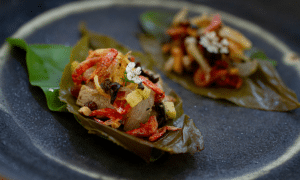
Miang Sot (เมี่ยงซด) - Miiang Soht, circa 1928
The word ‘miang’ is often used to designate Thai hors d’oeuvre-like snacks consisting of various ingredients wrapped in leaves. To chew on a miang parcel delivers a delightful melee of flavors and textures, each triumphing over the other in a continuous transformation, creating a captivating and ever-evolving taste experience throughout the bite.
Miang sot is a fermented leaves dish that appeared in a cookbook published in honor of Thao Suphatigaanapakdee (also known as Prik Sirisamphan) (ท้าวสุภัติการภักดี (ปริก ศิริสัมพันธ์)), in 1928. Titled Gap Khaao Thai (กับข้าวไทย), the book features a collection of recipes that were once prepared and served to King Chulalongkorn Rama V. The author, Sohmboon Sirisamphan (เถ้าแก่ สมบุญ ศิริสัมพันธ์) a respected elder (known as thao gaae (เถ้าแก่) in Thai), was a distinguished businessman of Chinese origins.
The dish is composed of fermented tea leaves; it is perhaps the closest tea leaves wrap to the ‘miang’ style introduced to the Siamese court by Princess Dara Rasami in the late 1800s. The dish gives us a glimpse of flavor of what her household, which participated in the informal marketplace events within the palace, might have to offer.
The popularity of miang in Siamese cuisine is tied to the history of two kingdoms, Siam and Lanna, and the life of one princess, Princess Dara Rasami. The daughter of King Inthawichayanon of Chiang Mai and the fifth consort of King Chulalongkorn, the princess was selected at the age of thirteen, in 1886, to serve as a consort to King Chulalongkorn in the Inner Palace; the decision was shaped by both political strategy and personal transition. At the time, Siam was consolidating its power and extending its influence over neighboring regions, including Lanna. As the ruler of Chiang Mai, Princess Dara Rasami’s father, Intawichayanon, viewed the move as a strategic alliance. In return, King Chulalongkorn presented him with the medal of the Order of Chula Chom Klao, which is the Siamese equivalent of a knighthood.
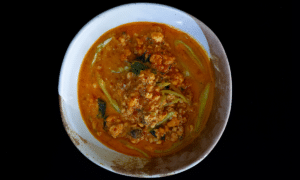
Minced-Bird Curry with Fish (ปลาช่อนแกงนก; Bplaa Chaawn Gaaeng Nohk)
Lady Plean Passakornrawong’s historic, first-ever recipe for minced-bird curry with snakehead fish revives the old minced-bird curry syle. The fish is minced and cooked with the curry paste, producing a hearty and comforting thick-textured curry.
Coconut Batter for Fried Accompaniments (แป้งชุบเครื่องทอด; bpaehng choop khreuuang thaawt)
Coconut Batter for Fried Accompaniments, a rice flour mixture kneaded with limestone solution until glossy. From Jeeb Bunnag's 1945 cookbook of Thai snacks and desserts.
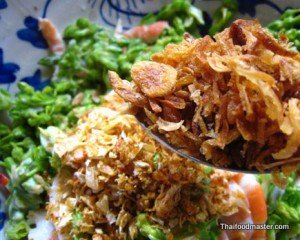
Salad of Thai milkweed flower buds (yam daawk khajaawn ; ยำดอกขจร)
The first Thai restaurant in London was opened during the 1960's by HRH Princess Jurairat Nasiriman (1910-2000) (พระเจ้าวรวงศ์เธอ พระองค์เจ้าจุไรรัตนศิริมาน), the granddaughter of HRH King Mongkut (Rama IV). Princess Jurairat chose to offer this salad on the menu and named it "Salad of Thai Milkweed Flower". (Other names: Cowslip creeper, Telosma Cordata).
This fresh and tasty salad is so vibrant and easy for us to enjoy, it takes in the very basic flavors, sweet, salty, hot and sour and wrap them in a creamy coat of reduced coconut cream. The milkweed flower buds retain their crunchiness and their pleasant fragrance with only a gentle and very quick blanching in sweet boiling water.
Crispy Cooked Liver (ตับสุกกรอบ; dtap sook graawp)
Dtap sook graawp, pork liver boiled then deep-fried in a coconut cream batter with garlic and coriander root. Jeeb Bunnag, 1933.
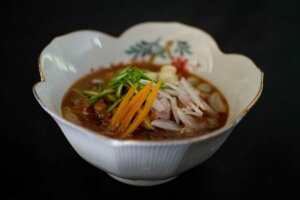
Kapi pla, an old-fashioned fermented shrimp paste relish (กะปิพล่า ; gabpi phlaa)
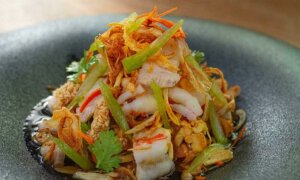
c1933 Sour bilimbi fruit and crispy candied peanut salad with pork, shrimp and pork fat (ยำตะลิงปลิง ; yam dtaling bpling)
A candied peanut bar might be considered an unlikely ingredient for an old-fashioned Siamese-style salad. Yet, peanut bars were familiar to the Siamese as early as the Ayutthaya period and were part of a broader set of Teochew Chinese sweets called, in Thai, “khanohm janap (ขนมจันอับ)”.
1
2
3
4
5
6
7
8
9
10

Get Access – Join Thaifoodmaster Today
Practical and kitchen-tested recipes with a mix of theory, history, psychology, and Siamese culture tidbits.
-
Get access to everything right away. Unlock more than 50 Masterclasses, over 700 recipes and Articles
Access to Thaifoodmaster’s constantly growing library of prime professional classes, articles, recipes and videos on Siamese culinary topics, available nowhere else in English.
-
GET EXTRA - New Masterclasses and Daily Recipes
Gain access to NEW masterclasses as they become available. Access DAILY translations of heritage-recipes.
-
1-1 support from Hanuman
1-1 support from Hanuman to help you achieve your professional Thai culinary goals
-
Live Q&A Sessions
The opportunity to join a monthly live two-hour videoconference where I can answer your questions.
-
Great Value!
one year access for the price of 3 days in-person training.
You will get everything you need to:
-
To Get inspired
When you design or build a new menu for an event or restaurant or even prepare for dinner with friends.
-
To Satisfy your curiosity.
Finally !
-
To Master Your Craft
Master your Thai cooking skills and expand your repertoire.
It is truly brilliant with a revolutionary approach introducing aspects and concepts never broached by cookbooks.

Ian Westcott
Sourcing Wines for Discerning Private Clients
© 2008 – 2026 Thaifoodmaster


