
Celebrating the Art of Siamese Culinary Wisdom and Thai Cuisine
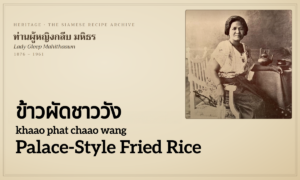
Palace-Style Fried Rice (ข้าวผัดชาววัง; khaao phat chaao wang)
Khao phat chao wang, fried rice cooked in the rendered fat of salt-stewed pork with shrimp and egg. From Lady Gleep Mahithaawn, 1949.
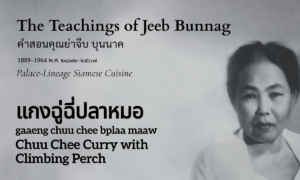
Chuu Chee Curry with Climbing Perch (แกงฉู่ฉี่ปลาหมอ; gaaeng chuu chee bplaa maaw)
Chuu chee curry with climbing perch — pan-fried fish in split coconut cream based chuu chee curry with kaffir lime leaves and coriander leaves. From Jeeb Bunnag's 1933 cookbook.
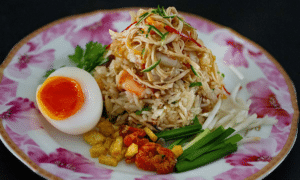
Khao Mee Seasoned Rice (ข้าวหมี่อย่างคลุก; khaao mee yaang khlook)
This article explores two methods of preparing Mee Fried Rice - the traditional Khao Mee Fried Rice and the lighter, seasoned rice alternative known as khaao mee yaang khlook. Discover the flavor chemistry at play and choose your preferred method for a delicious meal.
Yam "Goliath Special" (ยำ "โกไลพิเศษ"; yam go:h lai phi saeht)
Yam Goliath Special: eight boiled proteins — shrimp, pork, squid — dressed with pounded coriander root and garlic. Delicious Side Dishes, 1935.
Young Jackfruit Salad (ยำขนุนอ่อน; yam kha noon aawn)
Young Jackfruit Salad featuring tender jackfruit stir-fried with coconut cream and aromatic herbs and dressed with chili jam. From Maawm Ying Soophaa's 1949 manuscript on Thai salad recipes.
The Earliest Printed Recipe for Papaya Som Tum (ส้มตำมะละกอ; sohm dtam ma la gaaw)
Sohm dtam ma la gaaw, the first printed Siamese recipe for som tum — a Central Thai papaya salad with dried shrimp. Tamra Khraawp Lo:hk, 1929.
The Golden Trails of Curry Powder - เรื่องราวของผงกะหรี่
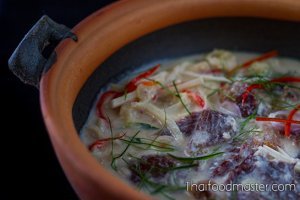
Coconut-Braised Sun-Dried Salted Beef with Bamboo Shoots (แกงต้มกะทิเนื้อโคเค็ม ; gaaeng dtohm gathi neuua khoh khem)
แกงต้มกะทิเนื้อโคเค็ม - In this dish, umami-charged, salted sun-dried beef is gently grilled over charcoal, adding smoke and caramelized elements that emerge in the core of the flavor profile, alongside the umami and the savor of fat. The meat is then cut into bite-size pieces, and slowly braised in thick coconut milk. The coconut fits perfectly onto the triangle of umami, fat and smoke. It brings its own umami and fatty shades, and introduces a rich sweetness that pairs seamlessly with the caramelized character of the grilled beef. The braising also rehydrates the beef and softens it. Bamboo shoots, shallots, galangal, lemongrass and kaffir lime leaves are added, perfecting the dish with a complementary sweetness, echoing the umami hues, and cutting citrusy notes while creating hidden astringent layers. The dish is finished with fresh chili peppers and hair-thin julienned kaffir lime for a fresh aroma and piquant bite.
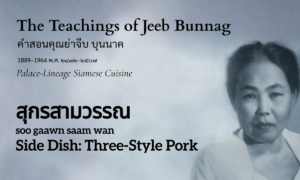
Three-Style Pork (สุกรสามวรรณ; soo gaawn saam wan)
Soo gaawn saam wan: fatty pork reduced three ways—fish sauce with palm sugar, garcinia leaf juice, and fermented bean curd. Jeeb Bunnag, 1933.
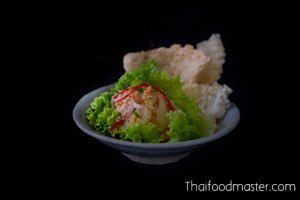
Goong Saawn Glin - A Thai Royal Appetizer of Flaky Acid-Cooked Shrimp, Peanuts and Pickled Garlic, with a Sour-Salty-Sweet Shrimp Tomalley Dressing. (กุ้งซ่อนกลิ่น)
กุ้งแนม" หรือ "กุ้งซ่อนกลิ่น - Goong naaem (goong saawn glin) according to the 1908 recipe in Lady Plean Passakornrawong’s “Maae Khruaa Huaa Bpaa (ตำราแม่ครัวหัวป่าก์)” cookbook. Flaky acid-cooked shrimp and the pork fat, along with thinly sliced roasted peanuts and very small unpeeled diced bitter orange (ส้มซ่า som saa), plus paper-thin slices of pickled garlic and julienned fresh red long chili peppers are mixed and seasoned with shrimp tomalley dressing. It is served in wrapped squares, using iceberg lettuce and young thaawng laang leaves.

Steamed Stuffed Winter Melon Clear Soup (แกงจืดฟักเขียวตุ๋น; gaaeng jeuut fak khiaao dtoon)
Steamed Stuffed Winter Melon Clear Soup, a refined royal Thai dish featuring hollowed winter melon filled with crab, pork, and egg sausage. From Jeeb Bunnag's 1933 cookbook.
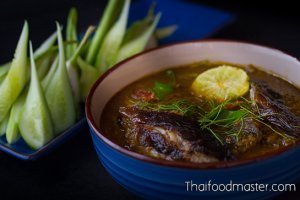
Southern Thai Ancient Fermented Fish Innards Curry with Grilled Catfish (แกงไตปลาปลาดุกย่างโบราณ ; gaaeng dtai bplaa bplaa dook yaang)
แกงไตปลาปลาดุกย่างโบราณ - Fermented fish innards curry is a dense curry made of fermented fish innards is dark coffee-brown in color – a salty, fiery hot dish, it grips the palate in an intense umami embrace. As the flagship dish in the repertoire of spicy southern Thai cuisine, it comes in different versions: some are water based; some have a base of coconut cream. But whatever the style, it is a fiercely hot dish that features both dried and fresh chilies.

Emperor's Hong Te Rice Vermicelli (หมี่ฮ่องเต้; mee haawng dteh)
Emperor's Hong Te Rice Vermicelli, a royal Thai dish combining delicate shredded chicken and crab meat over rice noodles. From Jeeb Bunnag's 1945 cookbook.
Khanohm Jeen with Hindu Style Nam Ya Sauce (น้ำยาฮินดู; naam yaa hin duu)
Naam yaa hin duu, a coconut curry sauce with red and white beans, flavored with fermented soybean paste. From Jeeb Bunnag's 1945 cookbook.
Dressed Shrimp and Salt-Pressed Jellyfish (ยำกุ้งแท่; yam goong thaae)
Yam goong thaae, a royal Thai salad featuring shrimp and salt-cured jellyfish with multiple textures and proteins. From Maawm Ying Soophaa's 1949 manuscript.
Spicy Salad with Crispy Fish and Bird's Eye Chili (ยำปลากรอบกับพริกเม็ดเล็ก; yam bplaak raawp gap phrik met lek)
Yam bplaak raawp gap phrik met lek - smoke-dried fish salad with fried aromatic herbs and salt-tempered bird's eye chilies. Jeeb Bunnag, 1933.
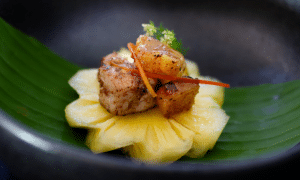
Spiced Skewers of Grilled Pork Neck and Firm Pork Fat with Fresh Pineapple (หมูปิ้งสัปปะรด; Muu Bping Sapbparoht)
Known as muu bping sapbparoht (หมูปิ้งสัปปะรด) and translated as grilled pork with pineapple, this dish showcases cubes of grilled pork meat and firm fat with fresh pineapple. The pork meat is marinated in light soy sauce and an array of dry spices, giving it earthy and slightly spicy notes. The cubes are then threaded onto skewers, interspersed with evenly sliced pieces of firm pork fat. When grilled, these pieces of pork fat introduce an additional layer of richness and juiciness to the meat. The preferred cut of choice for this dish is pork neck, a cut highly valued for its optimal ratio of lean meat to fat, culminating in a pleasingly succulent texture when grilled.
In Thai cuisine, it is common practice to sprinkle grated coconut over glowing charcoal while grilling. The heat-induced combustion of aromatic fats within the coconut introduces an additional dimension of sweet, smoky richness to the dish. Meanwhile, the charring of the edges of the meat catalyzes the caramelization of its natural sugars, yielding a delightful sweetness that further enhances the smoky undertones of the meat.
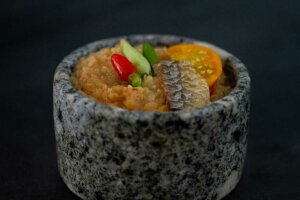
Salted Indian salmon chili relish (น้ำพริกปลากุเลาเค็ม; naam phrik bplaa goo lao khem)
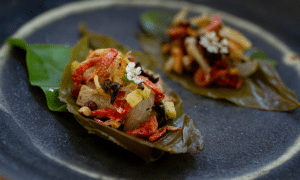
Miang Sot (เมี่ยงซด) - Miiang Soht, circa 1928
The word ‘miang’ is often used to designate Thai hors d’oeuvre-like snacks consisting of various ingredients wrapped in leaves. To chew on a miang parcel delivers a delightful melee of flavors and textures, each triumphing over the other in a continuous transformation, creating a captivating and ever-evolving taste experience throughout the bite.
Miang sot is a fermented leaves dish that appeared in a cookbook published in honor of Thao Suphatigaanapakdee (also known as Prik Sirisamphan) (ท้าวสุภัติการภักดี (ปริก ศิริสัมพันธ์)), in 1928. Titled Gap Khaao Thai (กับข้าวไทย), the book features a collection of recipes that were once prepared and served to King Chulalongkorn Rama V. The author, Sohmboon Sirisamphan (เถ้าแก่ สมบุญ ศิริสัมพันธ์) a respected elder (known as thao gaae (เถ้าแก่) in Thai), was a distinguished businessman of Chinese origins.
The dish is composed of fermented tea leaves; it is perhaps the closest tea leaves wrap to the ‘miang’ style introduced to the Siamese court by Princess Dara Rasami in the late 1800s. The dish gives us a glimpse of flavor of what her household, which participated in the informal marketplace events within the palace, might have to offer.
The popularity of miang in Siamese cuisine is tied to the history of two kingdoms, Siam and Lanna, and the life of one princess, Princess Dara Rasami. The daughter of King Inthawichayanon of Chiang Mai and the fifth consort of King Chulalongkorn, the princess was selected at the age of thirteen, in 1886, to serve as a consort to King Chulalongkorn in the Inner Palace; the decision was shaped by both political strategy and personal transition. At the time, Siam was consolidating its power and extending its influence over neighboring regions, including Lanna. As the ruler of Chiang Mai, Princess Dara Rasami’s father, Intawichayanon, viewed the move as a strategic alliance. In return, King Chulalongkorn presented him with the medal of the Order of Chula Chom Klao, which is the Siamese equivalent of a knighthood.
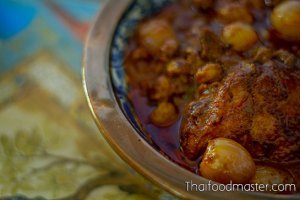
Massaman Curry - The Untold Story (แกงมัสมั่น – แกงมาชะแมน – แกงหมัดสมั่น)
Considered by some to be the most famous, and the most delicious, dish in Thai cooking, the story of Massaman curry is interwoven with trade, politics and religion in 17th-century Siam. The story is filled with mighty kings, legendary explorers and unsolved mysteries, adding an air of magic and power to this already-heavenly perfumed dish, and thickening the plot of this full bodied, coconut-based curry’s birth.
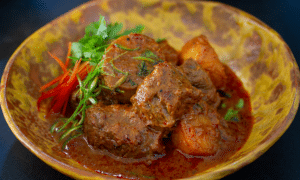
Perfumed Braised Beef and Potato Curry with Three Gingers, Thai Basil and Bitter Orange (แกงเนื้อใส่เปราะหอมสดและส้มซ่า; Gaaeng Neuua Sai Bpraw Haawm Soht Lae Sohm Saa)
Discovered in a memorial book for the funeral of SubLt. Soophoht Jeungpraphaa (ร.ต. สุพจน์ จึงประภา) (1925-1966), this beef and potato curry dish unites two distinct curry styles: Massaman curry, known for its sweet and warming complexity of dry spices, punctuated by the vibrancy of bitter orange juice; and gaaeng phet (แกงเผ็ด) spicy curry, dominated by a basil herbal identity. The recipe maintains a sense of traditional elegance despite the startlingly unusual culinary fusion; as these two cooking styles are woven together, their spiced comfort, earthy warmth, citrusy freshness, and cool herbaceous notes meld in a gentle refinement. Drawing upon familiar and novel elements, this curry is both comforting and stimulating.
Massaman curry typically presents as a deep, rich dish. Its unique flavor profile is derived predominantly from a range of dry spices that point to its Persian-inspired roots in Siamese cuisine, along with a curry paste that exudes a sense of freshness. The dried chilis are roasted to deepen their color; the rest of the ingredients, such as the shallots, garlic and dry spices, are roasted too, individually, before being pounded into the paste. Conversely, the gaaeng phet (แกงเผ็ด) curry integrates dry spices more sparingly and is known for flavor qualities that are based on a phrik khing (พริกขิง) paste made of fresh aromatics and a basil herbal identity.
1
2
3
4
5
6
7
8
9
10
11
12
13
14

Get Access – Join Thaifoodmaster Today
Practical and kitchen-tested recipes with a mix of theory, history, psychology, and Siamese culture tidbits.
-
Get access to everything right away. Unlock more than 50 Masterclasses, over 700 recipes and Articles
Access to Thaifoodmaster’s constantly growing library of prime professional classes, articles, recipes and videos on Siamese culinary topics, available nowhere else in English.
-
GET EXTRA - New Masterclasses and Daily Recipes
Gain access to NEW masterclasses as they become available. Access DAILY translations of heritage-recipes.
-
1-1 support from Hanuman
1-1 support from Hanuman to help you achieve your professional Thai culinary goals
-
Live Q&A Sessions
The opportunity to join a monthly live two-hour videoconference where I can answer your questions.
-
Great Value!
one year access for the price of 3 days in-person training.
You will get everything you need to:
-
To Get inspired
When you design or build a new menu for an event or restaurant or even prepare for dinner with friends.
-
To Satisfy your curiosity.
Finally !
-
To Master Your Craft
Master your Thai cooking skills and expand your repertoire.
It is truly brilliant with a revolutionary approach introducing aspects and concepts never broached by cookbooks.

Ian Westcott
Sourcing Wines for Discerning Private Clients
© 2008 – 2026 Thaifoodmaster


