
Celebrating the Art of Siamese Culinary Wisdom and Thai Cuisine
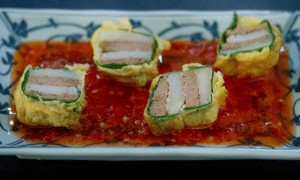
Pork liver and firm pork fat fried in batter (มันสลับตับสุกร; man salap dtap soogaawn)
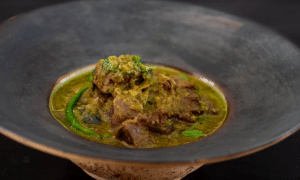
Perfumed Muslim-style Curry of Fresh Chilies with Beef (แกงเขียวหวานเนื้อทรงเครื่อง; Gaaeng Khiaao Waan Neuua Sohng Khreuuang)
The Indian and Muslim cuisines present distinct approaches to using dried spices in curries, both of which influence Siamese cuisine in different ways. Indian-inspired Siamese curries spotlight chilies for their vibrant color, fragrance, flavor and heat, while spices like cumin and coriander play a supporting role. The spices complement and temper the chilies’ intensity, creating a rounded, multi-layered flavor profile; nonetheless, the chilies remain the star ingredient, gently complemented by the spices.
Conversely, Muslim-influenced curries, such as massaman curry, prioritize spices over chilies. Spices like cardamom, nutmeg and mace take center stage, while the chilies provide subtle background heat rather than being the primary flavor. In these curries, the focus is on the rich, warm and complex aromas created by the blend of spices, which is a defining characteristic of many Muslim dishes.
Moreover, Siamese cuisine favors using rehydrated dried chilies in curries for their depth; this depth is highly appreciated, along with the complexity, and comparatively milder heat of the rehydrated dried chilies. As well, the harsh grassy notes of fresh chilies are not favored; they’re referred to in Thai as “green rank” or “men khiaao (เหม็นเขียว)”. Muslim curries often use fresh green chilies, tempering their vibrant, grassy taste with dry spices and thus shifting the flavor from bright and fresh to more subdued and earthy tones, resulting in a dish that is perceived to be layered, despite the burst of fresh chilies.
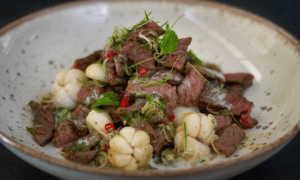
Grilled beef and mangosteen (or grape) salad with mint dressing, by Princess Jongjittanom Dissakul (ยำเนื้อย่างกับมังคุดหรือองุ่น; yam neuua yaang gap mangkhoot reuu angoon)
This grilled beef salad with luscious mangosteen (or grapes) is seasoned with a crisp, cooling dressing of fermented shrimp paste and mint. The mangosteen’s tropical character – a flavor redolent of many other fruits – dominates its fruity essence and is a perfect complement to both the grilled meat and the lingering, sour-salty-sweet, minty dressing. Furthermore, citrusy notes of thinly sliced lemongrass and kaffir lime leaves, coupled with richness of thickened coconut cream, unite the caramelized, meaty elements with the dish’s fruity spectrum.
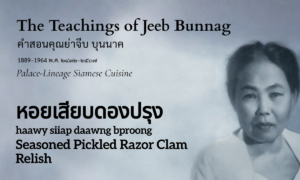
Seasoned Pickled Razor Clam Relish (หอยเสียบดองปรุง; haawy siiap daawng bproong)
Haawy siiap daawng bproong, pickled razor clam relish seasoned with three acids—kaffir lime, lime, and tamarind. From Jeeb Bunnag, 1933.
Mussel Salad (ยำหอยแมลงภู่; yam haawy maae lohng phuu)
Yam haawy maae lohng phuu, mussels tossed with lemongrass, kaffir lime, and toasted coconut. From Maawm Ying Soophaa's Salad Recipes, 1949.
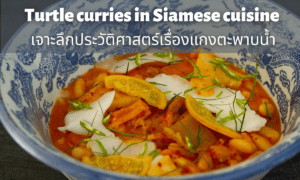
The complete story of turtle curries in Siamese cuisine (เจาะลึกประวัติศาสตร์เรื่องแกงตะพาบน้ำ)
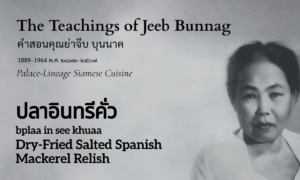
Dry-Fried Salted Spanish Mackerel Relish (ปลาอินทรีคั่ว; bplaa in see khuaa)
Bplaa in see khuaa — grilled salted mackerel pounded with seven aromatics, fried in roasted coconut oil. Jeeb Bunnag, 1933.
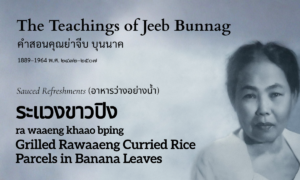
Grilled Rawaaeng Curried Rice Parcels in Banana Leaves (ระแวงขาวปิง; ra waaeng khaao bping)
Ra waaeng khaao bping, rice parcels with duck and coconut cream wrapped in banana leaves and grilled. From Jeeb Bunnag's 1945 Thai appetizer cookbook.
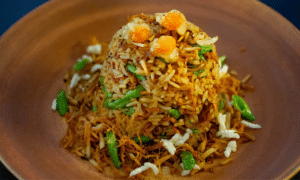
Crispy Rice - Khaao Graawp (ข้าวกรอบ อย่างหม่อมเจ้าสาย ลดาวัลย์)
Suan Sunandha Palace was the permanent residence of Mom Chao Sai Ladawan (HRH Princess Saisawali Phirom, พระวิมาดาเธอ หม่อมเจ้าสาย ลดาวัลย์), the Royal Consort to Rama V. In the kitchen of Suan Sunandha Palace, the Princess presided over a peak era of culinary innovation until her passing on June 24, 1929. Reflecting her practicality, the Princess’ recipes frequently incorporated the era’s common pantry ingredients in new and surprising combinations.
For example, in her boat-embarking chili relish (น้ำพริกลงเรือ; naam phrik lohng reuua), a relish still enjoyed today, the Princess pairs fermented shrimp paste chili relish with sweet pork, crispy fried fish, salted duck eggs and hairy-fruited eggplant (maeuk) (มะอึก). Another example is her gaaeng ran juaan (แกงรัญจวน) – the Princess prepares a vibrant spicy and sour soup, fragrant with the aroma of Thai basil, from the leftovers of a stir-fried beef dish and fermented shrimp paste chili relish, which she cooked together with lemongrass, shallots and garlic.
Mom Chao Sai Ladawan’s recipes, many already recreated here at Thaifoodmaster, were recorded by Princess Sadap Ladawan (เจ้าจอมหม่อมราชวงศ์สดับลดาวัลย์), a key figure in the Palace’s culinary affairs, and subsequently compiled and published by Suan Sunandha Rajabhat University in a volume dedicated to seasoned rice dishes and chili relishes.
In this dish called khaao graawp (ข้าวกรอบ), or “crispy rice” the Princess seasons cooked jasmine rice with chili jam, and adds four fried components, each highlighting a different element of the crispiness indicated by the dish’s name.
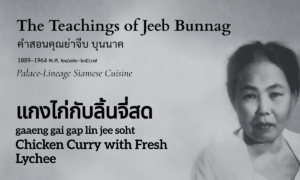
Chicken Curry with Fresh Lychee (แกงไก่กับลิ้นจี่สด; gaaeng gai gap lin jee soht)
Gaaeng gai gap lin jee soht: coconut chicken curry with whole fresh lychee, added last to preserve its floral aroma. Jeeb Bunnag, 1933.
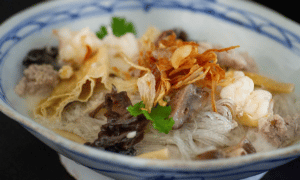
Gaaeng Raawn (แกงร้อน)
Gaaeng raawn (แกงร้อน) is a colloquial Thai term that refers to ‘hot curry’. Today, gaaeng raawn is used to denote soups or curries served with steamed rice. While the precise origin of the term is unclear, gaaeng raawn (แกงร้อน) was deployed in the 1800s for a specific dish – a Siamese soup featuring glass noodles, cooked as either a coconut or a water-based soup with an assortment of dry ingredients revered in Chinese cuisine. The soup’s potential health benefits, combined with its ease of preparation and subtle yet profound flavor, made it a popular choice for entertaining large groups of people, of all ages and backgrounds. The soup is often augmented with fresh proteins: in its more luxurious versions, multiple proteins may be added, including a combination of chicken, pork, shrimp, squid, and crab meat. Thus, over the years, gaaeng raawn (แกงร้อน) was established as a staple source of comfort and warmth for people of all walks of life in Siamese society.
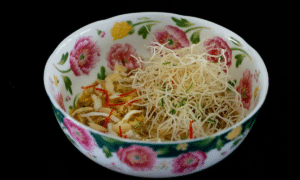
The Ambassador’s House Style Noodle Soup (หมี่น้ำบ้านราชทูต; Mee Naam Baan Raat Thuut)
This soup dish features crispy rice vermicelli noodles, a chicken broth that has a three-flavor profile infused with the aroma of bitter orange, and a plethora of other ingredients such as crispy fried tofu, chicken, pork, crab and pickled garlic.
In Thai, the phrase mee naam baan raat thuut refers to a rice vermicelli noodle soup in the style of the Ambassador’s house. The dish was not new when it appeared in the 1956 book Snacks, Tea Nibbles, Hors D’oeuvres and Drinking Food (ตำราอาหารว่าง - เครื่องน้ำชา และ เครื่องเคี้ยว หรือ กับแกล้ม) by Jeeb Bunnag (จีบ บุนนาค), as noodle dishes were often the preferred ingredient for light meals or snacks. In Grandparents Recipes: 100 Years Old Recipes (จานอร่อยจากปู่ย่า สูตรโบราณ 100 ปี), a volume printed in 2014 that highlights recipes from the kitchens of fifteen prominent families, a similar version of the dish is referred to as mee naam baan bpaak naai leert (หมี่น้ำบ้านปาร์คนายเลิศ) and is associated with Nai Lert.
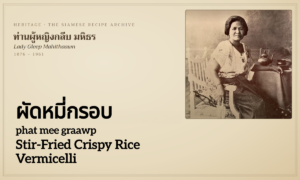
Stir-Fried Crispy Rice Vermicelli (ผัดหมี่กรอบ; phat mee graawp)
Phat mee graawp, rice vermicelli fried crisp in pork lard, seasoned salty–sweet–sour, finished with slivered bitter orange. Lady Gleep Mahithaawn, 1949.
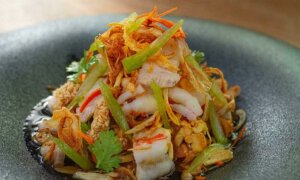
c1933 Sour bilimbi fruit and crispy candied peanut salad with pork, shrimp and pork fat (ยำตะลิงปลิง ; yam dtaling bpling)
A candied peanut bar might be considered an unlikely ingredient for an old-fashioned Siamese-style salad. Yet, peanut bars were familiar to the Siamese as early as the Ayutthaya period and were part of a broader set of Teochew Chinese sweets called, in Thai, “khanohm janap (ขนมจันอับ)”.
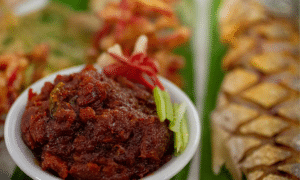
Tamarind flesh chili relish (น้ำพริกส้มมะขามเปียก; naam phrik sohm ma khaam bpiiak)
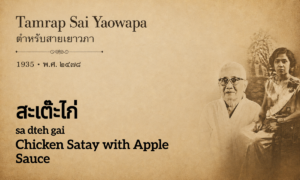
Chicken Satay (สะเต๊ะไก่; sa dteh gai)
Sa dteh gai: chicken on sugarcane skewers with bacon, basted with cream and breadcrumbs, served with a stewed-apple dip. Tamrap Sai Yaowapa, 1935.
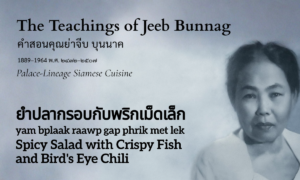
Spicy Salad with Crispy Fish and Bird's Eye Chili (ยำปลากรอบกับพริกเม็ดเล็ก; yam bplaak raawp gap phrik met lek)
Yam bplaak raawp gap phrik met lek - smoke-dried fish salad with fried aromatic herbs and salt-tempered bird's eye chilies. Jeeb Bunnag, 1933.
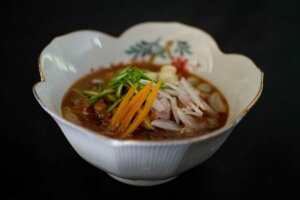
Kapi pla, an old-fashioned fermented shrimp paste relish (กะปิพล่า ; gabpi phlaa)
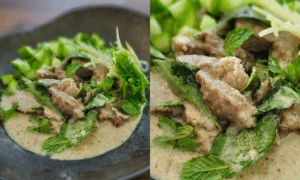
Tasty Beef (เนื้ออร่อย ; neuua araawy)
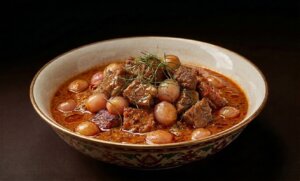
Phanaeng Curry of Grilled Duck Stock with Shallots (แกงพะแนงน้ำเป็ดย่างกับหอมเล็ก; gaaeng pha naaeng naam bpet yaang gap haawm lek)
Phanaeng curry from Mrs Puang Bunnag's 1931 manuscript, built on grilled duck stock and a paste of roasted coriander, cumin, and cinnamon.
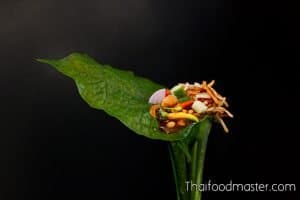
Miang kham - A royal leaf wrap appetizer เมี่ยงคำ
Each leaf-wrapped parcel is a kaleidoscope of flavors and richness, textures, aromas and sensations. Fresh green-earthy-chlorophyll-herby-tobacco-peppery wild betel leaves enfold bursts of flavor from nutty roasted peanuts and crispy roasted coconut matches, the umami of savory dry shrimp, pungent-sweet diced shallots, small ginger cubes with a warm bite, sour and bitter unpeeled lime cubes, citrusy perfumed diced bitter orange (som za), naughty whole fresh tiny bird’s eye chilies, and small slices of the sharp and sour dtaling bpling (Averrhoa bilimbi, a relative of the carambola/starfuit). All of which is blended with a thick paste of sweet-sour and salty palm sugar and tamarind sauce.
The miang kham takes every taste bud on a fascinating pleasure trip through sweetness, saltiness, sourness, bitterness, and umami, piquancy, sharpness and spiciness, with an array of textures that slowly subside as the journey ends, leading to a familiar post orgasmic expression, a smile and the desire for more.
1
2
3
4
5
6
7
8
9
10
11
12
13

Get Access – Join Thaifoodmaster Today
Practical and kitchen-tested recipes with a mix of theory, history, psychology, and Siamese culture tidbits.
-
Get access to everything right away. Unlock more than 50 Masterclasses, over 700 recipes and Articles
Access to Thaifoodmaster’s constantly growing library of prime professional classes, articles, recipes and videos on Siamese culinary topics, available nowhere else in English.
-
GET EXTRA - New Masterclasses and Daily Recipes
Gain access to NEW masterclasses as they become available. Access DAILY translations of heritage-recipes.
-
1-1 support from Hanuman
1-1 support from Hanuman to help you achieve your professional Thai culinary goals
-
Live Q&A Sessions
The opportunity to join a monthly live two-hour videoconference where I can answer your questions.
-
Great Value!
one year access for the price of 3 days in-person training.
You will get everything you need to:
-
To Get inspired
When you design or build a new menu for an event or restaurant or even prepare for dinner with friends.
-
To Satisfy your curiosity.
Finally !
-
To Master Your Craft
Master your Thai cooking skills and expand your repertoire.
It is truly brilliant with a revolutionary approach introducing aspects and concepts never broached by cookbooks.

Ian Westcott
Sourcing Wines for Discerning Private Clients
© 2008 – 2026 Thaifoodmaster


