
Celebrating the Art of Siamese Culinary Wisdom and Thai Cuisine
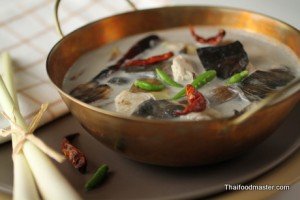
Fresh Coconut Milk Tom Yum Soup Recipe of Grilled Banana Blossom and Chicken
(dtohm yam gathi huaa bplee yang sai gai ;
ต้มยำกะทิหัวปลีย่างใส่ไก่) It will not be an overstatement to say that banana trees accompany Thai people from their birth to the afterlife. Starting with the decorative objects made out of banana leaves newborns receive to invite protective spirits, and continues their entire life with the endless uses for banana leaves, trunks and fruits; finally ending with the female spirit ghost, maae praai taanee (แม่พรายตานี), who resides in banana trees and Thai beliefs.
(dtohm yam gathi huaa bplee yang sai gai ;
ต้มยำกะทิหัวปลีย่างใส่ไก่) It will not be an overstatement to say that banana trees accompany Thai people from their birth to the afterlife. Starting with the decorative objects made out of banana leaves newborns receive to invite protective spirits, and continues their entire life with the endless uses for banana leaves, trunks and fruits; finally ending with the female spirit ghost, maae praai taanee (แม่พรายตานี), who resides in banana trees and Thai beliefs.
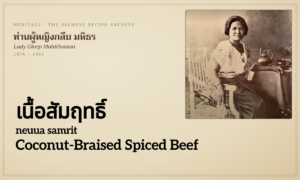
Coconut-Braised Spiced Beef (เนื้อสัมฤทธิ์; neuua samrit)
Neuua samrit — beef tenderloin dry-braised in coconut milk with roasted coriander and cumin, glazed dry. Lady Gleep Mahithaawn, 1949.
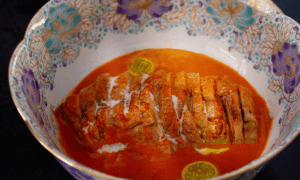
Pan Roasted Duck Breast and Hairy-Fruited Eggplant Curry (แกงเป็ดคั่วมะอึก; gaaeng bpet khuaa maeuk)
The hairy-fruited eggplant, known as ‘maeuk’ in Thai, is similar to the tomato in its unique confluence of sweetness, fruitiness, and savoriness. This ingredient is used in a wide range of Siamese dishes, including curries, salads, relishes, and seasoned rice dishes. This recipe, from the central region of Thailand, is a traditional duck khuaa sohm curry (แกงคั่วส้มเป็ด) that commonly uses garden ingredients to achieve sourness, including the madan (garcinia schomburgkiana) (มะดัน), the sour bilimbi fruit (averrhoa bilimbi) (ตะลิงปลิง), and the hairy-fruited eggplant.
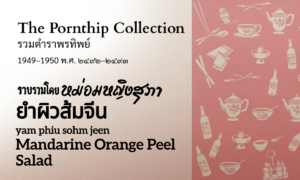
Mandarine Orange Peel Salad (ยำผิวส้มจีน; yam phiu sohm jeen)
Yam phiu sohm jeen features carefully prepared mandarine orange peel combined with minced shrimp and pork. From Maawm Ying Soophaa's 1949 royal Thai culinary manuscript.
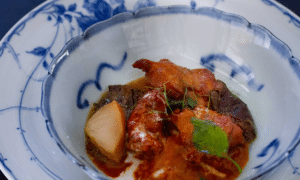
Duck Curry with Prunes and Apples (แกงเป็ดกับพรูนและแอปเปิ้ล อย่าง ม.ล. เติบ ชุมสาย; gaaeng bpet gap phruun lae aaep bpeern)
When it comes to pairing fruits with meats in savory dishes, it’s hard to match the bold tangy-luscious combination of apples and prunes in this old-fashioned coconut-based spicy curry with braised duck. The dish is seasoned to a spicy, salty, and sour-sweet flavor profile, which is further intensified by the prunes’ subtle nectareous, savory-sweetness and the apples’ fruity, sweet-tartness. This curry is a perfect example of how fruits can complement the already complex and profound aromatic relationships between meaty-savory flavors, the curry paste’s aromatic identity, and the dish’s herbal character of Thai basil and fresh peppercorns – creating a most memorable flavor impression.
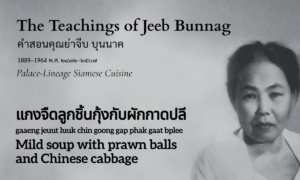
Mild soup with prawn balls and Chinese cabbage (แกงจืดลูกชิ้นกุ้งกับผักกาดปลี; gaaeng jeuut luuk chin goong gap phak gaat bplee)
Gaaeng jeuut with steamed prawn-and-cabbage rolls in a clear shiitake broth with fried garlic, from Jeeb Bunnag's 1933 cookbook.
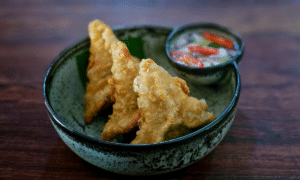
The Elegance of Khanohm Khaang Khaao (ขนมค้างคาว)
If palaces represent grandeur and wealth within a society, and poems often focus on emotional experience or the beauty of language, then the significance of a dumpling may be inferred by its structured elegance and minimalism – each fold and pleat a deliberate act, and each filling a curated experience constructing comfort in its most elemental form.
Khanom khaang khaao (ขนมค้างคาว) is a traditional Siamese fried, triangular-shaped dumpling with obvious Chinese origins. Its earliest recorded recipe can be traced back to Jao Khraawk Thaawng Yuu (เจ้าครอกทองอยู่), a distinguished aristocrat from the royal court of Ayutthaya. Historical records indicate that, from the early days of the Rattanakosin era, her recipe was a favored snack within the Siamese royal court.
These dumplings are shaped like triangles and, according to some, resemble bats: For this reason, they are called khanom khaang khaao (ขนมค้างคาว) – ‘the bat’s treat’. The dumpling’s dough is made from rice and mung bean flours; its filling is prepared by combining grated coconut and shrimp meat, which are cooked together into a dense, flavorful mixture that brings out the nutty-sweet taste of the grated coconut and the savory-sweet flavors of the shrimp. Kaffir lime leaves, sliced into hair-thin juliennes, add a hint of citrus.
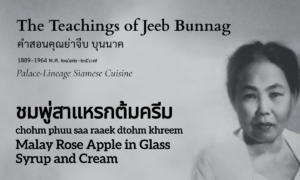
Malay Rose Apple in Glass Syrup and Cream (ชมพู่สาแหรกต้มครีม; chohm phuu saa raaek dtohm khreem)
Chohm phuu saa raaek dtohm khreem: Malay apple wedges simmered in strained glass syrup, served chilled with cream. Jeeb Bunnag, 1933.
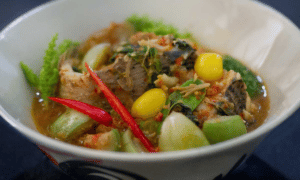
Kanchanaburi-Style Snakehead Fish Jungle Curry with Bitter Yellow Eggplants (แกงป่าปลา ; gaaeng bpaa bplaa)
This recipe is adapted from a recipe I obtained from a jungle food restaurant in Kanchanaburi province. The paste is a downgrade of a phrik khing paste – it omits the coriander roots and shallots. In addition, the recipe substitutes the fermented shrimp paste (kapi) with maawn fermented fish paste (กะปิมอญ; gabpi maawn), which is a popular ingredient among the Mon-Burmese population of the western province. The lack of shallots eliminates any sweetness that might impair the sharpness and heat of the dish. Furthermore, a double hit of citrus notes from holy basil are infused into the dish: from the holy basil flowers added to the paste and the holy basil leaves added to the curry.
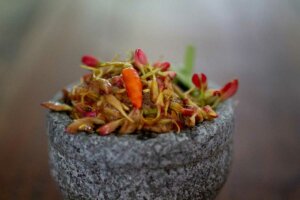
Tamarind flower chili relish inspired by Princess Jongjittanom Dissakul (น้ำพริกดอกมะขาม อย่าง หม่อมเจ้าหญิงจงจิตรถนอม ดิศกุล ; naam phrik daawk makhaam)
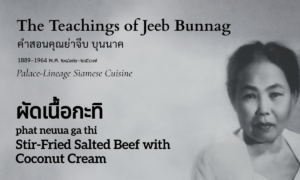
Stir-Fried Salted Beef with Coconut Cream (ผัดเนื้อกะทิ; phat neuua ga thi)
Phat neuua ga thi, grilled sun-dried salted beef shredded and wok-tossed in thick coconut cream with shallots. Jeeb Bunnag, 1933.
Traditional Sampanee Confection (ขนมสำปะนีแบบเดิม; khanohm sam pa nee baep deerm)
Khanom sampanee, dry-roasted glutinous rice flour and coconut milk set by sugar recrystallization, scented with jasmine. Jeeb Bunnag, 1933.
Thong Yip Naan Nueng (ทองหยิบนานนึ่ง; thaawng yip naan neung)
Thong Yip Naan Nueng, mold-fried wheat batter with crab, pork, and chicken, inverted mid-fry until golden. From Gingganok Gaanjanaaphaa, 1935.
Crispy Cooked Liver (ตับสุกกรอบ; dtap sook graawp)
Dtap sook graawp, pork liver boiled then deep-fried in a coconut cream batter with garlic and coriander root. Jeeb Bunnag, 1933.
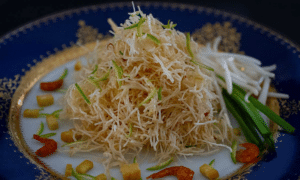
Sour-Sweet Savory Crispy Rice Vermicelli with Bitter Orange (Mee Krob) (หมี่กรอบส้มซ่าทรงเครื่อง ; Mee Graawp)
mee graawp sohng khreuuang (หมี่กรอบทรงเครื่อง), is an exquisitely regal dish of crispy rice vermicelli. The delicate noodles strands are washed and dried, then fried to a crisp light-golden hue. They retain their brittle crunch and airy texture even after being stir-fried with a clinging sticky sauce that encases the noodles in a thin layer of sheen. This sauce, mixed into the noodles together with other ingredients such as thin slices of pickled garlic and bitter orange peel, impart the dish with a light, fresh sweet and sour, and slightly salty and citrusy glaze.

Into The Woods – The Story of Jungle Curry (แกงป่า; gaaeng bpaa)
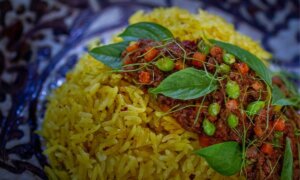
c1935 "Dry Curry" with beef over coconut infused jasmine rice (แกงแห้ง ตำรับสายเยาวภา พ.ศ. 2478 ; gaaeng haaeng)
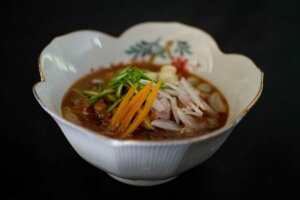
Kapi pla, an old-fashioned fermented shrimp paste relish (กะปิพล่า ; gabpi phlaa)
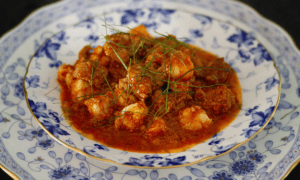
Coconut Cream-Based Chuu Chee of Pork and Shrimp Glazed with Shrimp Tomalley (แกงฉู่ฉี่หมูกับมันกุ้ง; gaaeng chuu chee muu gap man goong)
In the context of Siamese samrub meal planning, this thick chuu chee of pork and shrimp with a reddish coconut-based, curry-like sauce is considered a side dish (ของจาน; khaawng jaan). It consists of small, equal-sized slices of pork meat and shrimp fried in coconut cream together with a phrik khing curry paste. With no other vegetables or herbs, the dish is seasoned using fish sauce and palm sugar to a salty and only slightly sweet profile. Finally, it is glazed with shrimp tomalley poured on top and left unstirred, then cooked covered with the lid on, until the tomalley is baked-cooked. When serving, garnish with hair-thin juliennes of kaffir lime leaves and hand-picked coriander leaves.
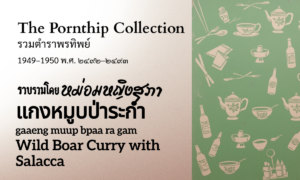
Wild Boar Curry with Salacca (แกงหมูบป่าระกำ; gaaeng muup bpaa ra gam)
Gaaeng muup bpaa ra gam, wild Boar curry with sourness from both tamarind and crushed salacca. From Maawm Ying Soophaa's Divine Dishes, 1949.
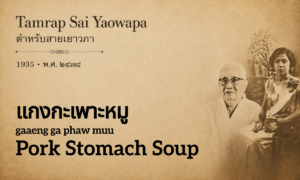
Pork Stomach Soup (แกงกะเพาะหมู; gaaeng ga phaw muu)
Gaaeng ga phaw muu: pork stomach and chicken broth built in two stages with a fried coriander-root pounding. Tamrap Sai Yaowapa, 1935.
1
2
3
4
5
6
7
8
9
10
11
12
13
14


Get Access – Join Thaifoodmaster Today
Practical and kitchen-tested recipes with a mix of theory, history, psychology, and Siamese culture tidbits.
-
Get access to everything right away. Unlock more than 50 Masterclasses, over 700 recipes and Articles
Access to Thaifoodmaster’s constantly growing library of prime professional classes, articles, recipes and videos on Siamese culinary topics, available nowhere else in English.
-
GET EXTRA - New Masterclasses and Daily Recipes
Gain access to NEW masterclasses as they become available. Access DAILY translations of heritage-recipes.
-
1-1 support from Hanuman
1-1 support from Hanuman to help you achieve your professional Thai culinary goals
-
Live Q&A Sessions
The opportunity to join a monthly live two-hour videoconference where I can answer your questions.
-
Great Value!
one year access for the price of 3 days in-person training.
You will get everything you need to:
-
To Get inspired
When you design or build a new menu for an event or restaurant or even prepare for dinner with friends.
-
To Satisfy your curiosity.
Finally !
-
To Master Your Craft
Master your Thai cooking skills and expand your repertoire.
It is truly brilliant with a revolutionary approach introducing aspects and concepts never broached by cookbooks.

Ian Westcott
Sourcing Wines for Discerning Private Clients
© 2008 – 2026 Thaifoodmaster


