
Celebrating the Art of Siamese Culinary Wisdom and Thai Cuisine
Home > Heritage – Siamese Recipe Archive
The Pornthip Collection (รวมตำราพรทิพย์)
The author published under the name Mom Ying Supha (หม่อมหญิงสุภา), signing one preface as M.L. Ying Supha (ม.ล. หญิงสุภา)—a title indicating royal descent. No further biographical record has been located. On the cover of Pornthip's Savory Dishes (กับข้าวพรทิพย์), she advertised that her recipes were "Royal kitchen-tested" and had been cooked, savored, and enjoyed by high-ranking members of the Royal family. (เป็นตำรับจากห้องเจ้านายเสวยสบพระทัยมาแล้ว)
In her prefaces, she set out a philosophy: Thai cooking relies on estimation, on tasting and adjusting, on what she called roht meuu (รสมือ)—one's delectable hands. Some cooks possess skill and knowledge of all ingredients, she wrote, yet lack "charm in the touch" (เสน่ห์ในรสมือ). Their cooking lacks deliciousness, lacks thoughtfulness, and fails to win appreciation from family and society.
Between 1949 and 1950, she published four books through Chamroen Sueksa (จำเริญศึกษา) in Bangkok: Thai salads, savory dishes, sweets, and a five-volume set spanning Thai, Chinese, and Western cooking. The table of contents reveal dishes with names shaped by court culture—Egg of the Moon (เครื่องเคียงไข่ดวงเดือน), Three Kings (เครื่องเคียงสามกษัตริย์), Pretending to Be Delicious (เครื่องจิ้มแสร้งว่าอร่อย). The identity behind the pen name may remain unknown. The recipes do not.
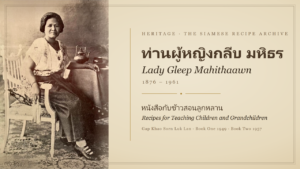
Recipes for Teaching Children and Grandchildren (หนังสือกับข้าวสอนลูกหลาน) - Collection Introduction
The 1949–1957 household cookbook of Lady Gleep Mahithaawn (ท่านผู้หญิงกลีบ มหิธร, 1876–1961), dictated to her grandchildren near the end of her life. Two hundred forty-eight recipes of aristocratic Siamese home cooking — fermented rice noodles, curries and soups, Thai salads, stir-fries, dips and relishes, and a full book of fruit, savory snacks, and sweets — each presented with the original Thai manuscript, a direct translation, and the household measures of the period kept as she gave them.
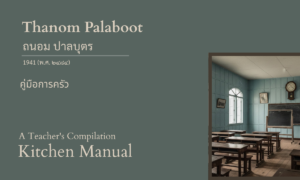
Thanom Palaboot (ถนอม ปาลบุตร) - A Teacher's Compilation
Thanom Palaboot (ถนอม ปาลบุตร) was a teacher at the Girls' School (โรงเรียนสตรี) in Maha Sarakham Province (จังหวัดมหาสารคาม) when she compiled this four-volume kitchen manual (คู่มือการครัว) in May 1941 (พฤษภาคม พ.ศ. ๒๔๘๔). She wrote from the northeastern region (ภาคอีสาน), far from Bangkok (กรุงเทพฯ), producing a work intended for practical household instruction.
She had researched and compiled cooking recipes (ตำราปรุงอาหาร), organizing them into categories as a household manual for her own use. Friends and fellow teachers (เพื่อนครู) urged her to publish, and she undertook further research to meet their expectations. Her sources were multiple: teachers and professors (ครูและอาจารย์), textbooks (ตำรา), explanations from those with expertise (ผู้ชำนาญ), and friends who shared her interest in cooking.
The series totals approximately 800 recipes across four volumes covering curries (แกง), salads (ยำ), stir-fries (ผัด), fried dishes (ทอด), dipping sauces (เครื่องจิ้ม), side dishes (เครื่องเคียง), snacks (ของว่าง), sweets (ของหวาน), and beverages (เครื่องดื่ม).
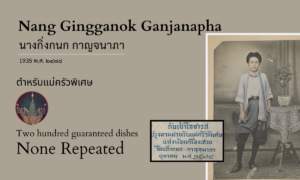
Nang Gingganok Gaanjanaaphaa (กิ่งกนก กาญจนาภา) - None Repeated
Gingganok Gaanjanaaphaa (กิ่งกนก กาญจนาภา) opened her 1935 cookbook with a complaint: the market was flooded with small recipe pamphlets, each copying the others, changing only the name on the cover. A buyer who purchased two or three books received the contents of one. Her solution was consolidation—recipes from the special cooks of the royal kitchen (แม่ครัวพิเศษแห่งห้องเครื่องเสวย), assembled into a single volume. Over two hundred preparations, none repeated.
She wrote from a seaside house in Hua Hin (หัวหิน), completing the manuscript in July 1935 (พ.ศ. ๒๔๗๘). Three women contributed to the compilation: Khun Praphai, Khun Jira, and Khun Noi—thanked for recipes "beyond her own ability to find." The book appeared that October, priced at three baht.
No biographical record of Gingganok beyond this text has been located. The royal kitchen staff whose recipes fill the collection are not named. What survives is the cooking itself: technique, proportion, and method as these women understood royal kitchen practice in the mid-1930s.
Dtam Raa Khraawp Lo:hk (ตำราครอบโลก) A Cookbook Encompassing the World
Handpicked recipes from Tamra Khraawp Lo:hk (ตำราครอบโลก, 1929), an early Thai cookbook holding regional, household, palace, and foreign repertoires under one technique sequence.
Memorial Book Culinary Selections (หนังสืองานศพ)
Memorial Book Culinary Selections (หนังสืองานศพ) - A historical Thai recipe from our archives.
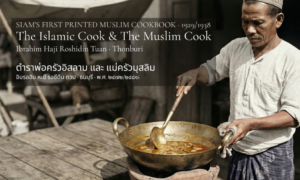
The Islamic Cook & The Muslim Cook (ตำราพ่อครัวอิสลาม และ แม่ครัวมุสลิม)
Recipes from Thailand's first documented Thai-Muslim cookbook, published by Ibrahim Haji Roshidin Tuan (อิบรอฮิม หะยี รอซีดีน ตวน) of Thonburi. The collection originated in 1929 as "The Islamic Cook" (ตำราพ่อครัวอิสลาม), later expanded in 1938 as "The Muslim Cook" (แม่ครัวมุสลิม). Ibrahim was a professional caterer working weddings, funerals, and hired events—his recipes specify quantities for feeding crowds and preserve techniques from working Thai-Muslim kitchens of the era.
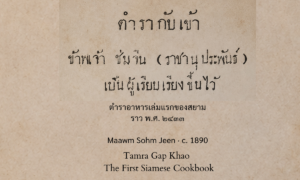
Tamra Gap Khao (ตำรากับเข้า) - The First Record and the First Cookbook
Tamra Gap Khao (ตำรากับเข้า) - The First Record and the First Cookbook - A historical Thai recipe from our archives.
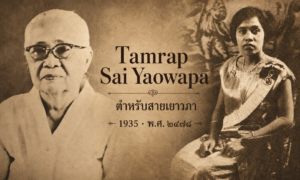
Heritage page - Tamrap Sai Yaowapa (ตำหรับสายเยาวภา)
Compiled by M.R. Tuang Sanitwong (ม.ร.ว.เตื้อง สนิทวงศ์) and first printed in 1935 as the cremation volume of Princess Yaowaphaphongsanit (พระเจ้าบรมวงศ์เธอ พระองค์เจ้าเยาวภาพงศ์สนิท), Tamrap Sai Yaowapa (ตำหรับสายเยาวภา) records 195 recipes of the royal Siamese kitchen alongside chapters on cooking terms, seasonings, food arrangement, meats, fish and vegetables. Western and Chinese methods sit beside Siamese ones throughout — consommés, double-boiled soups and sago broths entering a palace repertoire in the 1930s.
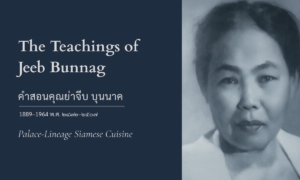
The Teachings of Jeeb Bunnag (คำสอนคุณย่าจีบ บุนนาค)
In 1929, fire destroyed her home in Bang Krabue—manuscripts, possessions, the material inheritance of generations. What survived was knowledge. Trained by Lady Plean Passakornrawong in the palace kitchens, she carried a culinary tradition that could not burn. Four years later, she began publishing. She signed her books with her actual address so anyone could write to her.
This archive gathers recipes from across her publications, spanning four decades from her 1933 Samrub Raawp Bpee (สำรับรอบปี) to works published after her death in 1964. Each preparation carries her teaching method—tested instructions, structural logic preserved, substitutions provided for those with dietary restrictions. Palace technique made accessible. Court cuisine adapted for household kitchens. The grammar of Siamese cooking recorded by someone who carried it by birthright and gave it away through teaching.
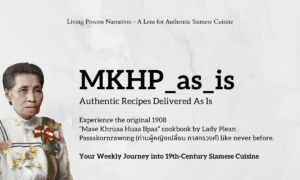
MKHP_as_is — Lady Plean Passakornrawong's Maae Khruaa Huaa Bpaa (แม่ครัวหัวป่าก์ ท่านผู้หญิงเปลี่ยน ภาสกรวงศ์) (1908)
Recipes from Siam's first printed cookbook, published in 1908 by Lady Plean Passakornrawong (ท่านผู้หญิงเปลี่ยน ภาสกรวงศ์). The collection documents late 19th-century Siamese cuisine from palace banquets to household cooking, recorded with archaic weight systems and traditional techniques. Lady Plean was a noblewoman of the Rama V court—her recipes preserve methods and ingredients from a culinary world now largely inaccessible.

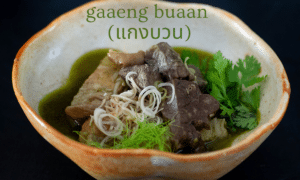
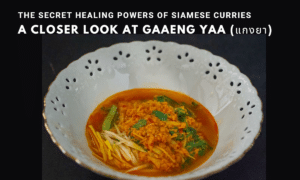
Get Access – Join Thaifoodmaster Today
Practical and kitchen-tested recipes with a mix of theory, history, psychology, and Siamese culture tidbits.
-
Get access to everything right away. Unlock more than 50 Masterclasses, over 700 recipes and Articles
Access to Thaifoodmaster’s constantly growing library of prime professional classes, articles, recipes and videos on Siamese culinary topics, available nowhere else in English.
-
GET EXTRA - New Masterclasses and Daily Recipes
Gain access to NEW masterclasses as they become available. Access DAILY translations of heritage-recipes.
-
1-1 support from Hanuman
1-1 support from Hanuman to help you achieve your professional Thai culinary goals
-
Live Q&A Sessions
The opportunity to join a monthly live two-hour videoconference where I can answer your questions.
-
Great Value!
one year access for the price of 3 days in-person training.
You will get everything you need to:
-
To Get inspired
When you design or build a new menu for an event or restaurant or even prepare for dinner with friends.
-
To Satisfy your curiosity.
Finally !
-
To Master Your Craft
Master your Thai cooking skills and expand your repertoire.
It is truly brilliant with a revolutionary approach introducing aspects and concepts never broached by cookbooks.
Ian Westcott
Sourcing Wines for Discerning Private Clients
© 2008 – 2026 Thaifoodmaster


