
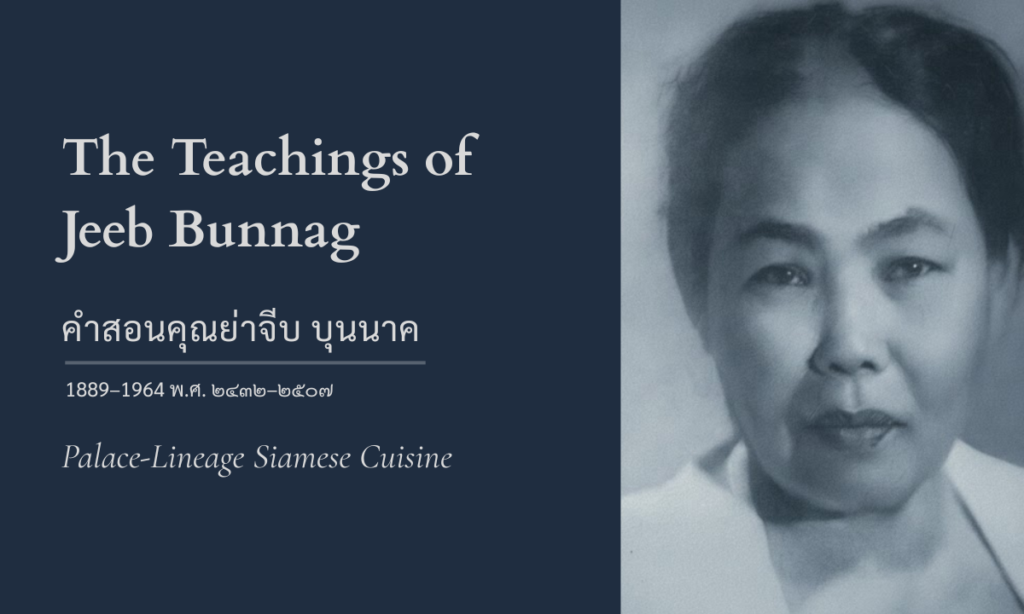
The Teachings of Jeeb Bunnag
1889–1964 พ.ศ. ๒๔๓๒–๒๕๐๗
Palace-Lineage Siamese Cuisine
คำสอนคุณย่าจีบ บุนนาค
Mrs. Samaknantapol (Jeeb Bunnag) (นางสมรรคนันทพล (จีบ บุนนาค)) was born in 1889 (พ.ศ. ๒๔๓๒) into the Chuto (ชูโต) clan, the same lineage as Lady Plean Passakornrawong (ท่านผู้หญิงเปลี่ยน ภาสกรวงศ์). Her father, Nawam Chuto (น่วม ชูโต), and Lady Plean’s father, Ploy Chuto (พลอย ชูโต), descended from the same patriarch. This blood connection preceded her marriage in 1909 (พ.ศ. ๒๔๕๒) to Puech Bunnag (พืช บุนนาค), Lady Plean’s grandson, which made her both blood relative and daughter-in-law to the author of Mae Khrua Hua Pak (แม่ครัวหัวป่าก์).
She trained in the palace kitchens under Lady Plean’s direct instruction. The knowledge she received came through apprenticeship in the Classical Rattanakosin tradition of court cuisine—methods codified in the era of King Rama II’s poetry, transmitted through demonstration, repetition, and correction.
In January 1929 (พ.ศ. ๒๔๗๒), fire destroyed her home in Bang Krabue (บางกระบือ), consuming her possessions and inherited manuscripts. She and her family escaped with their lives and the clothes they wore. From this loss, she drew a principle she later recorded: “Wisdom is a companion in times of hardship; it never deserts one” (วิชชาเป็นเพื่อนตัวในวันยาก หากชื่อจุดยงครอย์). The destruction of material inheritance clarified what could not burn.
Four years later, in 1933 (พ.ศ. ๒๔๗๖), she published Samrub Raawp Bpee (สำรับรอบปี) under the pen name Laan Mae Khrua Hua Pak (หลานแม่ครัวหัวป่าก์), meaning “Descendant of Mae Khrua Hua Pak.” The three-volume work presented 365 complete samrub—traditional Siamese meal sets for morning, lunch, tea, and dinner—arranged so that no day repeated. The structure documented daily rhythms of eating that were already disappearing from common practice, preserving the organizational logic of palace meals alongside individual preparations.
Her pen name carried specific meaning. The Thai word laan (หลาน) denotes a blood descendant, and her memorial later confirmed this relationship by using laan paa (หลานป้า) rather than the terms for in-law connection. She claimed her authority by birthright.
The 1933 (พ.ศ. ๒๔๗๖) preface reveals her teaching methods. She states that every recipe was tested and invites readers to observe her demonstrations, whether in person or by correspondence. She acknowledges readers who avoid shrimp paste, fish sauce, fermented fish, beef, or pork, and provides substitutions that maintain the structural logic of each preparation. She addresses the economic conditions of the 1930s directly, explaining that monthly publication reduced costs for both production and purchase. She closes by signing with her full name, pen name, and actual address at Thanon Nong Krak (ถนนนองครักษ์), Bang Krabue (บางกระบือ)—making palace culinary knowledge directly reachable to anyone who wished to correspond.
Following Lady Plean’s example, she concluded each meal set with a literary selection. These passages framed cooking within a larger order of memory, conduct, and cultivation.
Her teaching career spanned decades at institutions including Gaan Reuuan School (โรงเรียนการเรือน), Suan Dusit Teachers’ College (วิทยาลัยครูสวนดุสิต), and Sarit Sa-nga School (โรงเรียนสฤติสง่า). She advocated for vocational schools in every province where girls could learn cooking alongside sewing and weaving—skills that could provide financial independence.
Her teachings were documented across several publications:
- 1933 (พ.ศ. ๒๔๗๖): Samrub Raawp Bpee (สำรับรอบปี) — Year-round meal sets in three volumes
- 1954 (พ.ศ. ๒๔๙๗): Dtamraa Aahaan Waang – Khreuuang Naam Chaa Lae Khreuuang Khiaao (ตำราอาหารว่าง – เครื่องน้ำชา และ เครื่องเคี้ยว) — Snacks, tea service, and accompaniments
- 1956 (พ.ศ. ๒๔๙๙): Special memorial edition of Dtamraa Mae Khrua Hua Pak (ตำราแม่ครัวหัวป่าก์), containing her recollection of seeing Lady Plean’s beeswax flowers
- 1977 (พ.ศ. ๒๕๒๐, posthumous): Pheua Saai Jai Thai – Dtamraa Gap Khaao (เพื่อสายใจไทย-ตำรากับข้าว) — Published thirteen years after her death
She died on May 21, 1964 (พ.ศ. ๒๕๐๗), at seventy-eight years old.
This archive gathers her teachings from across these publications. The preparations reflect palace training adapted for household kitchens, the integration of Muslim, Chinese, and Indian techniques into Siamese cuisine, and the systematic instruction of a teacher who understood that clarity serves students she would never meet.
Index of Recipes
About the Siamese Recipe Archive
The Archive collects and translates historical Thai culinary manuscripts—primary sources written by the cooks, noblewomen, and food professionals who shaped the cuisine of the Rattanakosin era. Each document records practical knowledge shaped by its moment: what was available, what the tradition demanded, what a specific cook decided under real constraints.
Visit Heritage

The life of Mrs. Samaknantapol (Jeeb Bunnag) (นางสมรรคนันทพล (จีบ บุนนาค)) offers a direct view into the transmission of Thai culinary knowledge across a century of change. Her teaching, writing, and documentation preserved the structures of palace cuisine while shaping methods that could be studied and applied in classrooms throughout modern Bangkok.
Her 1933 work Samrub Raawp Bpee (สำรับรอบปี) remains an unparalleled record: 365 complete Samrub, old style Siamese meal sets, arranged with precision, reflecting daily rhythms of eating that were already disappearing from common practice. Through her work, we can study not only individual dishes but also the organization of meals and the cultural reasoning that guided them.
As someone who follows her teaching, I approach this story with both historical and practical attention. Her writing has informed my own study of Thai cuisine, and years of cooking from her instructions have shown me the clarity and discipline of her teaching. This account presents her life within its contexts—family, education, print culture, and the evolving society of twentieth-century Siam—while also acknowledging how her work continues to guide readers today.

Roman Tube Noodles, a 1945 Thai-Western fusion dish with rich duck broth and macaroni. From Jeeb Bunnag’s ‘Cookbook of Desserts, Tea Accompaniments, and Snacks or Appetizers’.
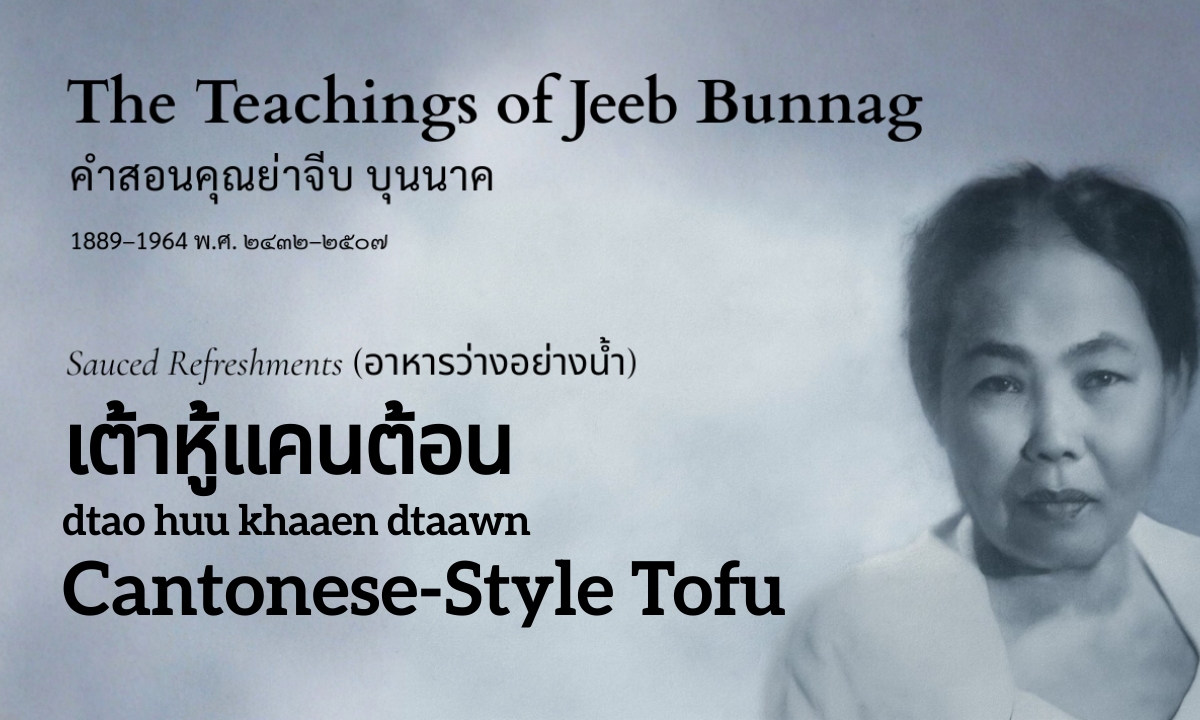
Cantonese-Style Tofu, an elaborate Thai-Cantonese fusion dish featuring stuffed tofu and squid with pork offal in sweet-sour sauce. From Jeeb Bunnag’s 1945 cookbook.
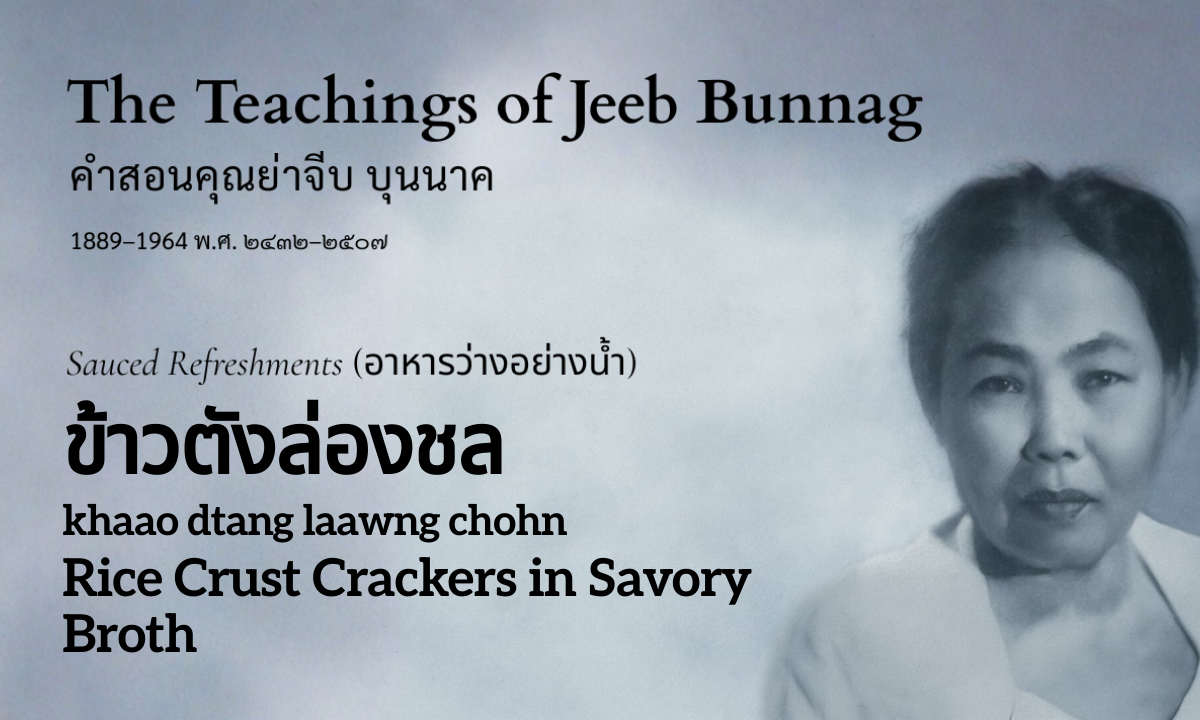
Khaao dtang laawng chohn, crispy rice crackers served with umami-rich seafood broth. From Jeeb Bunnag’s 1945 cookbook of Thai appetizers.
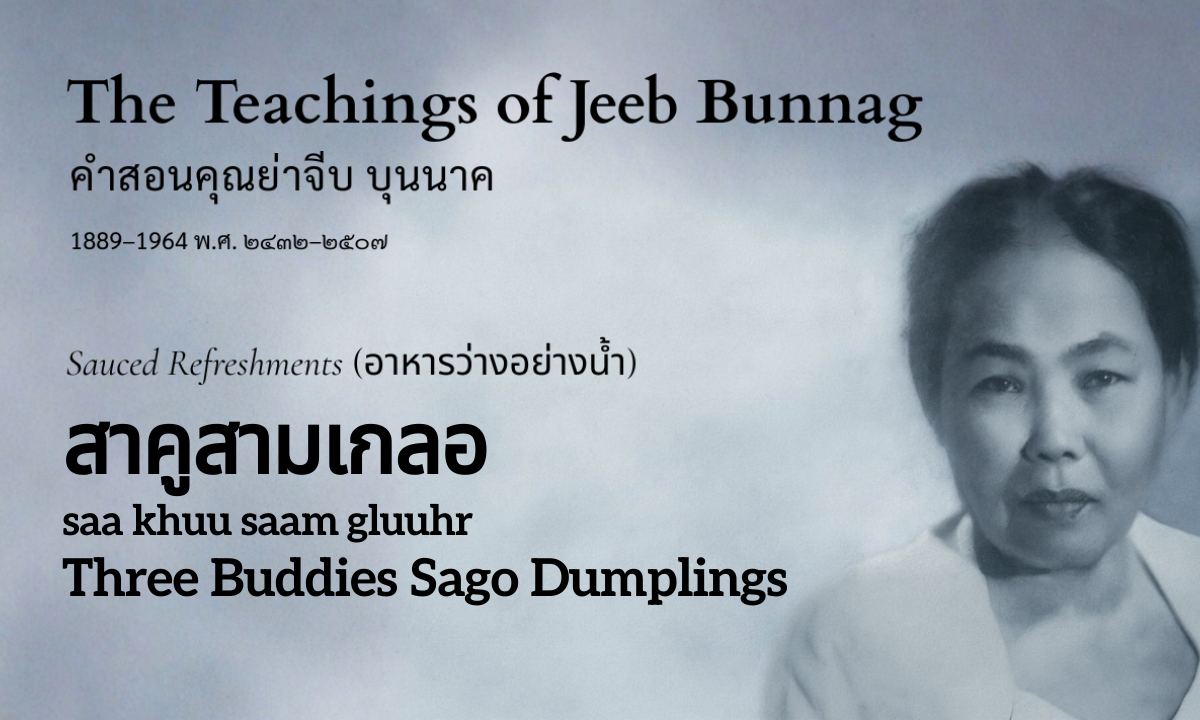
Three Buddies Sago Dumplings combine chicken, pork, and shrimp coated in translucent sago pearls and served in clear broth. From Jeeb Bunnag’s 1945 cookbook.


