
Celebrating the Art of Siamese Culinary Wisdom and Thai Cuisine
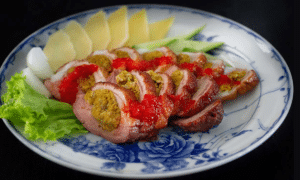
Roasted Stuffed Duck Breast with Chestnuts and Mackerel (เป็ดยัดไส้เกาลัดรมควัน; bpet yat sai gaolat rohm khwan), circa 1935
Smoked duck stuffed with a mackerel and chestnut filling is a dish that defies cultural boundaries. An exemplar of blended culinary influences, featuring inviting colors and an elegant presentation that serve as a prelude to the complex flavors and textures that await, the dish is an eloquent testament to the cooking style of Mrs. Samaknantapol (Jeep Bunnag, who went by the pen name “the granddaughter of Maae Khruaa Huaa Bpaa”). In the 1930s. Mrs. Jeep Bunnag published her first cookbook. Following in the footsteps of her revered grandmother-in-law, Lady Plean Passakornrawong, she continued to document the art of Siamese cuisine through the treasured books she published and was known for her ability to merge culinary traditions into beautiful and innovative dishes that represent an era.
The rich, dark color of the smoked duck’s skin is visually striking and appetizing, evoking a sense of indulgence and luxury. The smoky flavors that permeate the meat reflect our deep connection to primal cooking techniques, a fascinating juxtaposition to the refined presentation of the dish. When the smoked duck is sliced, its succulent pink meat is revealed, surrounding the golden filling of chestnuts and mackerel.
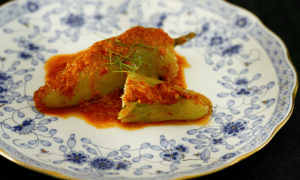
Chuu Chee Curry of Stuffed Banana Chilies with Pork, Shrimp and Crab Meat (ฉู่ฉี่พริกสอดไส้ ; chuu chee phrik yuaak saawt sai)
This chuu chee features avocado-green banana chilies and the pinkish mixture of pork, shrimp and crab meats. The chilies are sliced open and stuffed with a mixture of the meats, which is seasoned with the basic saam gluuhr (สามเกลอ) paste – the Siamese trio of coriander roots, Thai garlic and white peppercorns. The stuffed chilies are then steamed before being cooked in a thick, reddish, coconut cream-based curry. The liquids collected in the tray during the steaming process are packed with the light sweet fruitiness of the banana chilies; these liquids are reserved and added to the broth, producing a bright and light-bodied dish.
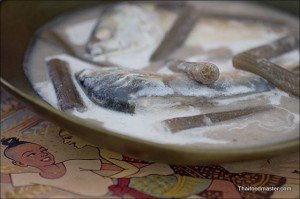
แกงกะทิสายบัวปลาทูนึ่ง
This old-fashioned Thai coconut curry dish is a simple expression made with ingredients commonly available to Thais, it features steamed mackerels - the fish that Thai people probably love the best and the stems of the lotus flowers - one of Buddhism's most recognized motifs.
The fish together with peeled lotus stems are boiled in coconut milk, to which a simple yet very aromatic curry paste, made only of white pepper corns, shallots and fermented shrimp paste is added.
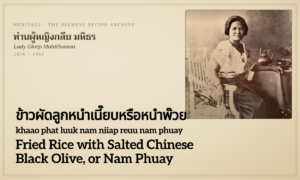
Fried Rice with Salted Chinese Black Olive, or Nam Phuay (ข้าวผัดลูกหนำเนี๊ยบหรือหนำพ๊วย; khaao phat luuk nam niiap reuu nam phuay)
Khao phat luk nam nieb: salted Chinese black olive, shelled and mashed fine, tossed through rice. Lady Gleep Mahithaawn, 1949.
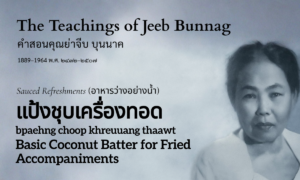
Coconut Batter for Fried Accompaniments (แป้งชุบเครื่องทอด; bpaehng choop khreuuang thaawt)
Coconut Batter for Fried Accompaniments, a rice flour mixture kneaded with limestone solution until glossy. From Jeeb Bunnag's 1945 cookbook of Thai snacks and desserts.
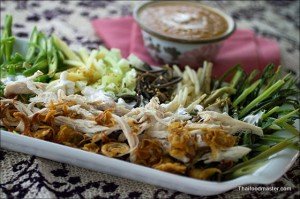
ยำทวาย
This recipe would probably change your perception about the term "salad", maybe because its dressing has a multi layered, curry-like personality, rather than the common sour vinaigrette-like dressing, or maybe because it takes some good few hours to prepare, somewhat longer than simply opening a bag of hydroponic greens.
This salad is the fruit of the dedication of court ladies from aristocratic households, that for centuries perfected and elaborated on the art of cooking through detailed and calculated process, to create sophisticated dishes that are not only delicious but also very healthy and visually pleasing.
These ladies made a very large commitment for small things, and they attended all their time and efforts to make minor things better and getting the small things just right.
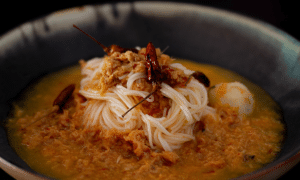
Khanohm Jeen Naam Yaa (ขนมจีนน้ำยา) - Fermented Rice Noodles with Minced Fish in Aromatic Coconut Curry
In the Central Plains of the Kingdom, fermented rice noodles are inextricably linked to a dish known as naam yaa. Composed of a dense, coconut-based minced fish curry, the dish is infused with layers of salted fish and possesses the distinctive, invigorating and purifying notes of fingerroot. Typically, naam yaa is served with fresh lemon basil as the herb of choice along with an array of side dishes collectively known as meuuat khanohm jeen (เหมือดขนมจีน). These include blanched bean sprouts seasoned with a touch of turmeric for color, fresh lemon basil leaves, thinly sliced three colored chilies, and ground chili for added heat. More elaborate versions will add blanched Chinese bitter gourd slices, batter-fried young morning glory shoots, and fresh shrimp minced and fried with its tomalley in pork lard, as well as crispy-fried shallots as the finishing touch.
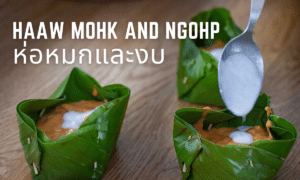
Haaw Mohk and Ngohp (ห่อหมก และ งบ)
Spicy Swamp Eel Curry (แกงเผ็ดปลาไหล; gaaeng phet bplaa lai)
Gaaeng phet bplaa lai: swamp eel sliced and tossed with its own blood, simmered in a pork-lard-fried red curry paste. Maawm Sohm Jeen, 1890.
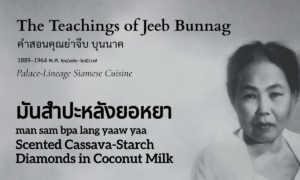
Scented Cassava-Starch Diamonds in Coconut Milk (มันสำปะหลังยอหยา; man sam bpa lang yaaw yaa)
Man sam bpa lang yaaw yaa: cassava starch diamonds kneaded with pandan, served in floral-scented coconut milk. Jeeb Bunnag, 1933.
Yam of Beef Innards (ยำเครื่องในโค; yam khreuuang nai kho:h)
Yam khreuuang nai kho:h, beef innards cleaned with slaked lime and dressed without coconut. From Maawm Sohm Jeen's Tamra Gap Khao, c. 1890.
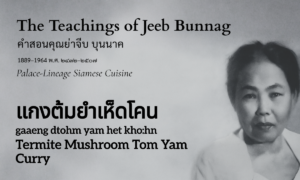
Termite Mushroom Tom Yam Curry (แกงต้มยำเห็ดโคน; gaaeng dtohm yam het kho:hn)
Gaaeng dtohm yam het khohn — termite mushrooms in reduced, strained stock with shredded chicken and crispy fried garlic. Jeeb Bunnag, 1933.
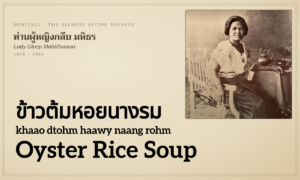
Oyster Rice Soup (ข้าวต้มหอยนางรม; khaao dtohm haawy naang rohm)
Khaao dtohm haawy naang rohm: raw oysters and egg set in the bowl by boiling soup, with a fried-garlic pork lard base. Lady Gleep Mahithaawn, 1949.
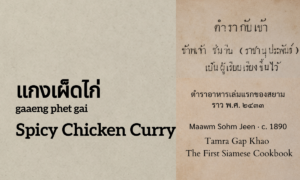
Spicy Chicken Curry (แกงเผ็ดไก่; gaaeng phet gai)
Gaaeng phet gai, chicken simmered in a pork-lard-fried red curry paste with optional brandy or sherry. From Maawm Sohm Jeen's Tamra Gap Khao, c. 1890.
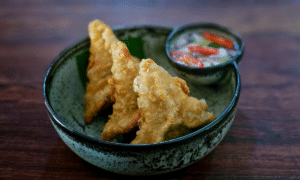
The Elegance of Khanohm Khaang Khaao (ขนมค้างคาว)
If palaces represent grandeur and wealth within a society, and poems often focus on emotional experience or the beauty of language, then the significance of a dumpling may be inferred by its structured elegance and minimalism – each fold and pleat a deliberate act, and each filling a curated experience constructing comfort in its most elemental form.
Khanom khaang khaao (ขนมค้างคาว) is a traditional Siamese fried, triangular-shaped dumpling with obvious Chinese origins. Its earliest recorded recipe can be traced back to Jao Khraawk Thaawng Yuu (เจ้าครอกทองอยู่), a distinguished aristocrat from the royal court of Ayutthaya. Historical records indicate that, from the early days of the Rattanakosin era, her recipe was a favored snack within the Siamese royal court.
These dumplings are shaped like triangles and, according to some, resemble bats: For this reason, they are called khanom khaang khaao (ขนมค้างคาว) – ‘the bat’s treat’. The dumpling’s dough is made from rice and mung bean flours; its filling is prepared by combining grated coconut and shrimp meat, which are cooked together into a dense, flavorful mixture that brings out the nutty-sweet taste of the grated coconut and the savory-sweet flavors of the shrimp. Kaffir lime leaves, sliced into hair-thin juliennes, add a hint of citrus.
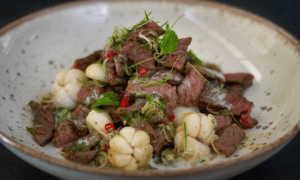
Grilled beef and mangosteen (or grape) salad with mint dressing, by Princess Jongjittanom Dissakul (ยำเนื้อย่างกับมังคุดหรือองุ่น; yam neuua yaang gap mangkhoot reuu angoon)
This grilled beef salad with luscious mangosteen (or grapes) is seasoned with a crisp, cooling dressing of fermented shrimp paste and mint. The mangosteen’s tropical character – a flavor redolent of many other fruits – dominates its fruity essence and is a perfect complement to both the grilled meat and the lingering, sour-salty-sweet, minty dressing. Furthermore, citrusy notes of thinly sliced lemongrass and kaffir lime leaves, coupled with richness of thickened coconut cream, unite the caramelized, meaty elements with the dish’s fruity spectrum.
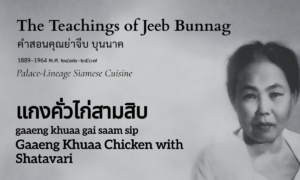
Gaaeng Khuaa Chicken with Shatavari (แกงคั่วไก่สามสิบ; gaaeng khuaa gai saam sip)
Gaaeng khuaa gai saam sip, chicken curry with young shatavari fruit; paste fried in rendered coconut oil. Jeeb Bunnag, 1933.
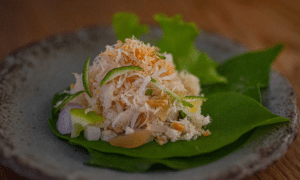
bplaa naaem (ปลาแนม) - A Siamese aristocratic small plate snack
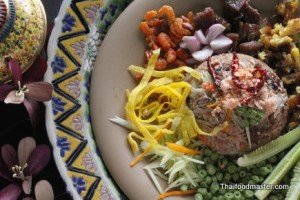
ข้าวคลุกกะปิ อย่างหม่อมเจ้าจงจิตรถนอม ดิศกุล
สูตรการทำข้าวคลุกกะปิของ หม่อมเจ้าจงจิตรถนอม ดิศกุล ซึ่งในสมัยนี้หาทานได้ค่อนข้างยาก โดยความเค็มเราจะได้จากกะปิ ความเปรี้ยวได้จากมะม่วงดิบ หรือ มะดัน ความมันจากปลาดุกย่างทอด และ กุ้งแห้ง ความหวานได้จากหมูหวาน สูตรนี้ มหาเสวกเอก พระยาบุรุษรัตนราชพัลลภ ได้เขียนลงในบันทึกชื่อ "บุรุษรัตน" ว่า ในครั้งสมัยรัชกาลที่ 5 เสด็จประพาสยุโรปครั้งที่สองในปี พ.ศ. ๒๔๕๐ ได้ทรงนำกะปิไปด้วย และรับสั่งกับพระยาบุรุษรัตนราชพัลลภว่า...
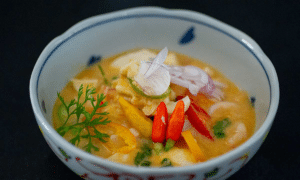
Salted duck eggs and shrimp creamy lohn (หลนไข่เค็ม ; lohn khai khem)
Lohn of salted duck eggs is a smooth, rich and creamy relish with a vibrant three-flavor profile of sour-salty-sweet. Unlike other lohn relishes, it does not contain any overbearing fermented ingredients, making it easy to enjoy, and it does not require an acquired taste.
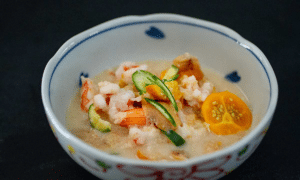
c1933 Luxurious lohn relish (น้ำพริกหลนหรู อย่าง จีบ บุนนาค เจ้าของนามปากกา "หลานแม่ครัวหัวป่าก์" พ.ศ. 2476 ; naam phrik lohn ruu)
A simple yet fun version of lohn relish is presented by Lady Plean’s granddaughter-in-law, Mrs. Samaknantapol (Jeep Bunnag) (นางสมรรคนันทพล, จีบ บุนนาค), in her 1933 book Sam Rap Raawp Bpee (สำรับรอบปี).
1
2
3
4
5
6
7
8
9
10

Get Access – Join Thaifoodmaster Today
Practical and kitchen-tested recipes with a mix of theory, history, psychology, and Siamese culture tidbits.
-
Get access to everything right away. Unlock more than 50 Masterclasses, over 700 recipes and Articles
Access to Thaifoodmaster’s constantly growing library of prime professional classes, articles, recipes and videos on Siamese culinary topics, available nowhere else in English.
-
GET EXTRA - New Masterclasses and Daily Recipes
Gain access to NEW masterclasses as they become available. Access DAILY translations of heritage-recipes.
-
1-1 support from Hanuman
1-1 support from Hanuman to help you achieve your professional Thai culinary goals
-
Live Q&A Sessions
The opportunity to join a monthly live two-hour videoconference where I can answer your questions.
-
Great Value!
one year access for the price of 3 days in-person training.
You will get everything you need to:
-
To Get inspired
When you design or build a new menu for an event or restaurant or even prepare for dinner with friends.
-
To Satisfy your curiosity.
Finally !
-
To Master Your Craft
Master your Thai cooking skills and expand your repertoire.
It is truly brilliant with a revolutionary approach introducing aspects and concepts never broached by cookbooks.

Ian Westcott
Sourcing Wines for Discerning Private Clients
© 2008 – 2026 Thaifoodmaster


