
Siamese Recipe Archive — Heritage Collection
Dtam Raa Khraawp Lo:hk (ตำราครอบโลก) A Cookbook Encompassing the World by Nor.Sor.Hor.Dor (น.ส.ห.ด)
Author: Nor.Sor.Hor.Dor (น.ส.ห.ด) — a pseudonym; Nor.Sor. abbreviates naang saao (Miss), with Hor.Dor. the author’s two-letter pen name
Proofreader: Norii (โนรี)
Publisher: Lee Hong Wan Sao Ching Chaa Press (โรงพิมพ์หลีหงวนเสาชิงช้า) — Bangkok
Year of publication: 1929 (พุทธศักราช ๒๔๗๒)
This entry: Volume 1, Part 1 — Thai cuisine (เล่ม ๑ ภาค ๑)
Dtam Raa Khraawp Lo:hk (ตำราครอบโลก) is among the earliest Thai cookbooks to print northeastern, northern, central-Thai household, palace, and foreign preparations under a single technique sequence. It contains the earliest published Thai recipe for sohm dtam in the form recognized today — sohm dtam ma la gaaw (ส้มตำมะละกอ) at page 70, six years before Princess Yaovabha Bongsanid’s khaao man sohm dtam (ข้าวมันส้มตำ), recorded by M.R. Tuang Sanitwong (ม.ร.ว.เตื้อง สนิทวงศ์) in Sai Yaowapa (ตำรับสายเยาวภา, 1935) as a samrub component. The book opens with ox or pig blood laap on page 28 and closes with a khaao chaae (ข้าวแช่) samrup on page 244 — a bookend that frames the volume’s geographic and social reach.
The author and the artifact
The author published under the initials Nor.Sor.Hor.Dor (น.ส.ห.ด) and supplied no other identifying information. No biographical record has been located. The proofreader signs as Norii (โนรี) and dates her closing note 7 January 2476 (๗ มกราคม ๒๔๗๖), four years after the imprint year, while the second volume was being typeset. Volume 1 issued from a press at Sao Ching Chaa (เสาชิงช้า) in Bangkok, in the reign of King Prajadhipok (Rama VII), on the inexpensive paper used for Thai trade publications of the late 1920s.
The preface
The preface is a speculative natural history of cooking. The author traces food preparation from a time before metal blades, when people foraged leaves and tore raw flesh with stone-sharpened nails, then learned to bring down game with arrow, lance, and snare. She gives the resulting dish two names — laap (ลาบ) and dtaak (ตาก) — and derives both from laap (ลาภ), fortune, since meat obtained from forest (ป่า), waterside (ท่า), or stream (ธาร) was reckoned as a windfall.
The natural history continues by accident. Surplus meat hung near sacred fires — offered to the fire-deity for safekeeping — emerged smoke-dried, hot from the coals, and edible; from this discovery come phao (เผา), bping (ปิ้ง), yaang (ย่าง), and mohk (หมก). The dryness drove cooks to bamboo-tube cooking, laam (หลาม), which restored moisture. A cook then packed extra tubes of salted, laam\-cooked meat (เนื้อหม่ำ, neuua mam) into a corner of the hut and forgot them; opened fifteen days later, the meat had transformed. Mixed with chili and pounded leaves, this method preserved meat for months — and the author names the resulting categories: neuua sohm (เนื้อส้ม) and neuua khem (เนื้อเค็ม) for meat substrates, bplaa raa (ปลาร้า), bplaa jao (ปลาเจ่า), and bplaa jaawm (ปลาจ่อม) for fish.
The fermentation insight then crossed back to grilling. Discarded offal — liver, lung, fat — was packed into cleaned intestines with salt and aromatic herbs and cooked over coals, producing sai graawk (ไส้กรอก). Hunters who later returned with surplus made a second, larger sausage: more salt, larger casings (intestines and stomachs), sun-dried for long preservation. Naam dtap (น้ำตับ) and jaawm (จ่อม) sit alongside this technique as parallel preservations, eaten raw, grilled, or laam\-cooked. Soup arrived when a cook lifted a not-yet-drained bamboo tube of fermented meat from the fire to feed empty-handed hunters and poured the warm liquid out to share. From this cooks worked out gaaeng (แกง) and dtohm (ต้ม) — wet methods built on whatever ingredients were at hand, down to meat boiled with salt and water alone.
The preface closes with a comparison the author makes in her own voice. European observers — Germans, English, French — marvel at Japanese soldier hardiness in the field, where one heavily salted dried fish, boiled and reboiled in fresh water, sustains a man through long campaigns. The author argues that Thais of the North and East do better. A bamboo tube of bplaa raa or naam phrik bplaa raa (น้ำพริกปลาร้า), carried into the forest and dipped against fresh leaves gathered along the way, will feed a traveler for months. The argument frames this volume’s regional repertoire as practical knowledge a country at war should have written down.
The introduction
A separate introduction (บทนำ) of roughly twenty-seven pages precedes the recipe text and changes how a reader meets the recipes that follow. The author writes as someone engaged with the nutritional science of her moment. She cites King Rama VI’s writings on home medicine and standard Thai-language references on first aid and nursing. She presents a daily nutrient accounting: an adult body loses approximately 4,500 grains of carbon and 300 grains of nitrogen each day, which she proposes to replace through two pounds of bread (yielding 4,500 grains carbon, 150 grains nitrogen) supplemented by three-quarters of a pound of meat (500 grains carbon, 150 grains nitrogen). Bread, she argues, can be substituted with khaao dtohm, khaao suay, khaao neung, or khaao laam — all starches at equivalent function — and meat can be diversified through gaaeng, dtohm, phat, yam, or phlaa, so the eater does not tire.
She tabulates conversions between Thai weight units (ชั่ง chang, ตำลึง tamlueng, บาท baht, สลึง salueng, เฟื้อง fueang) and Western units (ounce avoirdupois, pound, peck, bushel, sack, gram, kilogram, ton). She gives volumetric equivalences for spoons, kaffee\-cups, wineglasses, and pints. She gives weight equivalents for everyday cooking volumes — two cups of finely chopped meat equals one pound; ten chicken eggs equal one pound; four tablespoons of flour equal one ounce. She specifies infant feeding intervals (every two hours in the first month, every three from the second), composition of mother’s milk versus cow’s milk versus condensed milk, and the age at which rice porridge, then fish, then meat may be introduced. She writes a kitchen-hygiene chapter on cleaning floors, walls, ceilings, doors, stoves, knives, glassware, and on dealing with flies, ants, and rats as enemies of food.
Near the close of the preface she states her position: cookery has developed — through experimentation and rearrangement combined with the element-separation of medical science and the inventiveness of food scientists (นักวิชาอาหาระศาสตร์, nak wichaa aa haa ra saat). She places her recording of Thai cuisine inside this lineage, not against it. (ด้วยการยักย้ายถ่ายเทสับเปลี่ยนทดลองประกอบกับการแยกธาตุทางแพทย์ศาสตร์ ผสมกับการประดิษฐ์ประดอยของนักวิชาอาหาระศาสตร์)
Structure and contents
The chapter sequence runs sixteen technique chapters — laap (ลาบ), phao (เผา), bping (ปิ้ง), yaang (ย่าง), phlaa (พล่า), yam (ยำ), mohk (หมก), laam (หลาม), luuak and dtohm jeuut (ลวก, ต้มจืด), rice cookery, steaming, gaaeng (แกง), khuaa (ขั้ว), phat (ผัด), thaawt (ทอด), and oven roasting (ผิงหรืออบ) — followed by condiment categories naam phrik (น้ำพริก) and lon (หลน), preserved-food categories of dry chili pastes (น้ำพริกแห้ง), bplaa raa methods (วิธีทำปลาร้า), and naaem and naaem (แหนมและแนม), a miscellaneous section, and a special section devoted to khaao chaae (ข้าวแช่) with eleven accompaniments. Norii admits the categorization is uneven — pickled garlic sits inside the dry chili paste chapter, salt pork and boiled pork inside the bplaa raa chapter — and writes that “the owner was in a hurry to print.”
What is unusual is what fills the technique chapters. Four repertoires share the same framework.
The northeastern and northern repertoire appears in nearly every chapter. Blood laap of ox or pig (ลาบเลือดโคหรือสุกร) opens the volume. The yaang chapter holds northeastern ferments and offal preparations alongside grilled fish and meat: sour fermented sausage (ไส้กรอกเปรี้ยว), beef naam dtap (น้ำตับเนื้อ), fermented beef (เนื้อจ่อม, neuua jaawm), rice and pork sausages (ไส้กรอกข้าวและไส้กรอกหมู), and frog wrapped in leaves (กบอมเมียง). The northern banana-leaf grilling technique ngohp appears in the mohk chapter as ngohp bplaa raa and ngohp goong (งบปลาร้า, งบกุ้ง). Wild boar head buried in coals (เผาหัวสุกรป่า) opens the phao chapter. Sohm dtam ma la gaaw (ส้มตำมะละกอ) sits within the yam chapter at page 70 as a freestanding dish. Bamboo shoots simmered with bplaa raa (หน่อไม้ต้มปลาร้า, naaw mai dtohm bplaa raa, page 92) and gaaeng sohm chiang mai (แกงส้มเชียงใหม่, page 111) sit inside luuak and dtohm jeuut, the latter naming Chiang Mai outright. The phat chapter applies regional ferments as substrates inside the central-Thai stir-fry technique — phat jaawm and phat naam dtap (ผัดจ่อมหรือผัดน้ำตับ, page 167) — and includes Lao-attributed miiang laao (เมี่ยงลาว, page 168) along with miiang gai (เมี่ยงไก่, page 170).
Central-Thai household and palace cooking runs through the yam, gaaeng, steaming, and naam phrik chapters. The yam chapter opens with a single floral recipe taking pha yaawm blossoms, asoke flowers, khem flowers, or rose-apple stamens (ยำดอกพยอม, ดอกโศก, ดอกเข็ม, หรือเกษรชมภู่) — four foraged substrates given as alternatives within one method. Bitter orange yam (ยำส้มซ่า, yam sohm saa) follows. Shrimp phlaa with ma gaawk fruit (พล่ากุ้งกับมะกอก) appears in the phlaa chapter; termite-mound mushroom yam (ยำเห็ดโคน, yam het kho:hn) at page 68. The gaaeng chapter records featherback-fish ball red curry (แกงเผ็ดลูกชิ้นปลากราย, gaaeng phet luuk chin bplaak raai, page 137), softshell turtle curry (แกงตะพาบน้ำ, gaaeng dta phaap naam, page 142), and dry chuu chee (แกงฉู่ฉี่แห้ง, gaaeng chuu chee haaeng, page 147). Steamed banana-leaf curry custards (ห่อหมก, haaw mohk) fill the steaming chapter at pages 126–127 with bamboo-shoot, chicken, fish, and pork variants. Tamarind-and-shrimp-paste naam phrik (น้ำพริกส้มมะขาม, naam phrik sohm ma khaam, page 197) records the same condiment that Sai Yaowapa would record six years later as the dressing for khaao man sohm dtam. The volume closes with the khaao chaae (ข้าวแช่) special section: chilled jasmine-scented rice served with eleven accompaniments — stuffed chilies, fried shrimp paste, fried dried fish, fried bplaa salit, fried bplaa kuraao, salted-fish or salted-beef stir-fry, assorted vegetables, stir-fried river shrimp, fried stuffed shallots, and Chinese salted egg. This is palace summer cuisine arranged as a composed samrub, placed at the volume’s close.
Foreign dishes run inside the Thai technique chapters rather than waiting for the second volume. Corn soup (ซุปข้าวโพด, soop khaao pho:ht, page 105) sits within luuak and dtohm jeuut. Stir-fried rice noodles done in macaroni style (เส้นหมี่ซั่วผัดอย่างมักโรนีกลาย, page 162) appear in the phat chapter. Pickled garlic (กระเทียมดอง) sits in the dry chili paste chapter. The author folds these into the technique sequence as substrates within Thai methods.
The author’s substrate-flexibility instinct runs throughout. Laap of catfish or chicken or beef in one entry (ลาบปลาดุกหรือไก่หรือเนื้อวัว). Phlaa of beef or chicken or pork in one entry (พล่าเนื้อหรือไก่หรือหมู). Bplaa jaawm or goong jaawm together (page 224). Bplaa jao, goong jao, muu jao together (page 226). The dry chili paste chapter records field-crab naam phrik (น้ำพริกปูนา, naam phrik bpuu naa, page 196) alongside the standard gapi version. The thaawt chapter places fried silkworm pupae (ทอดดักแด้, thaawt dak daae, page 185) inside the same technique that holds fried shrimp patties, fried fish, fried eggs, fried chicken, and fried onion patties.
The three-volume project
The original plan was a single book holding regular Thai dishes, foreign cuisine, and sweets and preserves together. When the manuscript grew too large to hold in one hand, the author and Norii divided it into three parts: Volume 1, regular Thai dishes (กับข้าวธรรมดา); Volume 2, dishes from foreign nations (กับข้าวต่างประเทศ); Volume 3, sweets and various preserves (เครื่องหวาน และเครื่องดองต่าง ๆ). The title’s claim of encompassing the world describes this design.
Norii writes that Volume 2, in press as she signed her note in January 2476, contains “food from nearly every nation and every language”: roughly one hundred soups, two hundred gravies and sauces, thirty vegetable and salad preparations, two hundred batter and pastry preparations, separate chapters on eggs (ten or more), fish (twenty or more), meat (sixty or more), and birds (twenty or more), with images and names in various languages alongside the Thai. She describes the intended readership as “young Siamese, both girls and boys, who will grow up in the time to come.” Whether Volumes 2 and 3 were printed and survive is an open question.
The author closes her own preface with an apology to the reader:
I, the compiler who has gathered these things, must beg the reader’s pardon — as authors customarily do — should this book contain errors of inattention or fail to please in any respect; please grant your kindness.
(ผู้เรียบเรียงรวบรวมขึ้น ต้องขออภัยแต่ผู้อ่าน อย่างธรรมดาของนักประพันธ์ หากหนังสือนี้จะผิดพลาดด้วยพลั้งเผลอ หรือเป็นที่ไม่ถูกอกถูกใจด้วยประการใด ๆ ก็ดี ขอประทานความปราณีด้วยเทอญ)
Handpicked recipes from Dtam Raa Khraawp Lo:hk, Volume 1, Part 1 (ตำราครอบโลก, เล่ม ๑ ภาค ๑)
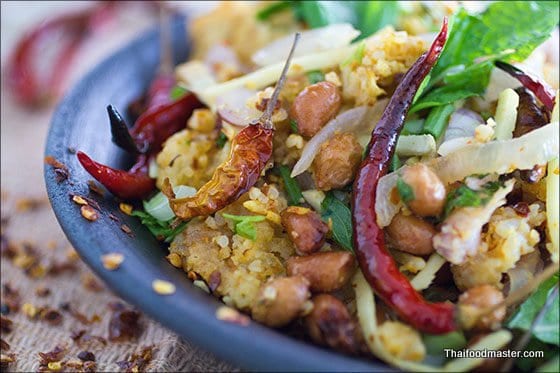
The dish was introduced to me by a street vendor in forsaken part of town some twenty years ago. Auntie Yai was a true character. She was wearing intensive makeup and I still remember her talkative hilarious manner. I and other customers waiting in line were regularly subjected to nonstop “interrogations” or “interviews”. I must admit I enjoyed the peek into other people lives while waiting over an hour for her mouth watering curried rice croquettes. I loved how the pungent, vibrant swirl of ginger was setting off the fermented pork sourness just perfectly, how the nutty crunch of those peanuts was balanced by the vivid tone of fresh herbs.


